How to Test AI Models Complete 2026 Guide?

Explore the complete 2026 guide on how to test AI models, including methods, tools, challenges, and best practices for building accurate and reliable AI systems.
In 2016, Google’s self-driving car misread a situation on the road and caused an accident. In 2023, Amazon pulled its AI-powered hiring tool after discovering it treated women unfairly during candidate screening. These issues were not small glitches. They were expensive failures that stronger testing could have caught early.
In this post, we will break down how to evaluate artificial intelligence solutions so they stay fair, predictable, and dependable.
What Is Artificial Intelligence Solution Model Testing?
AI model testing is the process of reviewing and examining an AI system to check whether its predictions stay accurate, balanced, and steady. Unlike traditional software testing, which revolves around strict input-output checks, AI evaluation digs into uncertainty, bias behavior, consistency, and how well the model can explain its decisions.
Types of AI Model Testing
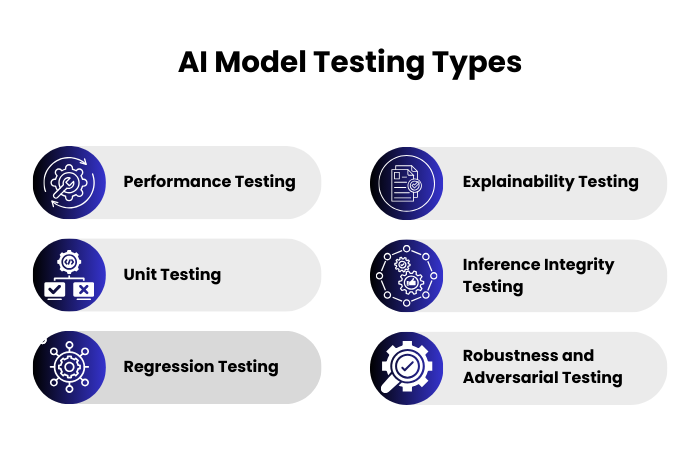
To assess an AI model correctly, organizations must blend classic testing methods with machine learning–specific techniques. No single method is enough on its own, so teams work across several angles.
Performance Testing
Performance testing focuses on how well a model performs across accuracy, precision, F1 score, recall, resource efficiency, and similar metrics on validation sets.
Key Metrics Checked Under Performance Testing
Accuracy: How often predictions are correct
Precision: How often positive predictions are truly positive
Memory Use: How much memory is consumed during training and prediction
AUC-ROC: How well the model separates different classes
Recall: The share of real positives the model identifies
Inference Speed: How long the system needs to respond to a single input
CPU/GPU Use: The amount of compute power used
Training Time: The amount of time needed to train the model on a dataset
Performance testing confirms that the model can support real-world workloads and still provide fast, consistent predictions.
Unit Testing
Unit testing reviews individual pieces of the AI workflow. This includes data cleaning functions, inference logic, feature engineering steps, and other smaller components that must operate correctly on their own.
Key Aspects of Unit Testing AI Models
Data Processing and Feature Work:
Check every function responsible for cleaning or converting raw data. Make sure transformations produce correct outputs and keep the original meaning of the data intact.
Model Architecture Elements:
Review neural network layers, custom blocks, and activation functions to confirm each one handles input the way it was designed to.
Loss Functions and Optimizers:
Check the loss calculations for accuracy and confirm that optimizers update parameters the way the algorithm intends.
Hyperparameter Setup and Management:
Verify that functions in charge of storing, loading, or adjusting hyperparameters work reliably and that their values are accessible when needed.
Evaluation Metrics:
Ensure that metric calculation functions produce correct results.
Regression Testing
AI models require consistent revisions to stay useful. When a model is retrained or updated, performance may slip without warning. Regression testing checks newer versions against earlier baselines to confirm nothing breaks.
AI/ML solutions in areas like healthcare and finance rely on this heavily. Even small performance drifts can lead to larger risks later. Many top AI development services providers automate these checks inside CI/CD pipelines to maintain stability as models evolve.
Explainability Testing
Explainability testing looks at whether the system’s reasoning can be understood by humans. Instead of treating the model like a black box, the goal is to reveal which features influence a decision.
Testers simulate scenarios and compare explanations with expected decision logic. Visual tools can help highlight decision paths and provide people with clear insight. With regulations such as the EU AI Act pushing for transparency, explainability has become essential in developing ethical artificial intelligence solutions.
Inference Integrity Testing
Inference integrity testing verifies that a model produces consistent results when similar inputs are given. It is especially important for detecting unpredictable behavior in processes that may introduce randomness.
For AI/ML services, this reduces the chance of hidden production issues, such as voice assistants misinterpreting similar audio clips.
Robustness and Adversarial Testing
Robustness testing checks how well a model handles noisy data, shifting environments, or unexpected inputs. Adversarial testing goes further by intentionally crafting inputs designed to mislead the model, such as adding tiny distortions to images.
As organizations rely more on artificial intelligence testing services, these defensive checks help reduce security risks. Many guides on building an AI model highlight strengthening the system during early development rather than patching it later.
Step-by-Step Guide – How to Test AI Models?
Testing AI models takes a structured approach to build confidence before deployment. Below is a practical six-step process suited for today’s advanced AI systems.
1. Define Objectives and Gather Data
Set clear targets first. For instance, a fraud detection system may need at least 95 percent accuracy. After that, assemble high-quality data and divide it into training (70 percent), validation (15 percent), and testing (15 percent). Run early data checks to avoid low-quality inputs.
2. Preprocess and Build Baselines
Clean and organize your dataset. Normalize values if needed, fill in or remove incomplete entries, and build your first version of the model. Baseline performance helps you understand whether later improvements are real. AI/ML tools can speed up this stage.
3. Conduct Unit and Integration Tests
Test components individually, then connect them and test the workflow end to end. Frameworks such as TensorFlow testing utilities make this easier to automate.
4. Perform Specialized Tests
Run explainability reviews, stress checks, fairness evaluations, and adversarial tests. Tools that compare outcomes across demographic groups help catch bias, so artificial intelligence solutions tools remain ethical and reliable.
5. Validate with Real-World Simulations
Test inside environments that act like production. Include load tests to check scalability. Measure response time and hardware use to ensure the system can handle peak demand.
6. Monitor and Update After Deployment
Continue tracking model behavior in production. Set alerts for drifts or strange output patterns. Refresh the model with newer data when needed and repeat regression tests to confirm performance remains stable.
Importance of AI Model Testing
Strong AI testing matters more than ever in 2026. As artificial intelligence solutions spread across every industry, proper evaluation reduces bias, improves compliance with new rules, and protects brand trust. Failures are expensive, while solid testing reduces rework, speeds up deployment, and improves long-term ROI.
Organizations working with top AI development companies benefit from a refined testing process that exposes flaws early in small language models or large systems. Thorough testing builds confidence, encourages responsible use of AI/ML services, and prevents unintended consequences.
AI Model Testing Best Practices
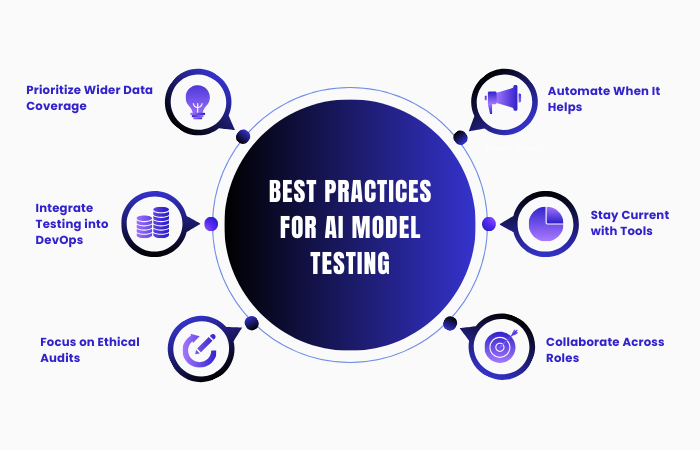
Prioritize Wider Data Coverage
When some scenarios are missing from the dataset, use generated or augmented data to fill gaps without exposing private information.
Automate When It Helps
Let automated tools handle repetitive checks while human testers focus on judgment-based reviews. Many teams aim for a balance where AI handles a smaller portion of test execution while humans control the critical decisions.
Integrate Testing into DevOps
Include testing steps inside your DevOps pipeline so issues show up during development rather than after release.
Focus on Ethical Audits
Review fairness regularly using dependable fairness metrics and pay special attention when working on high-impact fields.
Collaborate Across Roles
Bring developers, data scientists, and ethics experts into discussions so everyone agrees on how explainability and fairness will be maintained.
Stay Current with Tools
Explore new AI/ML solutions, including newer privacy-focused methods such as federated learning.
Following these practices helps strengthen modern AI software testing services.
Artificial Intelligence Solutions – Make your Business Outshine Competitors
AI is advancing quickly, and testing remains central to building solid artificial intelligence solutions that deliver real value without unexpected risks. Whether the task is evaluating performance or checking defensive resilience, every step adds stability that businesses can rely on.
Organizations working with top AI development companies should treat testing as a long-term investment. With careful evaluation and responsible use of AI/ML services, companies can avoid the pitfalls seen in earlier failures and turn their systems into dependable assets.
Loading FAQs
Please wait while we fetch the questions...