Small Language Models – A Complete Guide to AI Services' Latest Victory
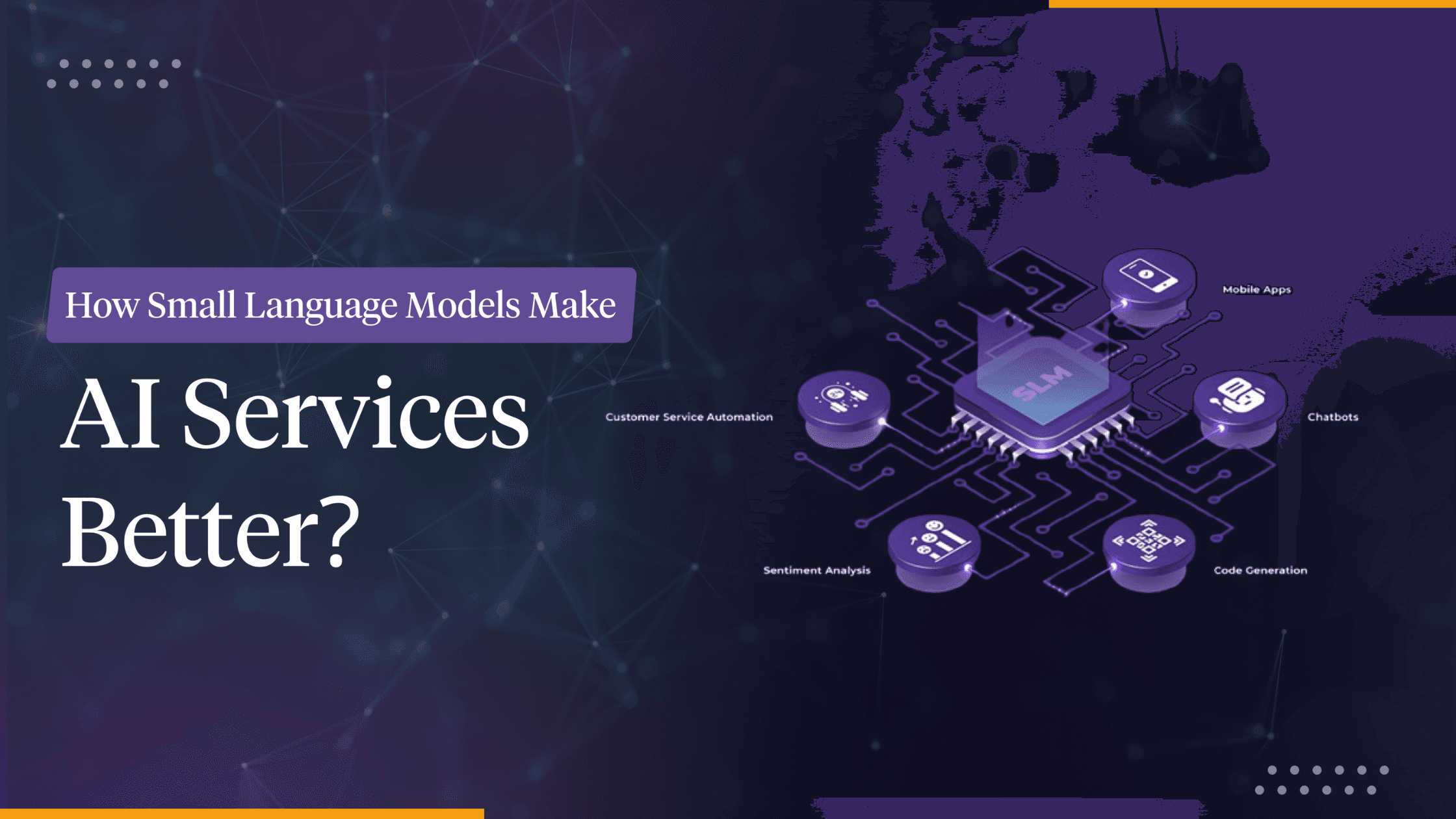
Explore how Small Language Models are transforming AI services with faster, efficient, and cost-effective performance in this complete guide.
AI agents are everywhere, and they're transforming businesses faster than a championship team breaking records. But here's what most business owners don't realize: the powerhouse behind every AI agent is those massive, large language models (LLMs), which might be the very thing holding your business back from true dominance. AI agents are plentiful, rapidly transforming businesses. However, many business owners overlook a crucial point: the large language models (LLMs) powering these AI services could actually be obstructing their business's full potential for success.
Now, everyone wants a smarter, cheaper, and more efficient way to run AI operations. Enter Small Language Models (SLMs), the lean profit-generating machines that are about to revolutionize how smart businesses deploy AI agents. Imagine a smarter, more cost-effective, and efficient approach to your AI operations. Small Language Models (SLMs) offer precisely that: they are powerful, economical tools poised to transform how intelligent businesses implement AI agents, driving profitability.
What Are Small Language Models?
Small Language Models (SLMs) can be thought of as agile startups outperforming corporate giants. Unlike Large Language Models (LLMs), which are akin to overqualified PhDs answering simple customer queries, SLMs are specialized experts. They are faster, more affordable, and come with a focused approach.
Here's the breakdown:
LLMs: Massive, generalist models requiring datacenter infrastructure (think 70-175 billion parameters).
SLMs: Compact, specialized models that run on your everyday devices (typically under 10 billion parameters).
However, their smaller size belies their powerful capabilities when applied to real-world business scenarios.
Are Small Language Models More Flexible?
SLMs' adaptability is their biggest merit as a component of AI services. These models are easy to fine-tune as per industry-specific data, tone, and tasks. So, irrespective of whether you are building a healthcare assistant, a legal document analyzer, or an internal HR chatbot, a small language model can evolve without any major re-engineering.
The light footprint also gives businesses the opportunity to deploy multiple variations for various use cases, giving teams the flexibility to test, iterate, and refine rapidly.
How are Businesses Adopting Generative AI Services?
Generative AI has become a go-to tool for innovation. Businesses are using it for tasks like
Dynamic Pricing Models
Customer Service
Workflow Optimization and More
Currently, organizations have already embedded AI across departments, including marketing, HR, IT, and customer operations. It has helped them improve efficiency and decision-making.
However, several of these initiatives rely heavily on Large Language Models, which, while powerful, often create more overhead than value when applied to narrow business contexts.
This over-reliance on heavy models is precisely where the problem begins.
For a deeper understanding of how Large Language Models differ from broader Generative AI systems, explore our detailed blog — LLM vs. Generative AI
The Eye-Opening Truth: Your AI Agents Don't Need a PhD for Every Task
Here's what NVIDIA Research discovered that's shaking up the industry: Most AI Services agent tasks are repetitive, specialized, and don't require the full firepower of massive LLMs.
Picture your HVAC business again. When a customer calls asking about your hours, do you really need a model trained on the entire internet to answer that question? Or would a specialized model trained specifically for your business queries work better and cost 90% less?
NVIDIA Research has made a significant discovery that's impacting the industry: the majority of AI agent tasks are repetitive and specialized and therefore do not necessitate the extensive power of large language models (LLMs).
Why is GenAI Adoption a Challenge?
The promise of GenAI sounds simple. It promises greater automation, smarter insights, and faster decisions, but its adoption often hits multiple roadblocks:
Infrastructure demands that exceed most mid-sized companies’ capabilities.
High operational costs tied to continuous API usage and data processing.
Complex integrations requiring specialized teams to deploy and maintain.
Privacy concerns, since many models process data externally on cloud servers.
These challenges have left many businesses wondering: is there a more practical path to AI adoption without compromising power?
The Reality Check: What Do Your AI Agents Actually Do?
Your AI agent solutions spend their time on:
Tool calling and API interactions (70% of operations)
Structured data processing (following specific formats)
Repetitive task execution (same workflows, different inputs)
Simple decision-making (if/then logic flows)
The shocking truth? Modern SLMs like Microsoft's Phi-3 (7 billion parameters) now match the performance of 70 billion parameter models from just two years ago, while running 15× faster and costing a fraction of the price.
What are Some of The Common Challenges of Large Language Models
Before diving into SLMs, let’s address why LLMs, despite their dominance, often hold businesses back when adopting AI Services.
1. Data Privacy Risks
Most LLMs are hosted on external servers, meaning sensitive customer data often leaves your secure environment. This not only raises compliance issues but also increases risk exposure, especially in finance, healthcare, and legal industries.
2. High Costs
Running or fine-tuning LLMs comes with enormous computational and licensing costs. You’re essentially paying enterprise-level fees even for routine, repetitive tasks.
3. Generalized, Not Specialized
LLMs are trained on massive, diverse datasets. While that gives them range, it also makes them less accurate when applied to niche or domain-specific queries.
4. Dependency on the Provider
Many LLMs operate as black-box solutions under proprietary control. If the provider changes pricing or access, your operations are directly affected.
5. Resource and Energy Demands
These massive models require GPU clusters, specialized infrastructure, and high energy consumption, making sustainability a growing concern.
How is Innovation Closing the Performance Gap of SLMs & LLMs?
Until recently, smaller models lagged far behind their large-scale counterparts. But that gap is closing fast.
Modern SLMs like DeepSeek-R1-Distill-7B and Microsoft’s Phi-3 now perform on par with models 10× their size, thanks to advancements in training efficiency, instruction tuning, and dataset curation.
This means your business no longer has to choose between speed, cost, and quality. You can finally have all three.
SLMs vs. LLMs: Performance Showdown
Let's cut through the noise with hard facts:
Performance Factor | LLMs | SLMs |
|---|---|---|
Speed | 3–5 seconds response | Under 1 second |
Cost | $0.03–0.12 per 1K tokens | $0.001–0.005 per 1K tokens |
Fine-tuning | Weeks, thousands of dollars | Hours, under $100 |
Deployment | Requires datacenter | Runs locally |
Customization | Complex, expensive | Quick, affordable |
Real-world proof: NVIDIA's Hymba-1.5B model delivers 3.5× greater token throughput than comparable transformer models while outperforming models 10× its size on instruction-following tasks.
Why SLMs Are Your Business's Secret Weapon?
1. Economic Domination
Running SLMs is 10-30× cheaper than LLMs for most agentic tasks. That's not just savings – that's reinvestment capital for growth. For most agentic tasks, running SLMs is significantly more cost-effective than LLMs, offering 10-30 times the savings. These savings can then be reinvested to fuel further growth.
2. Lightning-Fast Deployment
Need to update your AI agent's behavior? With SLMs, it's an overnight fine-tuning job, not a month-long project. Updating your AI agent's behavior is a quick process with SLMs, taking only an overnight fine-tuning job instead of a month-long project.
3. Edge Computing Power
SLMs run locally on your infrastructure, giving you:
Data sovereignty (your customer data never leaves your servers)
Zero latency (no waiting for cloud responses)
Offline capability (works even when internet goes down)
Ensuring compliance and maintaining model trust are critical as per the widely accepted AI TRiSM (Trust, Risk, and Security Management) frameworks to strengthen responsible AI deployment.
4. Modular Excellence
Instead of one massive generalist, build a team of specialists:
Customer service SLM
Scheduling optimization SLM
Lead qualification SLM
Follow-up communication SLM
Each one of these AI solutions laser-focused on their specific role, working together like a championship relay team.
What are the Functions of SLMs Specialized Task Agents?
Think of SLMs as a team of domain experts working under one roof. Instead of one massive model trying to do everything, each SLM handles a dedicated function, resulting in better accuracy and faster turnaround.
For example:
Customer Service SLM handles FAQs and sentiment-based routing.
Legal SLM reviews contracts and flags compliance issues.
Finance SLM generates reports and reconciles data.
This approach doesn’t just streamline processes. It builds a modular AI ecosystem that’s easier to scale and maintain.
The Hybrid Approach: Best of Both Worlds
Smart businesses aren't choosing between SLMs and LLMs for their AI/ML solutions; they're combining them strategically. Here's how the winning formula works:
80% of tasks → Specialized SLMs (routine operations, structured responses)
20% of tasks → Strategic LLMs (complex reasoning, novel situations)
This hybrid approach delivers:
90% cost reduction on routine operations
Maintained quality for complex tasks
Scalable architecture that grows with your business
Modern AI ecosystems increasingly rely on protocols like the Model Context Protocol (MCP) to enable seamless coordination between models — a principle that also supports hybrid SLM–LLM frameworks.
What does SLMs in Action Look Like? The Real-World Impact
Case Study Breakdown from Popular AI Agents:
Agent Type | SLM Replacement Potential |
|---|---|
MetaGPT (Software Development) | 60% of queries |
Open Operator (Workflow Automation) | 40% of queries |
Open Operator (Workflow Automation) | 40% of queries |
Cradle (GUI Control) | 70% of queries |
Translation: Even conservative estimates show that 40-70% of current LLM operations in popular AI agents can be replaced with faster, cheaper SLMs without performance loss.
What Industries Does SLMs Support?
Case studies show that 40–70% of current LLM operations under the machine learning services initiatives can be replaced with faster, cheaper SLMs without losing performance.
Examples include:
Healthcare: SLMs for secure patient data summarization.
Legal: Quick contract review and clause extraction.
Customer Service: Automated ticket management and response drafting.
Internal Knowledge Bots: Lightweight models that understand internal documentation.
Overcoming the "But What If" Objections
"But what about complex reasoning?"
Modern SLMs like DeepSeek-R1-Distill-7B now outperform premium LLMs like Claude-3.5-Sonnet on reasoning tasks. The gap is closing fast.
"What about setup complexity?"
With tools like NVIDIA's ChatRTX, you can deploy SLMs locally in hours, not weeks. Plus, the modular approach means you start small and scale.
"Will they work for my specific industry?"
That's the beauty. SLMs excel at specialization. Fine-tune them on your industry data, and they'll outperform generalist LLMs on your specific tasks.
How to Deploy Small Language Models (SLMs)?
Step 1: Start Small – Explore SLM Potential
Audit your existing AI tasks and identify high-volume, low-complexity operations.
Step 2: Proof of Concept (PoC) – Validate Effectiveness
Leverage AI development services to deploy a single SLM, measure performance, and benchmark cost savings.
Step 3: Scale Up – Full Integration
Expand deployment across business units and enable hybrid routing (SLMs + LLMs).
What Should Be Your SLM Migration Roadmap?
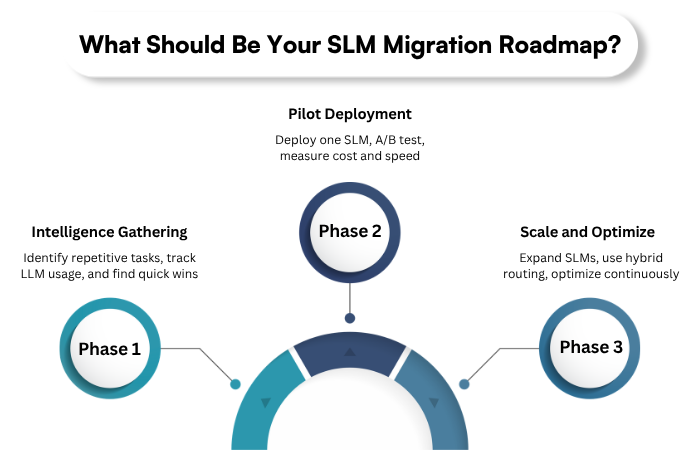
Ready to join the SLM revolution? Here's your step-by-step game plan:
Phase 1: Intelligence Gathering
Audit your current AI operations to identify repetitive tasks
Log all LLM interactions to understand usage patterns
Identify quick wins (customer service, data entry, scheduling)
Phase 2: Pilot Deployment
Start with one specialized SLM for your highest-volume task
A/B test performance against your current LLM setup
Measure cost savings and response times
Phase 3: Scale and Optimize
Deploy additional specialized SLMs for other routine tasks
Implement hybrid routing (SLMs for routine, LLMs for complex)
Fine-tune based on real usage data
SLM Deployment: Resource Overview
1. Entry Step: Exploring Possibilities
Focus on experimentation and data collection. Test open-source models like LLaMA-3 or Phi-3 locally.
2. Mid Step: Scaling Up
Refine model fine-tuning, integrate APIs, and introduce monitoring for accuracy and latency.
3. Final Step: Full-Scale Deployment
Develop automated pipelines, implement security layers, and enable cross-model communication for multi-agent synergy.
The Competitive Advantage You Can't Ignore
While your competitors are burning cash on oversized LLMs for simple tasks, you'll be operating a lean, mean, profit-generating AI machine. Here's what that competitive edge looks like:
40-70% lower AI operational costs
3-10× faster response times
Complete data control and privacy
Infinite customization possibilities
Future-proof, scalable architecture
Common SLM Deployment Pitfalls
Skipping Data Preparation: Poorly curated data leads to weak performance.
Overfitting During Fine-Tuning: Too much specialization reduces adaptability.
Ignoring Monitoring: Without continuous evaluation, accuracy can drift.
Underestimating Infrastructure Needs: Even small models require thoughtful deployment pipelines.
Neglecting Security Layers: Always encrypt and control access to internal data.
The Bottom Line: Your AI Evolution Starts Now
The shift from LLM-heavy to SLM-first AI services architectures isn't just a technical upgrade; it's a business revolution. Companies that make this transition now will dominate their markets while others struggle with expensive, slow, generalist solutions.
If you’re still running LLMs for basic tasks, you’re paying 10–30× more for the same results while moving slower. The SLM revolution isn’t coming; it’s already here.
Don't let your competition get ahead while you're stuck in the LLM stone age. The SLM revolution is here, and the early adopters are already winning.
Be among the businesses that lead the charge with specialized, intelligent, and cost-efficient AI. Leverage the best AI ML development services to start your growth journey.
Because in the world of AI, the fastest and smartest solutions win and right now, that’s SLMs.
Loading FAQs
Please wait while we fetch the questions...