A Guide to Tiny Machine Learning Services and On-Device Intelligence
Discover why Tiny Machine Learning services matter for businesses, enabling faster decisions, low-power AI, cost savings, and smarter edge devices.
Picture your smartwatch flagging a heart-rhythm anomaly or a home sensor predicting equipment failure the moment it begins, all without an internet connection or a heavy cloud pipeline. This shift is becoming possible because TinyML and modern model-compression techniques let artificial intelligence run directly on compact, low-power hardware.
Most AI models today are huge. They often contain millions or billions of parameters and usually require server-class GPUs.
However, phones, wearables, remote IoT nodes, agricultural sensors, and consumer electronics don’t have that kind of capabilities. To make AI practical in these environments, engineers use methods that shrink, optimize, and accelerate models so they can run efficiently on-device.
For companies building smart hardware or upgrading existing devices with AI capabilities, these advances change the game. They reduce infrastructure costs, enable new product lines, protect user privacy, and unlock faster real-time responses. And it’s why businesses increasingly turn to machine learning services and end-to-end AI/ML solutions to stay competitive.
Below, we break down the core techniques behind TinyML, including quantization, knowledge distillation, pruning, and LoRA, and walk through how they come together to create powerful on-device intelligence.
Quantization: The First Step Toward Smaller, Faster Models
Quantization is like rounding off the math in a model. Normally a model’s weights are 32-bit numbers (very precise), but quantization converts them to smaller bit formats (like 16-bit, 8-bit or even 4-bit integers).
In other words, we use fewer digits to represent each number. This makes the model much lighter: it takes far less memory, and the calculations are faster. It’s like saving a high-resolution photo as a compressed JPEG.
You lose very little detail, but the file is much smaller. Quantized models can often still give the same answers with almost no loss in quality. In fact, experts note that reducing precision “significantly decreases memory usage and computational overhead while maintaining near-original performance”.
Quantization has many benefits for small devices:
Smaller size: The model can fit in a phone’s storage or tiny chip memory.
Faster inference: With simpler 8-bit math, results come almost instantly.
Lower power: Less computation means the device’s battery lasts longer.
By shrinking the numbers this way, phones and gadgets can run advanced AI tools (like object recognition or speech commands) right on board, without needing a powerful cloud server.
Knowledge Distillation: Teaching a Small Model to Think Like a Big One
Knowledge distillation takes inspiration from teaching. A large, powerful model (the “teacher”) first learns a task with high accuracy. Then a smaller “student” model is trained to mimic the teacher’s output.
The result is a lightweight model that performs close to the original while using a fraction of the resources.
Why this matters for business:
You get nearly top-tier accuracy, even on cheaper hardware.
On-device decision-making becomes practical for smart wearables, cameras, industrial sensors, or drones.
Operating costs drop because you aren't running massive models on servers for every user request.
For companies working with an AI/ML development company, distillation opens the door to deploying high-performance intelligence across product lines without inflating infrastructure budgets.
Pruning: Cutting the Redundant Parts of a Model
Large neural networks often contain unnecessary connections. Pruning identifies these low-impact weights and removes them, very much like trimming branches from a tree so the healthy ones thrive.
A well-pruned model:
Runs faster
Consumes less memory
Maintains almost the same accuracy
This is extremely helpful for businesses building consumer AI devices or industrial IoT systems where memory and power are limited. Instead of reengineering hardware to fit a massive model, pruning lets the model adapt to the constraints.
Combined with quantization, pruning is one of the most impactful forms of optimization used across AI services and embedded ML deployments.
LoRA (Low-Rank Adaptation): Fine-Tuning Without the Overhead
Fine-tuning large models normally require updating their millions of parameters. LoRA changes that. It freezes the original model and adds a small set of additional trainable weights designed to adapt the model to new tasks.
According to IBM, LoRA “adapts large models to specific uses by adding lightweight pieces to the original model rather than changing the entire model.”
For a growing number of businesses experimenting with AI personalization or vertical-specific intelligence (healthcare, finance, retail, manufacturing), LoRA offers a few key benefits:
Fast fine-tuning with minimal compute
Extremely small changes added to the model
Lower training costs, especially at scale
Easy deployment on-device thanks to small deltas instead of full model retrains
This approach became popular with transformer-based models, which are increasingly used in edge-based NLP and speech applications.
How These Techniques Power TinyML
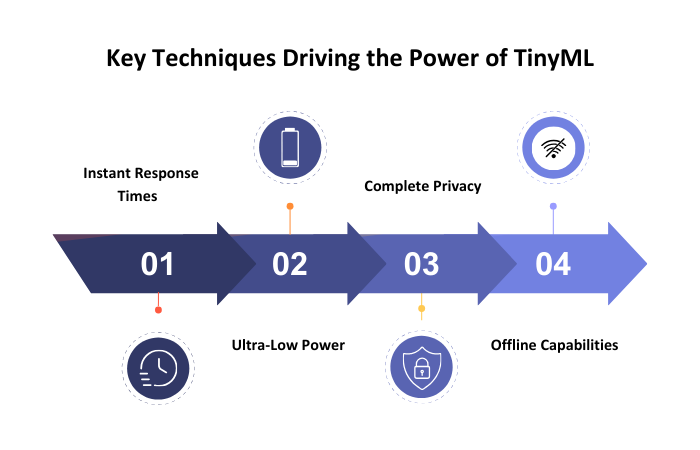
TinyML is the practice of running machine learning models on microcontrollers, sensors, and embedded devices that typically operate on milliwatts or less. These devices often don’t have an OS, GPU, or significant RAM. Yet they can now perform tasks once reserved for cloud servers.
Here’s why businesses are adopting TinyML across industries:
1. Instant Response Times
No internet. No round-trip latency. Devices can make decisions the moment they collect data.
This is vital for:
Wearables tracking vital signs
Smart home systems
Robotics and drones
Retail automation
2. Ultra-Low Power
TinyML models can run for months on a coin-cell battery. This is transformative for agriculture, logistics trackers, remote monitoring, and large sensor networks.
3. Complete Privacy
Data never leaves the device.
For sectors dealing with sensitive information — healthcare, finance, defense, enterprise IoT — this is a major advantage.
It also helps companies comply with global data regulations without complicating their architecture.
4. Offline Capabilities
Devices remain operational in remote or unstable network conditions. Think wildlife trackers, rural IoT installations, fleet management, and maritime systems.
Real-World Use Cases of TinyML
Healthcare & Wearables
ECG analysis, fall detection, sleep monitoring, motion classification — all processed on the wrist or body without exposing personal data.
Industrial IoT
Predictive maintenance for motors, pipelines, assembly lines, HVAC systems.
Sensors can detect irregular patterns before failures occur.
Agriculture
Smart soil monitors, crop health sensors, livestock trackers, and irrigation controllers that operate with little power and no connectivity.
Smart Homes & Consumer Electronics
TinyML enables features like gesture recognition, voice activation, local face recognition, or energy optimization without relying on cloud-based AI.
Automotive & Mobility
Edge-based anomaly detection, cabin monitoring, sensor fusion, and low-latency decision-making.
For businesses trying to innovate or differentiate hardware products, these use cases show how artificial intelligence solutions can reduce operating costs, improve user experience, and open new revenue channels.
Cloud AI vs. TinyML: A Quick Comparison
Below is a comparison of traditional cloud-based AI vs. on-device TinyML:
Aspect | Cloud AI (Big Models) | TinyML / On-Device AI |
|---|---|---|
Model Size | Huge (millions or billions of parameters) | Tiny (often kilobytes or megabytes) |
Hardware | Powerful GPUs/TPU-level computer | Microcontrollers or phone CPU/RAM |
Latency | Slower (round-trip over network) | Instant (runs locally) |
Power Use | High (server energy) | Very low (battery-friendly) |
Data Privacy | User data sent to cloud servers | Data stays on device |
This table shows why on-device AI is different: models are tiny, inference is fast, and your personal data never leaves your gadget.
For many businesses, the decision isn’t about choosing one or the other. It's about designing balanced architecture. Compute-heavy tasks stay in the cloud, while privacy-sensitive or real-time tasks move to the device.
Why TinyML Matters for Business Leaders Right Now
If your organization is exploring new digital products, modernizing hardware, or expanding IoT deployments, TinyML should be on your radar. It offers:
Lower operational expenses by reducing cloud usage
Better customer trust through on-device privacy
New product possibilities in markets where connectivity is limited
Faster user experiences that drive engagement
Energy-efficient intelligence, especially at IoT scale
Machine Learning Services – For Smarter Devices
Overall, TinyML techniques are what makes the next generation of smart devices possible. By using quantization, distillation, pruning, and other methods, engineers can squeeze AI into small packages. Users get smarter devices that react in real time and protect privacy, because sensitive data (speech, health stats, video frames, etc.) need not be transmitted over the internet.
If you’ve ever wanted AI features on your phone or gadget without relying on the cloud, TinyML is the key. And because these smaller models run locally, they also reduce cost and depend less on expensive data plans or servers.
Working with an experienced AI/ML development company like MoogleLabs gives businesses access to model compression expertise, optimized AI pipelines, transformer-based architectures, the Ray framework for distributed training, and scalable machine learning services tailored to real-world constraints.
TinyML is not simply a technical upgrade. It is a strategic advantage for companies heading into the next phase of smart device innovation.
Loading FAQs
Please wait while we fetch the questions...