Scalable Food Ordering Infrastructure Built for Growth Text element

Real-time ordering, restaurant operations, and delivery workflows powered by cloud-native engineering

Talk to Platform Engineering Experts
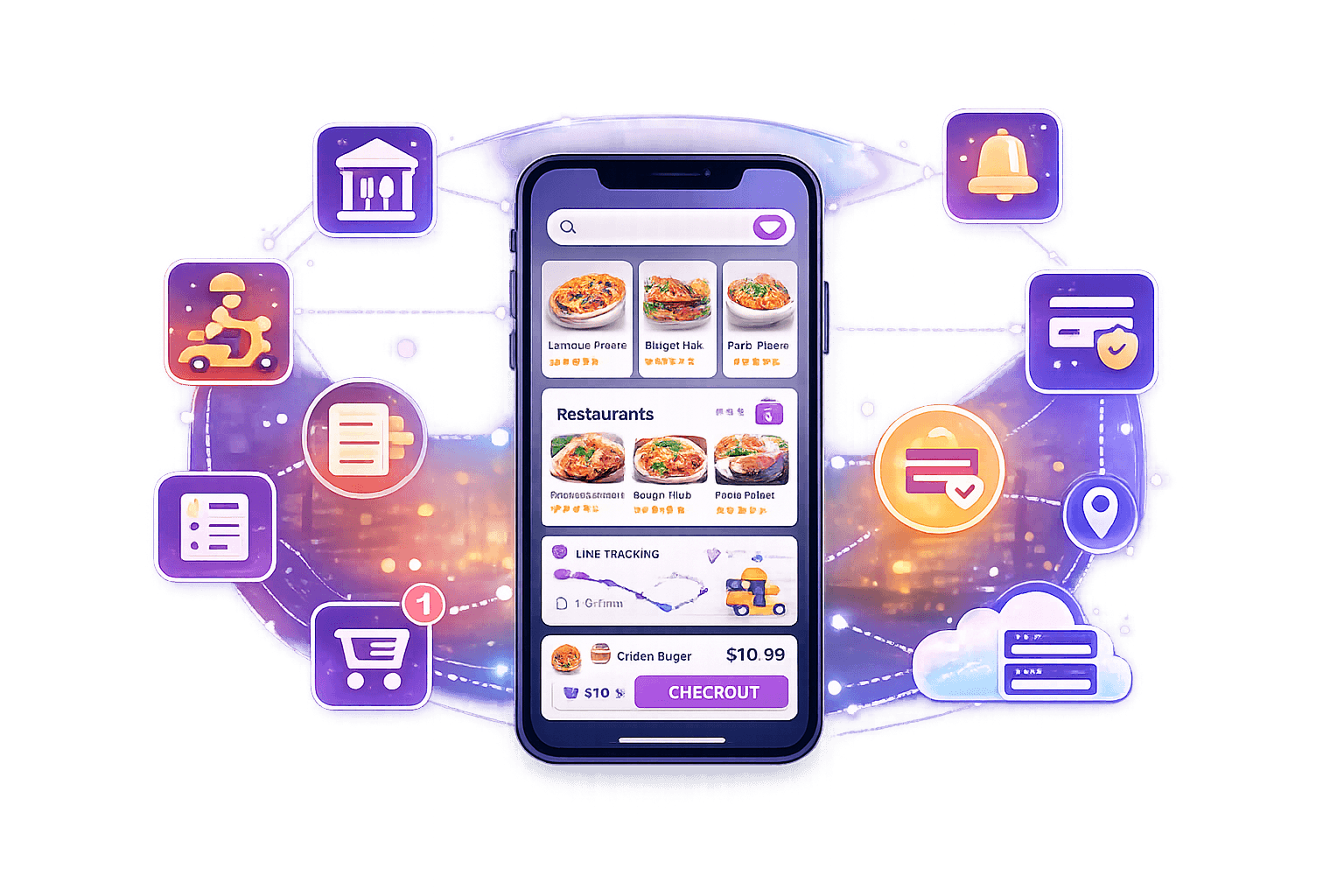
Cloud-Native Food Ordering & Restaurant Management Platform

About

Industry

  • Food Technology & Restaurant Management

Application Type

  • Web and Mobile Application

Core Functionality

  • Restaurant management, order processing, payments, delivery coordination, and customer engagement

The client required a modern food ordering and restaurant management platform capable of supporting the complete operational lifecycle, from restaurant onboarding and menu management to order processing, customer communication, and administrative oversight.

The engagement began with a discovery and solution planning phase where business workflows, scalability requirements, operational challenges, and long-term product goals were analyzed. Based on these findings, MoogleLabs designed and developed a microservices-based architecture capable of supporting real-time order processing, high user concurrency, and seamless coordination between customers, restaurants, delivery teams, and administrators.

The result was a scalable, maintainable, and high-performance platform designed to support rapid business growth while simplifying ongoing development and operations.

Results

Architecture modernization and cloud-native engineering delivered measurable improvements across platform performance, reliability, and development efficiency:

Code Maintainability

Improved maintainability by 70% through standardized architecture and engineering practices

API Performance

Reduced API response times by approximately 45% (500–800ms to 150–250ms)

Technical Debt Reduction

Eliminated nearly 60% of technical debt through refactoring and modernization initiatives

Feature Delivery Speed

Accelerated delivery cycles by approximately 60%

Production Stability

Reduced production bugs by 50% through improved testing and quality assurance practices

Testing Coverage

Achieved 85%+ automated test coverage across critical services

Infrastructure Provisioning

Reduced provisioning time by 70–80% using Infrastructure as Code

Deployment Reliability

Reduced deployment failures by approximately 60%

quote

For platform that could handle the demands of today while supporting the ambitions of tomorrow.

Challenges

Why It Mattered

For food ordering platforms, performance, reliability, and operational efficiency directly impact customer satisfaction, restaurant operations, and revenue generation. By modernizing the platform architecture and implementing scalable engineering practices, the client gained a future-ready foundation capable of supporting growth while improving development velocity, system stability, and user experience.

Our Approach-

MoogleLabs partnered with stakeholders from the earliest stages of product planning through architecture design, development, deployment, and ongoing platform evolution. The engagement focused on creating a scalable engineering foundation capable of supporting long-term growth, operational efficiency, and rapid feature delivery.

Before implementation, our team conducted a comprehensive discovery phase to map operational workflows, technical constraints, and business priorities. We identified bottlenecks in order processing, gathered requirements across customer and administrative portals, analyzed high-concurrency traffic risks, and defined service boundaries using domain-driven design, resulting in a robust microservices roadmap and clear integration blueprints that prioritized high-impact functionality.
The platform was architected around five independent core services: Authentication, Restaurant Management, Order Processing, Notifications, and Administrative Operations, to ensure modularity. By designing each service with clear domain ownership, independent deployment capabilities, and API-driven communication, we achieved enhanced system scalability, effective fault isolation, and the ability for teams to conduct parallel development.
We utilized a robust API-first strategy to establish rigid communication standards between services, ensuring seamless integration across web and mobile applications. This approach, centered on loose coupling and standardized service contracts, significantly improved long-term maintainability and provided the flexibility required to accelerate future development cycles.
To support high-volume traffic and operational workloads, multiple optimization strategies were implemented. Redis caching improved performance for menus, sessions, and frequently accessed data. Database indexing, query optimization, pagination, and connection pooling significantly reduced latency while improving scalability. These enhancements reduced API response times from 500–800ms to 150–250ms.
The platform adopted an event-driven architecture to handle notifications, logging, and background operations efficiently. By integrating Bull job queues, we enabled asynchronous task execution, which prevented API blocking, significantly improved overall system responsiveness, and allowed for better resource utilization during periods of high activity.
PostgreSQL was established as the primary transactional database layer, complemented by the Sequelize ORM to enforce structured data management and schema consistency. This architecture was further supported by automated migration and seeding strategies, which simplified environment management and ensured reliable, repeatable data operations across the entire platform lifecycle.
Security was integrated at the foundation through JWT-based authentication and rigorous role-based access controls. By implementing secure password hashing and middleware-driven API protection, we established a hardened environment that facilitates secure user management while maintaining the flexibility necessary to support future scaling requirements.
To maximize maintainability and development velocity, we established standardized architecture patterns across all services. By implementing centralized validation logic, reusable components, consistent project structures, and automated formatting standards, we fostered better collaboration among developers and significantly reduced long-term development overhead.
We introduced a comprehensive testing framework that encompassed integration testing, end-to-end testing, and automated workflow validation to ensure platform stability. This commitment to quality resulted in achieving over 85% test coverage across critical services, which directly contributed to a reduction in production defects and minimized deployment risks.
MoogleLabs implemented a mature, cloud-native DevOps framework to support reliable operations and scalable delivery processes. By utilizing Infrastructure as Code via Terraform, containerized services, automated CI/CD pipelines, and centralized monitoring, we accelerated release cadences, minimized deployment failures, and ensured high operational reliability across all environments.
Our engagement extended beyond initial deployment to provide ongoing maintenance, optimization, and platform enhancement services. Our support activities include continuous monitoring and incident resolution, root-cause analysis and production support, performance tuning and infrastructure optimization, security updates and dependency management, and database optimization and maintenance
As business requirements evolved, our team collaborated closely with stakeholders to evaluate new requests, estimate implementation impact, deliver enhancements through structured release cycles, and validate all changes before deployment.
To support long-term maintainability, comprehensive technical, infrastructure, deployment, and architecture documentation was continuously maintained and updated. This ongoing partnership ensured the platform remained scalable, secure, and aligned with evolving business objectives while empowering internal teams to operate efficiently.

Our Tools:

Cloud Platform

  • AWS

Infrastructure as Code

  • Terraform

Backend Framework

  • Node.js
  • Express.js

Database

  • PostgreSQL

Caching Layer

  • Redis

ORM

  • Sequelize

Development Tools

  • Axios
  • Bull
  • Nodemon

Version Control

  • GitHub

Authentication

  • JWT

Containerization

  • Docker

CI/CD

  • Automated Deployment Pipelines

Before & After

Modernizing the platform architecture significantly improved development efficiency, system performance, and operational reliability.

Feature/Metric Before After
API Response Time 500–800ms 150–250ms
Code Consistency Inconsistent patterns Standardized architecture
Bug Resolution Time 203 days 4-8 hours
Test Coverage ~30% 85%+
Feature Delivery 2–3 weeks 5–7 days
Deployment Reliability Frequent failures Stable automated pipelines

Testimonial

Building a Foundation for Sustainable Growth

We needed a platform that could handle the demands of today while supporting the ambitions of tomorrow. MoogleLabs delivered a robust, scalable ecosystem that has fundamentally changed how we manage our restaurant operations. They haven’t just given us a better platform, they’ve given us the operational stability we need to grow our brand without limits.

Product Leadership Team

Similar Case study

Let’s Collaborate

Reach Out To Our Subject Matter Experts

Find out how MoogleLabs can help your organization. We’d love to answer your queries.

Help Us Make It Smooth For You!

Drag & drop files here or

Support for PDF, DOCX, images, PPT, and all file types • Max 10MB per file • Up to 1 file