10 Agentic AI Use Cases Powering Enterprise ROI in 2026
Explore 10 practical agentic AI use cases helping enterprises improve efficiency, automate decisions, and drive measurable ROI in 2026.
For years, enterprises invested in AI with the promise of efficiency. Most of that value came from automation. Faster workflows. Fewer manual steps. Incremental gains.
That phase is ending.
In 2026, the conversation moved from automation to autonomy. Now, business leaders want AI systems that can plan, decide, and act towards specific business goals with minimal oversight.
That is where agentic AI enters the picture.
Agentic AI services are becoming a practical lever for enterprise ROI, not because they replace people, but because they change how work gets done at scale. AI agents do not just execute tasks. They observe context, reason across constraints, adapt to outcomes, and move work forward on their own.
This article breaks down 10 real, high-impact agentic AI use cases that enterprises are deploying in 2026 to drive measurable returns, reduce operational drag, and unlock new growth.
What Makes Agentic AI Different from Traditional Enterprise AI?
Traditional enterprise AI systems are reactive. They wait for inputs. They produce outputs. They stop.
Agentic AI systems behave differently.
An AI agent doesn’t just respond to commands. It works toward a goal. You are responsible for defining what success is, set clear boundaries, and giving system access and leaving the rest to agentic AI. The tool is then responsible for figuring out what to do, when to act, and adjust when something doesn’t go as planned.
Organizations are opting for AI agent development in their strategic priority within broader AI/ML services because it lets them move away from building dozens of isolated models and instead, invest in AI agents that can coordinate across tools, data sources, and workflows.
In practice, this means fewer handoffs, faster decisions, and better alignment between business intent and execution.
Why Enterprises Are Betting on Agentic AI for ROI?
The ROI conversation around AI has matured.
Enterprises are no longer impressed by proofs of concept. They care about:
Cost reduction that compounds over time
Revenue impact that is measurable
Risk mitigation at machine speed
Scalability without proportional headcount growth
Best agentic AI services deliver value because they operate continuously. They do not wait for tickets. They do not need daily instructions. They work inside real systems, responding to real signals, and improving with feedback.
That is why AI agents solutions are moving out of innovation labs and into core operations.
10 Agentic AI Use Cases in 2026
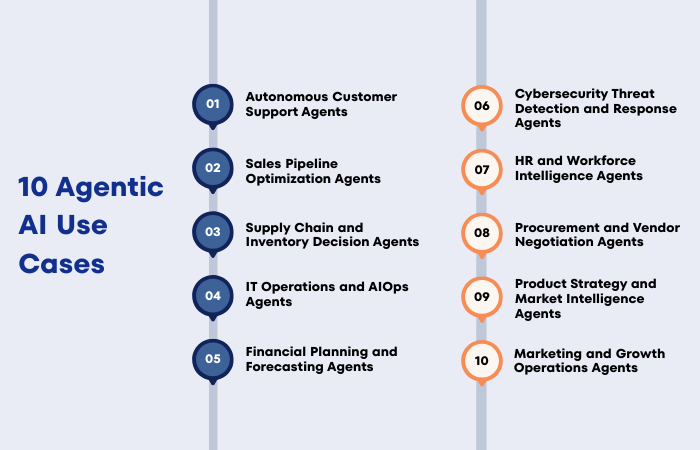
Here are some of the Agentic AI use cases that will experience higher adoption in 2026:
1. Autonomous Customer Support Agents
Customer support was one of the first areas to adopt AI, but most deployments stalled at scripted chatbots.
Agentic AI changes the model.
Modern customer support agents can handle end-to-end resolution. They understand customer history, product context, and policy constraints. They decide whether to resolve, escalate, or follow up, without human intervention.
For enterprises, the ROI shows up quickly:
Lower cost per ticket
Faster resolution times
Higher customer satisfaction
Reduced agent burnout
Instead of deflecting queries, agentic systems close loops.
2. Sales Pipeline Optimization Agents
Agentic AI can help optimize sales pipeline by qualifying leads, scheduling follow-ups, adjusting outreach timing, and updating forecasts based on the information available.
Consequently, the sales team is able to stop the loss of revenue due to poor follow-throughs.
They do not replace sales reps. They remove friction.
The result is:
Shorter sales cycles
Higher conversion rates
More accurate revenue forecasting
Better use of sales capacity
This is one of the clearest examples of AI agents solutions driving top-line impact.
3. Supply Chain and Inventory Decision Agents
Supply chains remain volatile in 2026. Demand shifts faster than planning cycles can keep up.
Agentic AI systems continuously analyze demand signals, inventory levels, supplier performance, and logistics constraints. When conditions change, they act.
They reroute orders. They adjust reorder points. They flag risks before they become disruptions.
For enterprises, this means:
Lower inventory carrying costs
Reduced stockouts and overstock
Faster response to market changes
This is where Agentic AI Solutions quietly outperforms legacy planning systems.
4. IT Operations and AIOps Agents
Enterprise IT environments are too complex for manual monitoring.
Agentic AI agents for IT operations detect anomalies, trace root causes, and initiate remediation without waiting for alerts to be escalated.
They learn from incidents. They refine thresholds. They optimize system performance continuously.
The ROI is not theoretical:
Reduced downtime
Lower incident resolution costs
Improved system reliability
In large enterprises, even small uptime gains translate into meaningful financial impact.
5. Financial Planning and Forecasting Agents
Financial teams spend enormous time building scenarios that are outdated the moment assumptions change.
Agentic AI flips the process.
These agents monitor financial data in real time, model scenarios dynamically, and adjust forecasts as conditions evolve. They can simulate the impact of pricing changes, cost fluctuations, or market shifts without manual intervention.
This capability gives leadership:
Faster, better-informed decisions
Reduced planning cycles
Improved capital allocation
It is one of the strongest examples of AI/ML Services moving from analysis to action.
6. Cybersecurity Threat Detection and Response Agents
Cybersecurity cannot rely on human reaction time.
Agentic AI agents operate continuously, scanning for anomalies, correlating signals across systems, and responding the moment a threat is detected.
They isolate compromised assets, trigger containment protocols, and escalate only when necessary.
Enterprises adopting AI Cybersecurity Solutions see ROI through:
Reduced breach impact
Lower security operations costs
Faster incident containment
In regulated industries, this is becoming a baseline requirement rather than a competitive advantage.
7. HR and Workforce Intelligence Agents
Talent decisions are often reactive and fragmented.
Agentic AI agents help HR teams forecast workforce needs, identify skill gaps, and optimize hiring strategies autonomously. They analyze performance data, attrition signals, and market trends to recommend actions before issues surface.
The business impact includes:
Lower hiring costs
Improved retention
Better workforce planning
This is a quiet but powerful application of AI agent development.
8. Procurement and Vendor Negotiation Agents
Procurement teams manage thousands of contracts, often with limited visibility into optimization opportunities.
Agentic AI agents analyze supplier performance, pricing patterns, and contract terms continuously. They flag renegotiation opportunities, suggest vendor switches, and even support negotiation strategies.
The ROI shows up as:
Reduced procurement spend
Better supplier performance
Lower compliance risk
For large enterprises, this can unlock millions in savings.
9. Product Strategy and Market Intelligence Agents
Product leaders have data but lack insights.
Agents can monitor feedback, market trends, competitor moves, and usage patterns. Using the information, they can recommend improvements to better align with business goals.
This shortens decision cycles and reduces the risk of misaligned investments.
It also reflects how AI trends 2025 laid the groundwork for more autonomous, strategic systems in 2026.
10. Marketing and Growth Operations Agents
Marketing execution has become too complex for manual orchestration.
Agentic AI agents manage campaigns across channels, personalize messaging at scale, and optimize spend based on real-time performance.
They test, learn, and adapt continuously.
For growth teams, this delivers:
Higher ROI on marketing spend
Faster experimentation cycles
Better attribution and insight
This is where agentic ai services connect directly to revenue growth.
What Enterprises Should Consider Before Adopting Agentic AI
Agentic AI is powerful, but it is not plug-and-play.
Enterprises need:
Clean, accessible data
Clear governance and oversight
Well-defined objectives and constraints
The choice of AI/ML company matters. Poorly designed agents can create risk instead of value. The best implementations balance autonomy with control.
Build vs Buy in AI Agent Development
Some enterprises start with off-the-shelf platforms. Others invest in custom AI agent development tailored to their systems and workflows.
There is no universal answer.
What matters is scalability, maintainability, and alignment with business strategy. Best agentic ai services focus on long-term value, not short-term demos.
Measuring ROI From Agentic AI
.png)
Enterprises that succeed with agentic AI track:
Decision cycle time reduction
Cost savings per workflow
Revenue uplift per agent
Risk reduction metrics
They move beyond experimentation and treat AI agents as core infrastructure.
Agentic AI Services Trends - Making World Smarter Every Day
In 2026, agentic AI is no longer experimental.
It is becoming the backbone of how modern enterprises operate, decide, and compete. Organizations that adopt AI agents strategically are not just automating work. They are reshaping how value is created.
For business leaders, the question is no longer whether agentic AI will deliver ROI.
The real question is how long they can afford to wait.
Loading FAQs
Please wait while we fetch the questions...