MLOps vs DevOps: Strategic Differences for Scalable Enterprise Artificial Intelligence
.png&w=3840&q=75)
Enterprises are investing billions in AI, yet most projects fail due to outdated DevOps approaches. This blog explains MLOps vs DevOps, highlighting key differences in managing data, models, and code—and how MLOps enables scalable, reliable, and high-ROI AI systems.
Enterprises today spend a massive amount on artificial intelligence. IDC reports that the global spending on AI will hit 631 billion dollars by 2028.
Yet, the majority of these projects never reach production. This failure stems from one thing: treating AI like regular software. Comparing MLOps vs DevOps shows that while they share roots, the way they handle data and code determines your ROI.
Business leaders need to know the shift in strategy required to scale. Standard DevOps solutions keep apps running, but they don't fix a model that makes wrong predictions. This guide breaks down the technical and strategic gaps to help you build a reliable AI factory.
Defining the Field: MLOps vs DevOps
DevOps connects software development and IT operations. The goal is to build, test, and release code faster. It uses automation and CI/CD to keep systems stable. DevOps development focuses on application code and infrastructure.
MLOps extends these ideas to the machine learning lifecycle. It handles data prep, model training, and monitoring. The major point of MLOps vs DevOps is that AI needs to manage three things at once: code, data, and models. If you only manage code, your AI will fail. Many firms now use MLOps services to handle this holy trinity.
Market Value and Business Impact
The market for these systems is growing. Fortune Business Insights projects the MLOps market will reach nearly 90 billion dollars by 2034. This growth happens as companies move past pilots and look for MLOps consulting services to drive real profit.
Investing in these practices pays off. Teams using structured MLOps services report a return on investment between 189% and 335% over three years. By using MLOps software to automate retraining, a large bank reduced its time-to-impact from 20 weeks down to 14 weeks.
Feature | DevOps | MLOps |
|---|---|---|
Primary Focus | Application code and infrastructure | Data pipelines and model lifecycles |
Core Artifacts | Source code, binaries, config files | Datasets, features, model weights |
System Nature | Deterministic | Probabilistic/Stochastic |
Lifecycle Model | Linear CI/CD | Iterative CI/CD/CT |
Tools and Pipelines | CI/CD tools such as Jenkins, GitLab CI/CD, Terraform | ML Pipelines using MLFlow, Kubeflow, Airflow, SageMaker |
Team Synergy | Developers and IT Operations | Data Scientists, ML Engineers, and Data Engineers |
Hardware Needs | Standardized cloud compute | Specialized GPU/TPU resources for training |
Main Risk | System downtime or software bugs | Model drift and silent failures |
The core of MLOps vs DevOps lies in how they react to change. Standard code is static. If it passes a test today, it works tomorrow. Machine learning models decay as the real world changes.
Artifact Management and Data Versioning
A critical requirement in the MLOps vs DevOps comparison involves the versioning of artifacts. In software engineering, version control systems like Git manage the history of source code and configuration. In machine learning, versioning must also include the datasets, model versions, and metadata such as training parameters and evaluation results. Without rigorous version control for data, reproducing an experiment or troubleshooting a decline in model performance is nearly impossible.
anaged Artifact | DevOps | MLOps |
|---|---|---|
Source Code | Git-based versioning | Git-based versioning |
Application Artifact | Binaries, Docker images | Serialized models (Pickle, ONNX) |
Data Component | Schema definitions | Raw data, feature sets, train/test splits |
Environment | Infrastructure as Code (IaC) | IaC plus specialized hardware (GPUs) |
To manage this complexity, teams use specialized MLOps software like DVC (Data Version Control) or MLflow.
These tools let the experts track large data files and model's lineage. Hence, every prediction can be traced back to the exact version of the code and data that produced it.
This capability is needed for AI safety, particularly in industries where auditability and transparency are mandatory.
Technical Gaps: Why DevOps Isn't Enough
In software, you version your code. In AI, you must version your datasets too. If your data changes, your model changes, even if the code is the same. This is why MLOps software like DVC and MLflow is needed alongside Git.
Another key factor in MLOps vs DevOps is Continuous Training (CT). Standard pipelines deploy an app and wait for a human to change the code. MLOps pipelines monitor the data. If the data shifts, the system triggers an automatic retraining loop. This keeps your AI models accurate over time.
The Importance of MLOps for Businesses
For decision-makers, the investment in MLOps software is a move toward cost optimization.
Enterprises adopting these tools experience up to an 8x reduction in costs and significant improvements in deployment speed.
By automating the retraining of models, businesses can respond quickly to changes in customer behavior or market conditions.
This agility is central to the DevOps strategies for startup and enterprises provided by MoogleLabs, which emphasize the transition from manual, error-prone deployments to automated, resilient systems.
The Problem of Silent Failures
Software fails loudly. A bug causes a crash or an error message. AI fails silently. The system stays up, but the predictions get worse. A fraud detection model might stop catching thieves as their patterns change.
MLOps vs DevOps: Failure Types
Failure Type | DevOps Context | MLOps Context |
|---|---|---|
Explicit Failure | 404/500 Errors, Crashes | Prediction errors (Inf/NaN) |
Silent Failure | Memory leaks, performance lag | Accuracy drop due to data drift |
Detection Method | Log analysis, uptime checks | Drift detection, bias monitoring |
Recovery Action | Rollback, reboot, hotfix | Retraining, model version switch |
Depending on the type of application, MLOps vs DevOps services need to be compared to determine which one works for your business.
In case of AI models, without MLOps development services, these failures cost money before you notice them.
MoogleLabs provides specialized AI testing services to catch these issues. We use drift detection and fairness testing to keep your systems reliable.
This is a key part of our machine learning consulting services.
Continuous Training and the Feedback Loop
A major innovation of MLOps vs DevOps is the introduction of Continuous Training (CT). In traditional software, once the code is in production, it does not change unless a human engineer intervenes. Machine learning models, however, are subject to decay.
As real-world data distributions shift, a process known as data drift occurs. It includes the model's predictions becoming less accurate. To maintain performance, the system must include an automated loop that triggers retraining when performance drops below a certain level.
Feedback loop needs monitoring of infrastructure far beyond system health checks of DevOps solutions. DevOps monitoring is focused on elements like CPU usage, memory, and uptime. MLOps monitoring also needs to track model-specific metrics like accuracy, precision, and recall.
The system must detect when the input data no longer matches the data used during the training phase. Upon drift detection, the CT pipeline automatically ingests the latest data, retrains the model, and evaluates it against the production model. The new model is promoted to the live environment if it performs better.
Step-by-Step: Setting Up Your AI Operations
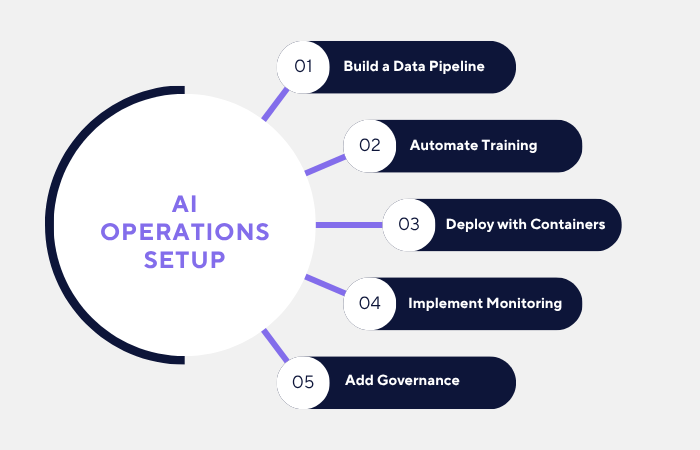
Building an AI-ready infrastructure requires a clear path. You can follow these steps to scale:
Build a Data Pipeline: Setup ETL processes to collect and clean data. Use a feature store to reuse data across different models.
Automate Training: Create a pipeline that trains and validates models automatically. Track all experiments to see what works.
Deploy with Containers: Use Docker and Kubernetes to serve your models as APIs. This ensures scalability.
Implement Monitoring: Track more than just uptime. Monitor prediction accuracy and data drift.
Add Governance: Keep an audit trail of every model. This is key for AI safety and meeting laws like the EU AI Act.
Managing these steps in the MLOps vs DevOps framework allows you to move models from lab to production in weeks instead of months.
MoogleLabs Expertise in Action
We have helped many firms master MLOps vs DevOps challenges. For example, our SleepBleep project uses AI safety in industry applications to detect driver drowsiness in real-time. This required a pipeline that could handle edge AI and continuous performance checks.
Other success stories include:
Screen Damage Detection: An automated system that classified over 200,000 devices for insurance quotes.
Skill Evaluation Platform: A system that automates hiring through NLP and speech-to-text.
AI-Guided Yoga: A computer vision app that tracks poses and gives real-time feedback.
Our DevOps strategies for enterprises help teams transition to these advanced workflows without losing speed.
Building the Team: Skills and Organizational Structures
The workforce requirements for MLOps vs DevOps highlight the interdisciplinary nature of machine learning. A traditional DevOps team is composed of software engineers and system administrators who focus on code delivery and infrastructure stability. Their success is measured by deployment frequency and mean time to recovery. An MLOps team must expand this circle to include data scientists, ML engineers, and data engineers.
Role | Primary Responsibility | Key Skill Sets |
|---|---|---|
DevOps Engineer | CI/CD, Infrastructure, Security | Jenkins, Docker, Kubernetes, Terraform |
Data Scientist | Experimentation, Model Design | Statistics, Python, R, ML Algorithms |
ML Engineer | Model Deployment, Productionization | MLOps frameworks, API design, Scalability |
Data Engineer | Data Pipelines, ETL, Feature Stores | SQL, Spark, Kafka, Database Design |
This collaboration is necessary because the performance of a model is as much a result of the data as it is of the code. MoogleLabs provides MLOps Services that help businesses assess their current maturity and build the necessary organizational structures to support long-term AI success.
MLOps vs DevOps: Security and Compliance
Scaling AI adds new risks. Our DevOps services now include model security. You must protect against data poisoning and prompt injection. Using machine learning prompt engineering best practices helps manage these risks in generative AI.
National Institute of Standards and Technology provides an AI Risk Management Framework that we integrate into our MLOps services. This builds trust with your users and keeps your business compliant.
Summary of Strategy: MLOps vs DevOps
Choosing between MLOps vs DevOps is about your business goals. If you build web apps, DevOps is enough. If you want to use AI to predict prices, detect fraud, or guide users, you need MLOps.
At MoogleLabs, we specialize in bridging this gap. We provide the artificial intelligence services and infrastructure you need to win. Ready to start? Contact Us to discuss your project.
Loading FAQs
Please wait while we fetch the questions...