DevOps Solutions for Startups vs Enterprises: Strategy, Scale, and What Really Changes

In 2026, DevOps drives business growth. Startups use it for speed; enterprises depend on it for stability and scale-especially when powering AI and digital transformation.
If you’re building a product-driven company in 2026, DevOps solutions aren't just some back-office technicality. It is the pulse of your operations. It directly impacts
how fast you can ship feature,
how often your platform crashes under load, and
how much sleep your engineering team gets on a Friday night.
But here is the reality: DevOps is not the same for 10-person startup and 5,000-person enterprise.
While the core principles remain, the execution is worlds apart. The complexity, the stakes, and the business impact shift dramatically as you scale.
What Is DevOps?
DevOps is a combination of processes, tools, and cultural practices that unify software development and IT operations to deliver applications faster and more reliably.
In simple terms, it helps you:
Ship features faster
Reduce downtime
Improve product stability
Scale infrastructure efficiently
Lower operational risk
If you're investing in AI platforms, SaaS products, or digital transformation, DevOps solutions development becomes the backbone of your technology strategy.
DevOps for Startups: Speed Is Survival
Startups operate under pressure. You’re racing competitors, testing product-market fit, and iterating weekly, sometimes daily.
Your DevOps solutions must support that speed.
Key Priorities for Startups
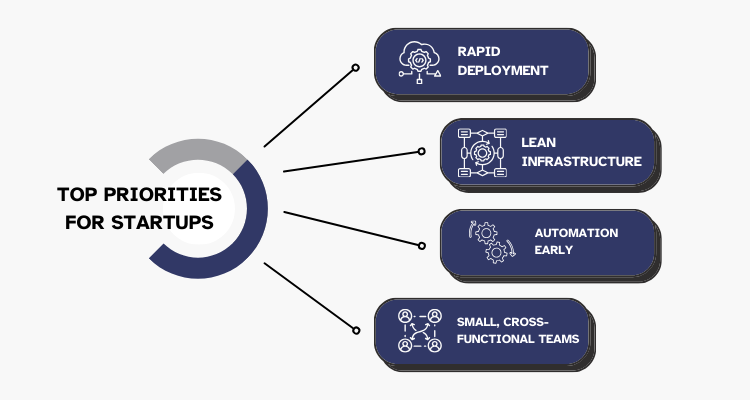
1. Rapid Deployment
Push features fast
Validate ideas quickly
Reduce time-to-market
2. Lean Infrastructure
Cloud-native from day one
Minimal overhead
Pay-as-you-grow cost model
3. Automation Early
CI/CD pipelines from MVP stage
Automated testing
Containerization (Docker, Kubernetes)
4. Small, Cross-Functional Teams
Developers handle infrastructure
Shared ownership
Faster decision-making
For startups, DevOps solutions are often about building the right foundation without overengineering.
You do not need 15 approval layers. You need agility.
DevOps for Enterprises: The Power of Stability
For an enterprise, the stakes are different. A ten-minute outage doesn't just mean a few missed signups; it can mean millions of dollars in lost revenue and a massive hit to brand reputation.
1. Compliance and Governance
Unlike startups, enterprises operate under heavy regulatory burdens (GDPR, HIPAA, SOC2). DevOps solutions in this space must prioritize "DevSecOps" integrating security into every step of the pipeline. It’s about creating a paper trail for every change made to the system.
2. Managing Legacy Debt
Enterprises rarely start from scratch. They often have decades of legacy code that must play nice with modern large language models. The DevOps challenge here is refactoring. They need to slowly update old systems to work with modern automated pipelines without breaking the business.
3. Scalability and Reliability
If your platform handles millions of users, "it works on my machine" is a liability. Large companies need deep visibility, fail-safe recovery plans, and clusters that never sleep. This is where expert DevOps support pays off, making sure even sophisticated agentic AI use cases stays fast and responsive for every customer, regardless of their location.
What Actually Changes? (Startup vs Enterprise Breakdown)
Here’s a side-by-side perspective decision-makers care about:
Area | Startup DevOps | Enterprise DevOps |
|---|---|---|
Goal | Speed & experimentation | Stability & governance |
Infrastructure | Simple cloud setup | Multi-cloud / hybrid |
Security | Basic security layers | Zero-trust, compliance-driven |
Automation | CI/CD pipelines | Full lifecycle automation |
Monitoring | Reactive alerts | Proactive observability |
Cost Focus | Keep costs low | Optimize performance & risk |
The difference isn’t better or worse. It’s about maturity.
What is DevOps Role in Business Growth
Companies that implement high-performing DevOps practices see 208x more frequent code deployments and a 2,604x faster time to recover from incidents.
For business owners, this means:
Protecting Your Budget: Stop paying your best engineers to do the same boring, manual tasks over and over. Automation cuts the "busy work" so your team can focus on innovation.
Keeping Customers Loyal: People have zero patience for bugs. Rolling out smooth, frequent updates keeps your users happy and prevents them from wandering off to a competitor.
Building for the AI Era: You can’t run a 2026 AI strategy on 2010 infrastructure. Modern DevOps is the mandatory starting point for MLOps.
If you want to leverage LLM vs Generative AI capabilities, your infrastructure must be able to handle the massive compute and data requirements these technologies demand.
The Intersection of DevOps and AI/ML
If you are looking at a Generative AI roadmap for 2026, DevOps is your foundation. You cannot effectively deploy AI solutions or move toward a B2A (Business-to-Agent) strategy if your underlying servers are brittle and manually configured.
Artificial intelligence services require a specific type of DevOps known as MLOps. This involves:
Data Versioning: Think of this as "Track Changes" for the massive datasets that train your AI. If a model starts acting up, you need to know exactly what data caused it.
Model Monitoring: AI can get "stale" or biased over time. This phenomenon is called model drift. You need systems that act as a smoke detector, alerting you the moment accuracy dips.
Automated Retraining: This creates a loop where your AI learns and improves from new data automatically, rather than requiring a human to manually "re-upload" its brain.
GPU Management: AI needs specialized, expensive hardware. MLOps ensures you’re using those resources efficiently without burning through your cloud budget.
Common Mistakes Business Owners Make
Treating DevOps as just tooling
Delaying automation until scaling issues arise
Ignoring security early
Not aligning DevOps with business KPIs
Running AI pilots without production-grade pipelines
DevOps solutions should support revenue growth, customer experience, and operational resilience.
Why Many Companies Need a DevOps Consulting Company
The gap between startup DevOps and enterprise DevOps is not linear. It’s exponential.
And internal teams often lack:
Cross-industry experience
Cloud architecture depth
Security compliance knowledge
AI deployment experience
That’s where a DevOps Consulting Company becomes valuable.
Not just to “set up pipelines,” but to:
Design scalable architecture
Optimize cloud costs
Secure AI deployments
Build MLOps frameworks
Align DevOps with business KPIs
Especially for companies adopting agent-based AI systems, as discussed in our Agentic AI Use Cases and How Agentic AI Services Are Changing Business to Agent B2A Strategy, infrastructure readiness determines whether AI becomes scalable or chaotic.
How to Choose the Right DevOps Solutions for Your Business
Ask yourself:
Are we building for experimentation or scale?
Do we handle sensitive data?
Are AI workloads part of our roadmap?
Do we require compliance certifications?
Is downtime financially damaging?
The answers determine the architecture.
How Business Owners Should Think About DevOps Investment
Instead of asking:
How much will DevOps cost?
Ask:
How much does downtime cost us?
How much revenue do delays block?
How secure is our AI infrastructure?
Can our systems scale 10x without breaking?
For startups, DevOps enables growth.
For enterprises, DevOps protects growth.
How to Transition from Startup DevOps to Enterprise-Ready DevOps
Business owners often ask:
When should we upgrade our DevOps solutions strategy?
Here’s a practical framework.
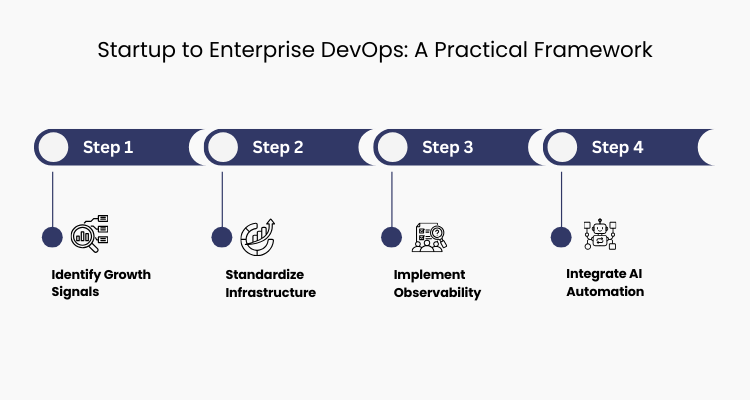
Step 1: Identify Growth Signals
You need stronger DevOps solutions if:
Deployment failures are increasing
Downtime affects revenue
Security audits are approaching
AI workloads are growing
Multiple teams are stepping on each other’s pipelines
Step 2: Standardize Infrastructure
Move from ad-hoc scripts to:
Infrastructure as Code (IaC)
Centralized CI/CD pipelines
Role-based access control
Step 3: Implement Observability
Not just logs.
You need:
Metrics
Distributed tracing
Performance dashboards
Predictive alerts
Step 4: Integrate AI Automation
According to our insights on AI Automation Trends in 2026, automation will define competitive advantage.
DevOps now includes:
AI-driven monitoring
Intelligent scaling
Automated remediation
This reduces operational burden while increasing reliability.
How DevOps Strategy Evolves as You Scale
Think of DevOps solutions maturity in 3 stages:
Stage 1: Foundation (Startup Phase)
Basic CI/CD
Cloud-native setup
Automated testing
Monitoring dashboards
Stage 2: Expansion (Growth Phase)
Infrastructure as Code
Multi-environment pipelines
Security automation
Performance optimization
Stage 3: Enterprise Maturity
DevSecOps integration
Multi-cloud governance
AI-driven monitoring
Regulatory compliance automation
If you’re building AI-driven systems, you’ll also integrate practices discussed in our guide on Prompt Engineering in Modern Machine Learning to understand operational demands.
DevOps solutions are no longer optional infrastructure. It’s strategic infrastructure.
How to Choose the Right DevOps Strategy
If you are a decision-maker, here is a step-by-step guide to determining your needs:
Step 1: Assess Your Scale
The scale of operations directly impacts the point of focus. For a smaller user base, prioritizing DevOps development for ease of use and low overhead is enough. For a bigger audience, leverage DevOps consulting company that can assist with Kubernetes, microservices, and complex networking.
Step 2: Identify Your Regulatory Requirements
Do you handle healthcare or financial data? If yes, your DevOps solutions strategy must be "Security-First." You need automated compliance checks built into your code commits.
Step 3: Evaluate Your AI Goals
If AI is central to your 2026 strategy, your DevOps solutions needs to be "Data-Centric." It isn't just about moving code; it's about moving and processing massive amounts of data efficiently.
DevOps Solutions – Making Your Businesses Better Platforms Faster
DevOps isn’t just an engineering function.
It’s is the tool that leads to growth.
For startups, it fuels speed.
For enterprises, it ensures resilience.
For AI-driven businesses, it enables transformation.
If you're building AI-powered platforms, scaling digital products, or preparing enterprise-grade expansion, aligning your DevOps solutions strategy early prevents expensive restructuring later.
The difference between startup toolchain and enterprise-grade DevOps solutions is not just tooling. It’s architecture, governance, and long-term vision.
And that’s where the right partner makes the difference.
Loading FAQs
Please wait while we fetch the questions...