The 2026 Generative AI Roadmap: From Experimental Pilots to Core Business Infrastructure
.png&w=3840&q=75)
In this blog, you’ll learn how AI in 2026 has evolved from chatbots to autonomous agents, the difference between LLMs and generative AI, and how to build secure, scalable AI solutions. It also shares key use cases and a simple framework to move from experimentation to real business impact.
As we navigate through 2026, the conversation surrounding artificial intelligence has shifted. We are no longer asking if AI can create value, but how it can be integrated into the very marrow of corporate strategy. For business owners and decision-makers, the "experimental phase" of AI is in the rearview mirror. Today, Generative AI Services are the backbone of operational efficiency, customer engagement, and product innovation.
At MoogleLabs, our AI/ML engineers have watched this evolution closely. The transition from 2023’s chatbot craze to 2026’s autonomous agent ecosystems has been rapid. This blog explores the current landscape of generative AI development and provides a roadmap for leaders looking to leverage AI solutions to secure a competitive edge.
Why 2026 is the Year of the "Agentic" Enterprise
In 2024, we were obsessed with "prompts." In 2026, we’re obsessed with "agents." The difference is massive.
Earlier artificial intelligence services were reactive. You asked a question, it gave an answer. Today, we are building autonomous workflows. That is the true power of modern AI/ML Development.
Decoding the Tech: More Than Just Chatbots
A common hurdle for decision-makers is distinguishing between the engine and the car. You’ll often hear the terms LLM and Generative AI used interchangeably, but they aren't the same.
LLMs (Large Language Models) are the linguistic powerhouses.
Generative AI is the broader umbrella that includes everything from synthetic data generation to automated video creation.
If you’re trying to figure out where your budget should go, understanding LLM vs generative ai is the first step toward building a sensible roadmap.
The Democratization Crisis: Low-Code vs. High-Performance
One of the biggest surprises of 2026 is how easy it has become to build bad AI. With the explosion of generative ai services with low-code no-code development, almost anyone can "spin up" an AI tool in an afternoon.
But there’s a catch.
For a business owner, a low-code tool is great for a prototype. But when you need to handle 10,000 concurrent customer queries or process sensitive financial data, those "drag-and-drop" solutions often fall apart. This is where professional AI development services come into play. You need an architecture that is:
Sovereign: Your data stays in your VPC (Virtual Private Cloud).
Grounded: Using techniques like RAG (Retrieval-Augmented Generation) to stop the AI from making things up.
Scalable: It shouldn't crash when your traffic spikes.
Practical 2026 Use Cases: Where the Money Is
According to Gartner, it is predicted that by the end of 2026, 40% of enterprise applications will feature task-specific AI agents, a massive jump from less than 5% just a year ago.
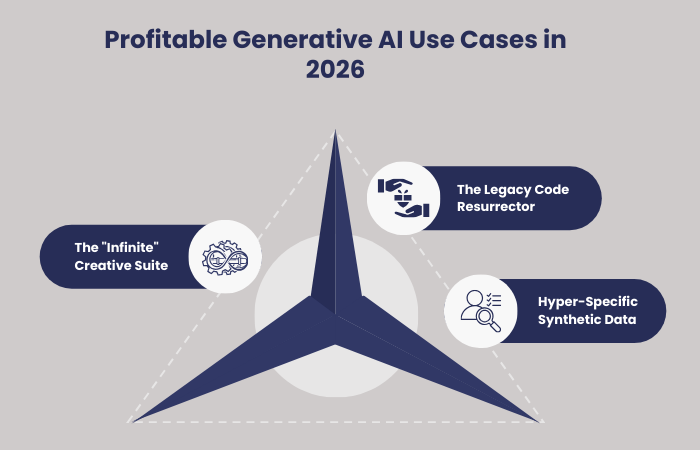
If you’re looking to invest in generative AI services, ignore the hype and look at these high-impact areas:
1. The "Infinite" Creative Suite
Marketing departments are no longer spending weeks on localized campaigns. Generative AI development now allows for the instant creation of thousands of variations of an ad, each tailored to the specific browsing habits and cultural context of the individual viewer.
2. The Legacy Code Resurrector
Thousands of companies are sitting on "spaghetti code" from the 90s. We are now using AI/ML Development to translate ancient COBOL or legacy Java into modern, secure frameworks in a fraction of the time it would take a human team.
3. Hyper-Specific Synthetic Data
Can't train your model because of privacy laws? We generate "synthetic" versions of your data that carry the same statistical patterns but contain zero PII (Personally Identifiable Information).
The recent incidence of AI creating its own social media has raised some safety concerns, but then all human innovations do come with side of danger (we literally have nuclear power plants), and that is not something that has stopped us before, so expecting it to
How to Spot a Reliable Partner?
The market is currently flooded with "AI experts" who started their companies three weeks ago. To find a partner that actually understands AI solutions, you need to look at their track record with complex integrations.
Check out this guide on the top 10 generative ai companies to see how the industry leaders are separating themselves from the hobbyists. At MoogleLabs, we pride ourselves on being in that upper echelon, focusing on the "heavy lifting" of AI that includes the back-end stability and data security that keeps your brand safe.
The MoogleLabs Advantage
At MoogleLabs, we don't just provide AI development services; we provide a partnership. Our team of experts specializes in:
Custom Generative AI Services: Building models that understand your specific industry jargon and business logic.
End-to-End AI/ML Development: From initial data strategy to final deployment and maintenance.
Scalable AI Solutions: Ensuring your AI infrastructure grows alongside your business.
Implementation Strategy: A 4-Step Framework for 2026
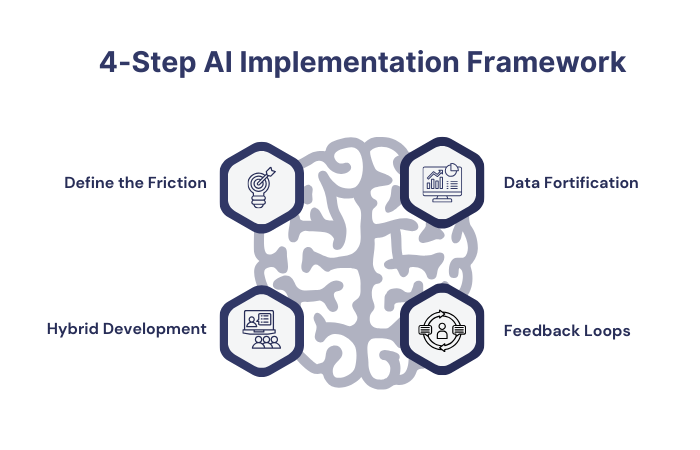
If you’re ready to move past the "evaluation" phase and into deployment, here is how we recommend you proceed:
Define the Friction: Where is your team currently wasting the most "human hours" on low-level cognitive tasks?
Data Fortification: AI is a mirror; if your data is messy, your AI output will be messier. Clean your pipelines first.
Hybrid Development: Use AI development services to build a custom core, but utilize low-code interfaces for your staff to interact with it.
Feedback Loops: Set up a "Human-in-the-Loop" (HITL) system. AI should augment your best people, not replace them in a vacuum.
Final Thoughts: The Cost of Waiting
In 2023, waiting was a valid strategy. The tech was moving too fast, and the risks were high. But in 2026, the "wait and see" approach has become a liability. The companies that are winning right now are the ones that treated artificial intelligence services as a fundamental infrastructure investment rather than a peripheral experiment.
At MoogleLabs, we don't just build models; we build business advantages. The future isn't about the smartest AI, it’s about the smartest integration.
Loading FAQs
Please wait while we fetch the questions...