Beyond the Hype: 11 AI & Automation Trends Driving Enterprise ROI in 2026
.png&w=3840&q=75)
In 2026, AI has become core business infrastructure. This blog highlights 11 key AI and automation trends—from agentic AI to ethical and scalable AI—and shares a simple framework to help businesses turn AI from experiments into measurable ROI.
If you’re a business owner or a decision-maker, you’ve likely graduated from the "What is ChatGPT?" phase. The honeymoon period, where simply having a chatbot felt like winning, is officially over. In 2026, the question isn't whether you should use AI; it’s how you scale it without your current infrastructure collapsing under the weight of "technical debt."
At MoogleLabs, we’ve spent the last year in the trenches with enterprises moving away from basic generative tools toward artificial intelligence solutions that actually move the needle on the balance sheet. AI has evolved from a flashy side project into the literal central nervous system of the modern company.
To stay ahead of the "laggards" this year, you need to understand the 12 trends currently redefining AI automation and development.
11 AI & Automation Trends of 2026
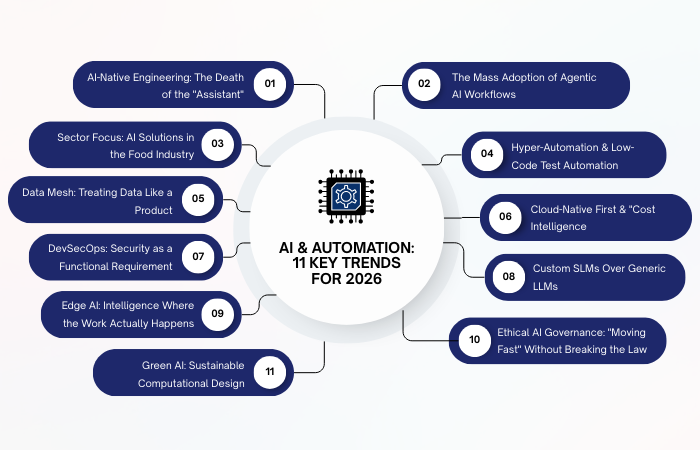
The companies that leveraged the top AI Trends of 2025 to improve their business operations reaped the benefits. The positive reaffirmation in terms of productivity and revenue growth has encouraged organizations to pay even closer attention to AI and automation trends for tomorrow.
As the world of AI and automation is expected to experience exponential growth in 2026 and to become a part of this trajectory, businesses need to be aware of the most recent AI and automation trends.
1. AI-Native Engineering: The Death of the "Assistant"
We’ve moved past simple "coding assistants" that suggest the next line of code. We are now in the era of AI-native engineering. This isn't just about speed; it’s about a fundamental shift from writing code to "expressing intent."
Software is increasingly built by autonomous AI agents that handle everything from architecture design to deployment. For your technical teams, this means a massive shift in skills. They aren't just coders anymore; they are "Context Engineers" managing the entire lifecycle of a model. By embedding Generative AI/LLM integration directly into the development cycle, AI development services are becoming drastically more reliable.
2. The Mass Adoption of Agentic AI Workflows
If 2025 was the year of the "wrapper," 2026 is the year of the Agent. Unlike a standard bot that follows an "If This, Then That" script, Agentic AI can reason, plan, and collaborate.
Real-World Impact:
Think of a procurement agent that doesn’t just alert you to low inventory. It researches three alternative vendors, negotiates terms based on your historical contract data, and serves you a finalized agreement for a one-click approval. It functions as a digital operator, not a passive tool.
3. Sector Focus: AI Solutions in the Food Industry
The food sector is currently undergoing a massive structural rebuild. From cloud kitchens to global supply chains, AI solutions in the food industry are necessary to survive.
Predictive Demand: Models now factor in local weather, social media spikes, and historical sales to predict orders with up to 95% accuracy, cutting food waste by a staggering 20%.
Farm-to-Fork Traceability: Real-time sensors ensure food safety, meeting the transparency demands of the 2026 consumer.
For a deeper dive, check out our insights on how AI is transforming food operations.
4. Hyper-Automation & Low-Code Test Automation
Hyper-automation is about automating every process that can be automated. One of the biggest breakthroughs for 2026 is Low-code Test Automation.
It’s a game-changer for non-technical stakeholders, like product managers, who can now execute automated tests via visual interfaces. But the real magic is "self-healing" scripts. If your software's UI changes, the AI detects the shift and updates the test script automatically, ending the era of "flaky" automation that breaks every time you push an update.
5. Data Mesh: Treating Data Like a Product
The old way: Dumping data into a "Data Lake" and hoping a scientist finds a miracle. The 2026 way: Data Mesh. This decentralizes ownership, treating data as a product owned by specific business units (Marketing, HR, Sales). This creates high-quality, real-time data pipelines that allow predictive AI models to spot market shifts before they show up in your quarterly reports.
6. Cloud-Native First & "Cost Intelligence"
Scalability isn't a "nice-to-have" anymore. However, a "one-cloud-fits-all" approach often leads to vendor lock-in and a bloated monthly bill. 2026's standard for artificial intelligence services includes:
Serverless Architectures: Pay only for the compute you actually use.
Cloud Cost Intelligence: AI that monitors your infrastructure in real-time to prevent "cloud sprawl" and "right-size" your environment automatically.
7. DevSecOps: Security as a Functional Requirement
As AI gets smarter, so do the threats (like prompt injection and data poisoning). Security is no longer the "final check" before launch; it’s built into the code from day one. With DevSecOps, we integrate AI-enabled threat detection that spots anomalous behavior in milliseconds, creating a "Zero-Trust" environment for every user and every AI agent.
8. Custom SLMs Over Generic LLMs
The era of relying solely on massive, public models like GPT-4 is ending for the enterprise. Businesses are now investing in Small Language Models (SLMs). These are trained on your proprietary data, making them faster, cheaper, and safer. Most importantly, they keep your company secrets inside your own firewall.
9. Edge AI: Intelligence Where the Work Actually Happens
Let’s be honest: the cloud is amazing, but it’s often thousands of miles away. In the high-stakes world of manufacturing and logistics, a two-second delay while data travels to a server in Virginia and back can be the difference between a smooth operation and a safety disaster.
Edge AI moves the "brain" directly onto the device, whether it’s a robotic arm on a factory floor or a thermal camera in a warehouse. By processing data locally, you get:
Zero-Latency Decisions: The machine reacts instantly to a safety hazard or a defect.
Bandwidth Savings: You aren't paying to send gigabytes of raw video to the cloud just to find one error.
Operational Resilience: If your internet goes down, your production line doesn't.
10. Ethical AI Governance: "Moving Fast" Without Breaking the Law
The old Silicon Valley mantra of "move fast and break things" has officially become a legal liability. With the EU AI Act’s high-risk regulations taking full effect in August 2026, flying blind with your models is a recipe for a massive fine.
This is where Explainable AI (XAI) moves from a "nice-to-have" to a business requirement. You can’t just have an algorithm that says "No" to a loan or a job applicant; you need to be able to show why.
The Goal: Transform your artificial intelligence solutions from "black boxes" into transparent, auditable assets that build trust with customers and regulators alike.
11. Green AI: Sustainable Computational Design
AI consumes massive amounts of power. In 2026, "Green AI" is a competitive advantage. We focus on "model pruning" and quantization, techniques that make your AI leaner and more energy-efficient, helping you hit those ESG (Environmental, Social, and Governance) goals without sacrificing performance.
How to Start: The 3-Step Scaling Guide
If you're looking to implement these trends, don’t try to do everything at once. Use this framework:
Find the "Friction": Don’t start with the tech; start with the pain. Where is your team wasting "dumb time"? Data entry? Manual QA?
Pilot with a Specialized Partner: A successful Proof of Value (PoV) should take 4-6 weeks, not 6 months. Partner with an AI/ML company like MoogleLabs to validate the ROI quickly.
Scale via AI Automation: Once the pilot works, use automation to push that solution across the organization. This is where the ROI compounds.
Final Thoughts: The Engineering Edge
In 2026, there is no such thing as a "traditional company" anymore. Every company is now a tech company, but the winners will be the ones that move from experimental pilots to disciplined AI/ML solutions.
At MoogleLabs, we don’t just track trends; we build the infrastructure that makes them work for your bottom line.
Would you like MoogleLabs to perform a free AI-readiness audit of your current business workflows?
Loading FAQs
Please wait while we fetch the questions...