MLOps Services: The 2026 Strategy for Scaling Enterprise AI
AI success depends on how well models perform in production. MLOps helps businesses keep AI systems scalable, accurate, and reliable as data and market conditions evolve. This guide explores how automation, monitoring, and continuous training turn AI projects into long-term business value.
Most AI initiatives don’t fail during development. They fail when organizations try to operationalize models at scale. While creating an algorithm is a win, the real profit lies in maintaining its accuracy as market data shifts.
This is where MLOps enter.
By implementing MLOps development services, organizations can keep AI systems reliable as data, user behavior, and business conditions evolve. It prevents the AI model from becoming a technical burden, turning isolated data experiments into scalable business systems.
Executive Summary
85% of machine learning models fail to launch. The difference between a lab experiment and a profit-generating system is MLOps. This guide explains how to turn raw algorithms into reliable business assets. We cover the infrastructure, tools, and strategies needed to scale AI without breaking your budget or your operations.
What is MLOps?
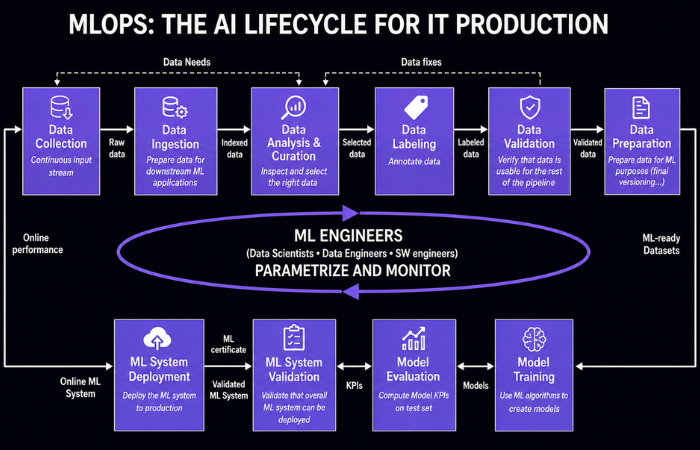
Machine Learning Operations (MLOps) combines machine learning, data engineering, and DevOps principles. It acts as an assembly line that bridges model development and operational deployment. The goal is to streamline the time and resources required to run data science models. This involves incorporating continuous integration and continuous delivery methodology.
To support AI systems in production, organizations need infrastructure that can manage models, data pipelines, and deployment workflows consistently.
A resilient MLOps framework rests on several foundational pillars. These pillars ensure the system handles unique technical intricacies. Implementing enterprise DevOps helps teams build modular environments that scale based on demand.
The framework standardizes the three core assets of machine learning systems: code, data, and models.
Core MLOps Components | Primary Function |
|---|---|
Experiment Tracking | Logging metrics, parameters, and code variants |
Model Registry | Versioning and lifecycle stage management |
Feature Store | Centralizing data definitions for training and inference |
CI/CD/CT Pipelines | Automating integration, delivery, and training |
Model Monitoring | Detecting drift, bias, and performance decay |
Understanding AI in cloud computing is necessary to manage these components at scale. The infrastructure must support massive, on-demand computing power.
The Reality of AI in Production
Market evaluations indicate the global market for MLOps practices reached 2.98 billion dollars in 2025. Projections suggest a rise to nearly 90 billion dollars by 2034. This growth reflects a broader shift, that is enterprises increasingly view operational AI capabilities as a competitive advantage.
It's important for organizations to use a structured DevOps strategy for startups and enterprises that aims to bridge the technical and commercial aspects of DevOps.
MLOps Market Outlook | 2025 Valuation | 2026 Projection | 2034/2035 Target | Estimated CAGR |
Global Market Revenue | $2.43 - $3.16 Billion | $3.33 - $4.39 Billion | $56.60 - $89.91 Billion | 37.0% - 45.8% |
Cloud-Based Deployment | 51.0% Share | 54.9% Share | Dominant | 50.0% |
North America Dominance | 30.87% - 36.4% | Consistent | High | N/A |
BFSI Sector Adoption | 25.9% - 28.4% | Leading | Major | N/A |
The shift toward cloude DevOps services deliver the compute elasticity to process large amounts of data. The need for custom MLOps development services increases as businesses expand their endeavors. These services manage models across their full lifecycle. They ensure that the models stay accurate even with changes in real world conditions.
The bottom line is evident: companies using these strategies report 10% – 20% improvement in ROI. The financial upside is pushing organizations toward greater automation, faster deployment cycles, and lower operational overhead.
Once organizations move beyond experimentation, the challenge becomes operational consistency. This is where standardized tooling and deployment frameworks become critical.
Path to Production with Open Source
Moving from experimentation to production requires repeatable infrastructure and deployment processes. Canonical’s MLOps stack delivers open-source solutions to streamline the machine learning lifecycle. These tools integrate to ensure a smooth journey. Using cloud native DevOps services with Kubernetes allows for enterprise-ready platforms that deploy on any cloud.
Step-by-Step Implementation:
Alignment: Define business goals and create a roadmap.
Preparation: Automate data extraction and set up feature stores.
Training: Integrate version control systems.
Serving: Deploy via APIs or containers.
Monitoring: Use real-time agents to track drift.
Teams must maintain proper DevOps practices for DevOps organizations standards. This prevents technical debt from accumulating as the number of models grows.
Core MLOps Components | Primary Function | Relevant Tools |
|---|---|---|
Experiment Tracking | Logging metrics, parameters, and code variants | MLflow, Neptune.ai, Comet |
Model Registry | Versioning and lifecycle stage management | MLflow, Databricks, Azure ML |
Feature Store | Centralizing data definitions for training and inference | Feast, Tecton, Hopsworks |
CI/CD/CT Pipelines | Automating integration, delivery, and training | Kubeflow, Airflow, Jenkins |
Model Monitoring | Detecting drift, bias, and performance decay | Arize, WhyLabs, Prometheus |
Effective AI models management requires the use of feature stores. These repositories standardize the calculation of inputs, ensuring that the features used to train a model are identical to those used during live inference.
This consistency eliminates the risk of training-serving skew, a common cause of model failure in production. In this context, the integration of Anthropic AI and other advanced models demands even more rigorous testing to ensure safety and reliability.
MLOps vs. DevOps: Key Distinctions
While business owners understand DevOps development, they often wonder why MLOps services are required. The difference lies in the artifacts. Traditional software behaves predictably once deployed. Machine learning systems change as the underlying data changes.
When data evolves, "model drift" occurs. It is where a model’s accuracy decays because the real world has changed. A fraud detection model trained on 2023 behavior may fail to detect fraud patterns emerging in 2026. MLOps solve this through Continuous Training (CT), which automatically triggers model updates when performance dips.
Understand MLOps vs. DevOps:
Aspect | DevOps Focus | MLOps Extension |
|---|---|---|
Core Artifact | Source Code, Binaries, Containers | Code, Data Lineage, Model Weights |
Pipeline Type | Continuous Integration / Deployment (CI/CD) | CI/CD + Continuous Training (CT) |
System State | Deterministic and Code-Driven | Probabilistic and Data-Driven |
Monitoring | Uptime, Latency, CPU Usage | Accuracy, Precision, Data Drift, Bias |
Team Roles | Developers, SREs, IT Ops | Data Scientists, ML Engineers, Data Engineers |
By leveraging an AI services company, businesses can implement these sophisticated monitoring layers. Traditional DevOps tools ensure that the server is running; MLOps tools ensure that the intelligence running on that server is still correct.
This distinction is pivotal for any machine learning solutions provider looking to offer long-term value. The complexity of these systems necessitates a shift in organizational culture toward shared ownership of the data lifecycle.
Strategic ROI and Business Outcomes for Decision Makers
For executives, investing in MLOps services shifts AI from a research experiment to a revenue driver. A primary benefit is accelerated time-to-market; standardizing pipelines cuts deployment from months to weeks. In retail, for example, dynamic pricing models can boost revenue by 15% through faster market responses.
Cost optimization is equally vital. By integrating "FinOps for AI," companies track compute spend and use automated scaling to manage expensive GPUs. Leveraging spot instances or model distillation can slash infrastructure costs by 40% to 60%, allowing a DevOps services and solutions provider to deliver high performance with minimal overhead.
Business Metric | Impact of MLOps Implementation |
|---|---|
Time to Resolution | Significant reduction through automated debugging |
Model Accuracy | Maintained at 85%+ through continuous retraining |
Compliance Costs | Significant reduction in provisioning time |
Employee Productivity | Reduction in manual counseling workload |
Infrastructure Speed | Significant reduction in provisioning time |
The transition toward cloud architecture consulting and services helps businesses avoid vendor lock-in while maintaining high availability. Furthermore, the implementation of AI safety measures protect the brand's reputation.
A model that makes biased or incorrect decisions can lead to legal liabilities and loss of customer trust. MLOps provides the safety guardrails needed to catch these issues before they reach the public, serving as an engineering discipline for risk management.
Vertical-Specific MLOps Implementations and Case Studies
The requirements for MLOps development services shift based on the industry. Highly regulated sectors like healthcare and finance demand different levels of traceability compared to retail or e-commerce.
Healthcare and Predictive Diagnostics
In the medical field, the focus is on accuracy and auditability. An AI healthcare software development company must provide clear records of how a model arrived at a specific diagnostic suggestion.
MLOps ensure that every prediction is logged alongside the version of the data and the model weights used at that moment. This level of detail is necessary for regulatory compliance and clinical trust.
FinTech and Financial Risk Management
Financial institutions use machine learning for fraud detection, credit risk assessment, and algorithmic trading. These models must handle high-velocity data and provide real-time responses. FinTech AI software development services relies on MLOps to monitor for shifts in market patterns.
When consumer behavior changes, the system can automatically retrain models to prevent false positives in fraud detection systems. Approximately 70% of financial firms have already adopted machine learning to enhance operational efficiency.
Supply Chain and Logistics Optimization
Supply chain networks remain volatile, requiring supply chain solutions that can adapt to disruptions. Agentic AI systems continuously analyze demand signals and logistics constraints.
MLOps allows these systems to reroute orders or adjust inventory levels without manual intervention, leading to lower carrying costs and fewer stockouts.
Insurance and Automated Claims Processing
The insurance company software solutions sector leverages machine learning for damage detection and automated quoting. By implementing standardized pipelines, insurers can handle high volumes of claims with minimal human review. This leads to faster turnaround times for customers and significant cost savings for the provider. MLOps infrastructure tracks the decision logic for every claim, ensuring fairness and transparency in automated settlements.
MLOps Services: Security and Governance
Modern AI initiatives face scrutiny regarding data privacy. Integrating DevSecOps services into the MLOps lifecycle ensures models are secure. Security involves protecting the entire data path. Organizations must perform "red teaming" to identify vulnerabilities.
For enterprise AI teams, safety and governance increasingly function as engineering requirements instead of compliance checklists. This is the underlying approach that shapes how companies like MoogleLabs design deployment pipelines and monitoring systems.
It serves as a primary differentiator for enterprise growth. A transparent framework reduces the "trust tax" that slows innovation. Safe AI implementation prevents catastrophic fines from regulations like the EU AI Act. It protects brand integrity from high-profile hallucinations.
Security Layers in MLOps:
.png)
Access Control: Role-Based Access (RBAC) for model registries.
Data Privacy: Encryption at rest and in transit.
Integrity Testing: Bias and fairness detection gates.
Incident Response: Kill switches and rapid rollbacks.
Maintaining Anthropic AI or similar high-scale models requires these guardrails. Governance is built into the platform, not added later.
The Evolution toward LLMOps and Agentic AI in 2026
The landscape of artificial intelligence is moving beyond traditional predictive models toward Large Language Models and autonomous agents. This shift has created a new operational sub-discipline known as LLMOps. Managing these models involves unique challenges, such as monitoring for hallucinations and optimizing prompt engineering workflows. Organizations are increasingly looking for AI trends to stay ahead, particularly focusing on the orchestration of multi-agent systems.
Many enterprises are beginning to deploy Agentic AI systems capable of handling operational tasks with limited human intervention. They act on behalf of the business to resolve support tickets or optimize sales pipelines.
Orchestrating these agents requires unified control planes that can manage both classical machine learning and generative workflows. Tools like LangChain and LangGraph are becoming central to these efforts, offering faster execution and more efficient state management.
The growth of on-device AI and TinyML is another significant trend, moving intelligence to edge devices. This adds complexity to the MLOps scope, requiring federated learning and over-the-air update management. As models become smaller and more specialized, the need for deep learning development company expertise becomes vital for optimizing performance on low-power hardware.
MLOps Services in Action: The Success Stories
For leadership teams, the value of MLOps lies in operational reliability, deployment speed, and long-term scalability
In sectors like retail, operational AI systems can improve pricing responsiveness and inventory efficiency.
MoogleLabs Success Stories:
Infrastructure Automation: A client needed a secure cloud foundation. “Implementing Terraform-based infrastructure automation reduced provisioning time by 99%.” See the AWS DevOps infrastructure automation case study.
Personalized Recommendations: An EdTech platform had static logic. MoogleLabs built an AI job recommendation system. Personalized accuracy rose from 25% to 85%. Manual counseling workload dropped by 50%.
Call Quality Monitoring: An automated system reviewed calls for sentiment and compliance. It achieved a 98% reduction in manual QA workload.
Businesses use cloud architecture consulting to avoid vendor lock-in. They implement DevOps infrastructure automation for faster response times. AI testing services validate the resilience of models before exposure.
Advancing Operational Maturity: A Roadmap for Implementation
Scaling AI is a cultural effort as much as a technical one. Organizations must move through levels of maturity, starting from experimental notebooks and progressing to fully autonomous platforms. This transition involves breaking down silos between data science, engineering, and business units to foster shared ownership over infrastructure.
Assessment and Strategy: Define business goals and audit existing IT infrastructure. Establish clear governance policies and select the appropriate technology stack.
Infrastructure Automation: Set up automated environments for development, staging, and production using tools like Docker and Kubernetes. Implement initial CI/CD pipelines.
Data and Feature Management: Centralize data definitions in feature stores. Ensure data quality is treated as an ongoing operation rather than a pre-processing step.
Productionization and Monitoring: Deploy models via APIs. Implement drift detection and automated alerting systems to maintain model accuracy.
Autonomous Operations: Reach a state of continuous training where models retrain, validate, and deploy themselves based on performance triggers, with human oversight for policy exceptions.
Businesses looking to optimize their workflows often turn to enterprise workflow automation and low-code development services. These tools democratize AI development, allowing personnel with varied technical backgrounds to contribute to the lifecycle. Coupled with sentiment analysis services and application modernization consulting, enterprises can build a resilient intelligence layer that drives long-term value.
Summary of Specialized MLOps Tools and Platforms
The market offers a diverse range of tools, each addressing different parts of the lifecycle. Decision-makers must choose between modular open-source tools and unified enterprise platforms depending on their internal resource capacity.
Platform Type | Example Tools | Best For |
Open-Source Standard | MLflow, Kubeflow | Teams wanting flexibility and community support |
Cloud-Native Unified | AWS SageMaker, Vertex AI | Enterprises already committed to a specific cloud |
Experiment Tracking | Neptune.ai, Weights & Biases | Teams focused on research and iteration speed |
Monitoring Specialized | Arize Phoenix, WhyLabs | Organizations with high-stakes production models |
Agentic Orchestration | LangChain, Langfuse, Domo | Teams building complex LLM and agent workflows |
Choosing a platform-first strategy over a patchwork of tools is becoming the preferred approach for 2026. This centralization simplifies governance and reduces the operational burden on IT leaders. Partnering with a comprehensive AI solutions provider like MoogleLabs allows businesses to navigate this landscape without needing a massive internal team of specialized engineers.
Final Thoughts
As AI systems become more deeply integrated into business operations, the challenge is no longer building models. It is maintaining them reliably at scale.
Organizations that invest in MLOps early are better positioned to deploy AI faster, govern it responsibly, and adapt as both data and market conditions evolve.
Loading FAQs
Please wait while we fetch the questions...