Why Anthropic AI is the Backbone of Business in 2026
Anthropic AI in 2026 marks a major shift from tools to intelligent partners. This blog explores agentic AI, Claude models, and how businesses can leverage safe, high-performance AI to drive growth, reduce costs, and scale efficiently.
By the middle of 2026, the way companies think about software has flipped. We no longer just use tools, we work with partners. Anthropic has moved from being a safe alternative to a primary engine for artificial intelligence solutions. If you are a business owner, the news around Claude isn't just tech gossip. It represents a shift in how your company can function, save money, and grow.
At MoogleLabs, we focus on making these agentic AI services work for you. Whether you need a generative AI services or deep learning services, knowing where Anthropic stands right now, is the first step toward staying ahead.
The Rise of Agentic AI Services
In 2026, the term agent is no longer just a buzzword. It describes a system that can complete multi-step tasks with minimal human intervention.
What is an AI Agent?
An AI agent is a software entity that uses a model like Claude to reason through a problem, select the right tools, and execute a plan. Unlike a standard chatbot, an agent can check its own work and fix errors before you ever see them.
At MoogleLabs, we specialize in building these Agentic AI Workflows. Whether it is automating your supply chain or managing customer outreach, these agentic AI services save time and money. Harvard Business Review reports that enterprises adopting agent-based AI/ML solutions have seen an average 40% reduction in operational costs this year.
The Rise of Agentic AI Services in the Enterprise
The shift from assistants to agents represents the most significant AI trends for 2026. These systems are capable of operating software tools, triggering business processes, and making decisions with minimal supervision.
An analysis of agentic behavior reveals four distinct pillars: perception, planning, action, and learning. While a standard chatbot runs a single loop and stops, an agent runs these phases repeatedly, checking whether each result moves it closer to the final goal.
This allows the agent to solve problems that take twenty steps to complete, such as researching market trends, summarizing data, and saving the results to a specific file on a computer.
The introduction of Claude Code and Claude Cowork has provided the tools necessary for this transition. Claude Code allows developers to manage entire codebases through natural language, while Claude Cowork gives the AI access to local folders to read, edit, and create files.
These tools utilize the Model Context Protocol (MCP), an open standard that connects AI assistants to real-world data systems, business tools, and repositories. MCP crossed 97 million installs by March 2026, cementing its status as foundational infrastructure for agents.
Capability | Standard Chatbot | Agentic System (2026) |
|---|---|---|
Interaction Model | Single-turn prompt and response. | Multi-step reasoning loops. |
Tool Utilization | Limited to web search or basic plugins. | Full computer use, API orchestration, and local file access. |
Memory Management | Short-term context within a single session. | Long-term memory and persistent state across tasks. |
The demand for these artificial intelligence solutions is reflected in the statistics from 2026.
Research suggests that agentic AI will lead to $3 trillion in corporate productivity and a 5.4% improvement in EBITDA (Earnings Before Interest, Taxes, Depreciation, and Amortization) for the average company annually.
What Anthropic Represents
Anthropic is a Public Benefit Corporation focused on reliable, safe systems. They develop AI Models built on Constitutional AI, which directs the software to act with honesty and safety. This identity makes them a top choice for leaders who want stable growth and ethical automation without risking brand reputation.
The 2026 Claude Model Lineup: Which One Fits Your Business?
Choosing the right model is about balancing speed, cost, and thinking power. Here is how the current family breaks down:
Model Name | Best Use Case | Key Strength |
|---|---|---|
Claude Opus 4.6 | Strategy, deep coding, and complex research. | Best at reasoning through multi-step problems. |
Claude Sonnet 4.6 | Daily office work, content, and sales. | The perfect balance of speed and smarts. |
Claude Haiku 4.5 | Quick responses and high-volume data. | Fast and very cost-effective for simple tasks. |
For most companies, Sonnet 4.6 is the default for chatbot development services, while Opus handles heavy lifting in specialized AI/ML solutions.
The Philosophical Expansion of Constitutional AI
The training methodology known as Constitutional AI is the mechanism that distinguishes Anthropic from other providers of a Generative AI Solution. In 2026, this framework has seen a massive expansion in both scale and philosophical depth.
The modest 2,700-word document that served as the foundation in 2023 has been replaced by an 84-page, 23,000-word constitution designed to provide a deeper reasoning layer for model behavior.
This document is not merely a set of rules; it represents a foundational authority that shapes how the AI identifies itself and interacts with the world.
The primary sections of the 2026 constitution address several distinct areas of operation:
Constitutional Section | Primary Goal | Implementation Mechanism |
|---|---|---|
Helpfulness | Prioritizing user utility across different principles. | Heuristics for weighing values in trade-offs. |
Ethics | Adherence to honesty and virtuous judgment. | Nuanced reasoning for avoiding harm. |
Broad Safety | Ensuring human oversight and control. | Prioritizing corrigibility over ethics during critical periods. |
AI Nature | Exploring the moral status and identity of the system. | Consideration of psychological security and wellbeing. |
The rationale for this expansion involves the move from a limited checklist of approved possibilities to a state of deeper reasoning.
How Anthropic is Redefining the Developer’s Role
The shift Anthropic brought to AI/ML Development isn't just about better code completion. It is about changing the mental model of how we build software. In the past, a developer spent most of their day fighting with syntax. Today, thanks to models like Claude 4, we focus on system architecture and intent.
From Syntax to Intent Engineering
We are seeing a move away from line-by-line coding. For an engineer at MoogleLabs, this means we describe the intent of a system, and the AI handles the implementation. This doesn't make developers obsolete; it makes them more like architects.
The demand for AI Orchestrators has only increased in 2026. Instead of writing a function, we design the workflow. We use agentic AI services to manage the smaller pieces of the project. This allows us to deliver artificial intelligence solutions much faster than two years ago.
The Standardization of AI Connectivity
One of the biggest hurdles in AI/ML solutions was getting different tools to talk to each other. Every company had its own way of connecting data. Anthropic changed this with the Model Context Protocol (MCP).
MCP acts as a universal translator. It allows a Generative AI Solution to plug into your existing databases or CRM without custom bridges for every single task. For developers, this means:
Less Boilerplate: We don't write the same connection code over and over.
Interchangeable Tools: If a better tool comes out, we can swap it in easily.
Open Ecosystem: This standard prevents companies from being locked into one vendor.
At MoogleLabs, we use MCP to help our clients integrate their data into Agentic AI Workflows. It makes the software more flexible and easier to update as your business grows.
The Safe-by-Design Paradigm
In the early days of AI, safety was a patch you added at the end. Anthropic flipped that. By using Constitutional AI, they made safety a core part of the development lifecycle.
For developers, this means the model itself helps identify security risks before the code is even run. When we build chatbot development services, we rely on these internal guardrails to ensure the bot doesn't share sensitive info or produce biased results.
This is a key reason why we follow a specific AI Safety protocol at MoogleLabs. We want to build tools that you can trust from day one.
Impact on the Software Life Cycle
Anthropic’s tools have compressed the time it takes to go from a concept to a launch.
Old Development Cycle | 2026 AI-Driven Cycle |
|---|---|
Weeks of manual coding | Intent-based code generation (hours) |
Manual security audits | Real-time Constitutional AI checks |
Custom data integration | Standardized MCP connections |
Human-led QA testing | Agentic AI self-testing and repair |
This shift allows us to focus on high-level strategy for our clients. Whether we are building FinTech solutions or Healthcare solutions, we spend our energy on solving your business problems, not fixing minor bugs.
The Global Impact on the AI World
Anthropic has forced the entire industry to prioritize ethics over pure power. Before they arrived, the race was only about who had the biggest model. Now, the race is about who has the most aligned model.
This change has made AI/ML solutions accessible to more than just tech giants. Even small business owners can now leverage agentic AI services because the tools are more predictable and safer to use.
It is clear that the Anthropic way – combining high power with strict safety, is the new standard. At MoogleLabs, we embrace this standard to deliver AI solutions that actually works in the real world.
If you are a business leader, this means you can finally stop worrying about the black box of AI. The tools we build today are transparent, secure, and ready to scale.
Why Business Leaders are Reinvesting in AI
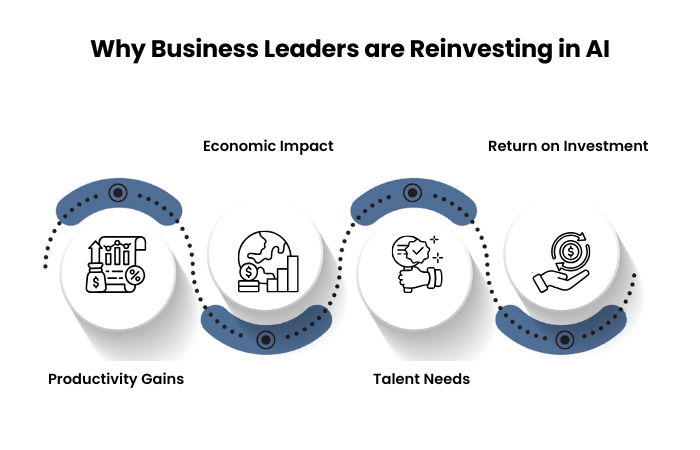
The numbers from 2026 tell a clear story. According to research from Forbes and Harvard, the adoption of these systems is no longer a maybe.
Productivity Gains: 71% of senior leaders at companies investing $10 million or more in AI report significant gains.
Economic Impact: Research suggests that agentic AI could add $3 trillion to corporate productivity globally.
Talent Needs: 56% of workers say they would switch jobs to get better training on working with AI.
ROI: On average, companies earn $3.50 for every $1 they spend on agentic AI.
At MoogleLabs, we help you hit these numbers by building artificial intelligence solutions that focus on ROI, not just trends.
The Latest Headlines: What Happened with Claude?
Anthropic has stayed in the news for two big reasons recently: the Claude Code leak and the rise of the Mythos model.
On March 31, 2026, a packaging error led to the accidental exposure of source code for Claude Code, their AI coding tool. While no user data was lost, it gave everyone a look at the agentic harness, the logic that allows an AI to manage its own memory and run multi-step tasks without human help. For competitors, it was a roadmap. For business owners, it was proof that agentic AI services are becoming highly sophisticated.
The other major story is Claude Mythos. This is a model built with 10 trillion parameters. In tests, it was so good at finding software vulnerabilities, even bugs that were 27 years old, that Anthropic decided not to release it to the general public.
Instead, they are using it in a restricted group called Project Glasswing to help fix security flaws before bad actors can find them.
The Feud: Anthropic vs. The US Pentagon
A significant part of the 2026 story for Anthropic is their ongoing legal battle with the US Department of Defense (Pentagon). This feud has created ripples throughout the industry and is something every decision-maker must monitor.
The Root of the Conflict
The dispute began in early March 2026 when Defense Secretary Pete Hegseth labeled Anthropic a supply-chain risk. This designation effectively blacklisted the company from new Pentagon contracts. The reason? Anthropic refused to remove specific safety guardrails from its models.
Anthropic builds its models using Constitutional AI, a method that gives the model a set of ethical rules to follow. The Pentagon reportedly wanted unrestricted access to Claude for use in fully autonomous weapons and mass surveillance. Anthropic stood its ground, arguing that removing these safety limits could lead to unpredictable and harmful outcomes.
Legal Status and Business Impact
This standoff led to two major lawsuits. In San Francisco, a federal judge recently sided with Anthropic, blocking the risk label for now. But in Washington D.C., an appeals court refused to halt the blacklist. This split decision means that if your company does a lot of work with the federal government, your choice of AI/ML solutions just got more difficult.
Why this matters for your business:
Contract Risk: If your business is a defense contractor, using Claude might require special certifications or could even be prohibited under current Pentagon rules.
Reputational Safety: Anthropic's refusal to lower standards shows a commitment to ethical AI that many consumer-facing brands value.
Vendor Stability: While Anthropic’s revenue has grown to over $30 billion, legal battles with the government can create long-term uncertainty.
At MoogleLabs, we help you prepare for these shifts by offering a Generative AI Roadmap 2026 that includes multi-model strategies. We make sure you aren't tied to a single provider that might face sudden regulatory hurdles.
Closing Thoughts for Business Leaders
The tension between Anthropic and the Pentagon is a sign of a maturing industry. Governments and corporations are now fighting over who gets to set the rules for the most powerful technology on earth. As a business owner, you don't need to be caught in the crossfire.
By working with an experienced team that understands both the technical and regulatory details, you can use artificial intelligence solutions to grow your business while staying safe. The era of the AI agent is here, and at MoogleLabs, we have the tools and the expertise to help you lead the way.
Explore our AI and ML Development services to learn more about how we can help you build the future of your company.
Loading FAQs
Please wait while we fetch the questions...