Top AI Trends in 2026: What Business Leaders Need to Know Now
AI is transforming business in 2026 with trends like Agentic AI, multimodal systems, and sovereign AI infrastructure. These innovations help organizations automate workflows, improve decision-making, and stay competitive in a rapidly evolving digital economy.
Executive Summary: Key AI Trends for 2026
Agentic AI defines the modern workforce. By the late 2020s, autonomous agents will manage a growing share of enterprise workflows, particularly in structured operational environments.
Sovereign Intelligence is the primary defense strategy. A growing share of Fortune 500 companies are exploring sovereign AI stacks to protect intellectual property and comply with data residency regulations.
Physical AI closes the digital-physical loop. Multi-modal models now provide real-time reasoning for edge-robotics in manufacturing, moving beyond pre-programmed automation to contextual awareness.
Multi-modal RAG represents the new search standard. Knowledge retrieval systems now index video, audio, and sensor data alongside text, providing a 360-degree view of corporate intelligence.
Token Economics drives profitability. Inference efficiency is the top priority for CTOs; parameter-efficient fine-tuning (PEFT) has become the standard for maintaining performance while reducing costs.
Introduction
Agentic AI is the move from models that generate text to systems that complete multi-step goals. In early 2025, we saw the rise of basic assistants. By 2026, the market has shifted toward autonomous agents. These systems do not wait for a user to type a query. They observe digital environments, identify bottlenecks, and take corrective action.
Across enterprise, deployments show a massive shift in how companies view "intelligence." We no longer build tools; we build digital colleagues. These agents use Long-Term Memory (LTM) architectures to retain context over months of operations. They utilize Chain-of-Thought (CoT) reasoning to break down a CEO's high-level objective into hundreds of sub-tasks.
Organizations are moving away from centralized "monolith" models. Instead, they deploy Multi-Agent Systems (MAS). In this setup, one agent critiques the output of another.
A "Legal Agent" checks the "Sales Agent's" contract before a "Finance Agent" approves the transaction. This multi-agent validation significantly reduces hallucination and logical errors.
This article explores the most important AI trends in 2026, not as surface-level buzzwords, but as structural shifts that business leaders need to understand now.
Learn how you can use artificial intelligence services to better your business operations.
The Market Context: Cooling Hype, Sharper Capital
The numbers tell part of the story.
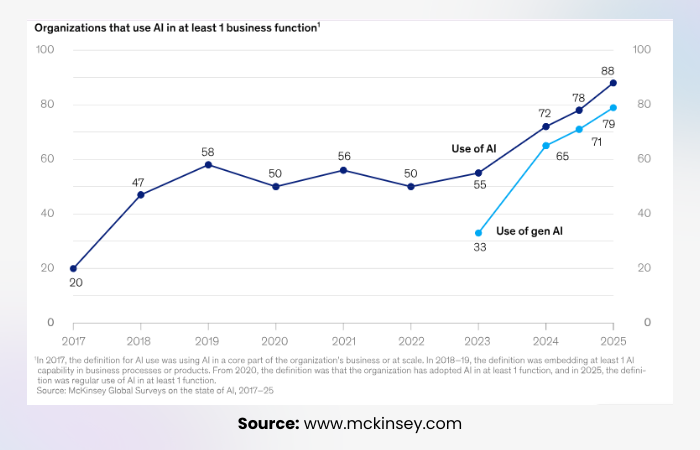
According to McKinsey’s 2025 global survey on AI adoption, over 88% of organizations report using AI in at least one business function, up from roughly one-third in 2023.
Gartner projects global AI software revenue to exceed $297.9 billion in 2027, driven largely by enterprise applications rather than consumer tools.
PwC estimates that AI could contribute up to $15.7 trillion to global GDP by 2030, with productivity gains accelerating post-2025 as automation deepens.
The Stanford AI Index continues to document rising enterprise investment in foundation models, AI infrastructure, and industry-specific AI solutions.
Venture capital funding has become more concentrated, favoring companies building verticalized AI systems and AI infrastructure over generic chatbot layers.
Adoption is no longer experimental. It is operational.
But the bigger shift is architectural. Enterprises are moving from isolated AI use cases to integrated AI ecosystems. And that shift underpins nearly every major AI trend in 2026.
How are Businesses using Artificial Intelligence Services for Operations?
Businesses have now started using AI to improve and perfect operations. As per one Forbes Advisory survey, 56% of respondents admitted the use of AI in customer service, the highest adoption rate. 51% of the respondents also accepted the use of AI for cybersecurity and fraud management.
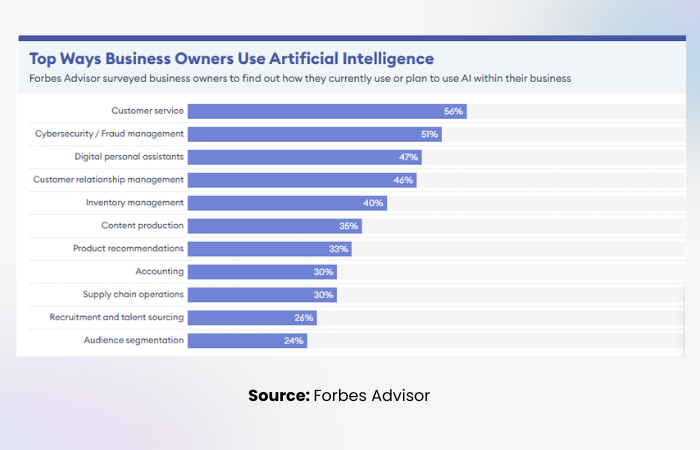
Some of the other notable uses of AI include customer relationship management, digital personal assistant, and inventory management.
AI Trends Shaping Modern Business World
The current state of the market is a clear indicator that artificial intelligence solutions are here to stay. Hence, the first relevant question to ask for any business leader is how they are going to incorporate the technology in their operations. Now, let us look at some of the most important AI trends of 2026 to get the ball rolling on ideas that can help your business grow.
.png)
1. Agentic AI and Autonomous Workflows
Agentic AI refers to systems that do not merely respond to prompts but autonomously plan, execute, and adapt multi-step tasks.
In plain terms, these systems can set goals, break them into subtasks, call external tools, monitor outcomes, and adjust in real time. Think less “chat assistant” and more “digital operator.”
Why It Matters
Agentic AI trends have changed the economics of process automation. Traditional automation required rigid scripting. Agentic systems can handle variability, exceptions, and dynamic environments.
For example, a global logistics company might deploy AI agents to manage shipment rerouting during weather disruptions. The agent evaluates inventory levels, transportation costs, regulatory constraints, and customer SLAs, then executes decisions without waiting for human approval on every step.
Business Implications
Reduced cycle times for complex operations
Reallocation of human staff to oversight and exception handling
New risk exposure if agent behavior drifts or misinterprets goals
The strategic challenge is governance. The automation and AI trends driving enterprise ROI amplify both productivity and risk. Leaders must design guardrails before scaling autonomy.
Also Read: 10 Agentic AI Use Cases Powering Enterprise ROI in 2026
2. Enterprise-Grade AI Orchestration
One of the most important AI trends for large organizations is the move toward orchestration layers that coordinate models, agents, and enterprise data pipelines.
In 2024, most companies integrated a single large model into isolated applications. In 2026, enterprises are orchestrating multiple models, agents, data sources, and APIs across departments.
AI orchestration platforms coordinate:
Foundation models from different providers
Internal fine-tuned models
Real-time data pipelines
Compliance and monitoring layers
Why It Matters
AI value now depends on integration, not model quality alone.
Consider a multinational bank deploying AI across fraud detection, risk modeling, and customer service. Without orchestration, each team builds separate AI stacks. That fragmentation drives cost, compliance risk, and duplication.
Enterprise AI orchestration creates a shared intelligence layer across functions.
Risks
Vendor lock-in
Complexity creep
Internal political resistance
The winners in 2026 are not those with the “best” model, but those with the cleanest orchestration architecture.
3. Conversational AI
Conversational AI in 2026 is defined by near-zero latency and emotional resonance. Static text interfaces have taken a backseat to high-fidelity voice interactions. Systems now process speech with a delay of less than 200 milliseconds, mimicking the natural cadence of human thought.
At MoogleLabs, we have seen enterprises move from "click-to-chat" to "speak-to-act" workflows. These systems do not just transcribe; they interpret intent through tone and pitch. Markets estimate the voice-first AI sector will reach $45 billion by the close of 2026.
Why It Matters
Speed is the primary metric for customer satisfaction. When an AI can handle a complex support ticket via voice without a human-detectable delay, the friction of digital commerce disappears.
Strategic Impact
Shift from screen-based UI to Zero UI environments.
Some enterprises report cost reductions of 30–50% when AI voice agents handle tier-1 support queries.
Risks
Voice-cloning security threats require new biometric verification.
Increased compute requirements for real-time audio processing.
Conversational interfaces remain one of the most visible AI trends because they directly reshape how customers interact with digital services.
4. Multimodal AI Systems Become Default
Multimodal intelligence is rapidly becoming one of the defining AI trends in enterprise analytics and decision-making.
It uses machine learning services to process text, images, audio, video, and structured data within a single system.
In 2023, this was emerging capability. In 2026, it is baseline.
Retailers use multimodal AI to analyze store video feeds alongside sales data. Healthcare systems combine imaging scans, lab reports, and physician notes. Manufacturing firms integrate sensor data with maintenance logs and visual inspection systems.
Strategic Implications
It unlocks operational intelligence that was previously siloed.
The impact is particularly strong in industries with complex data types. For example, predictive maintenance in manufacturing improves dramatically when AI analyzes vibration sensor data alongside visual defect detection.
Risks
Data privacy exposure across modalities
Infrastructure strain
Higher training and compute costs
Multimodality increases power, but also complexity.
5. From Predictive to Prescriptive Analytics
Prescriptive analytics uses AI to move from forecasting what will happen to dictating how to respond. In 2024, businesses were happy to know their churn rate might increase. In 2026, the AI identifies the high-risk customer and autonomously executes a personalized retention strategy before the human manager sees the report.
Our recent deployments in retail suggest that prescriptive models drive a 12% higher margin than predictive models alone. By 2030, it is projected that 70% of supply chain leaders will rely on prescriptive logic to manage inventory fluctuations.
Why It Matters
Knowing the future is useless without the logic to change it. Prescriptive AI removes the analysis paralysis that plagues mid-level management.
Business Implications
Faster pivot cycles in volatile markets.
Autonomous budget reallocation based on real-time ROI tracking.
Challenges
Over-reliance on "black box" decisions.
The need for high-quality, real-time data streams to ensure accuracy.
This transition from prediction to automated action represents one of the most practical AI trends for organizations seeking measurable ROI.
6. AI Governance Moves from Policy to Infrastructure
By 2026, AI governance is no longer a PDF document sitting in a compliance folder.
Regulations such as the EU AI Act and emerging US state-level frameworks have pushed enterprises to embed compliance directly into AI systems.
This includes:
Model explainability tools
Bias auditing systems
Real-time monitoring dashboards
Audit trails for AI decisions
Why It Matters
Governance is becoming a competitive advantage.
Organizations that can demonstrate trustworthy AI systems win enterprise contracts, particularly in regulated sectors like healthcare and finance.
Challenges
Fragmented global regulations
Cross-border data transfer constraints
Evolving compliance definitions
Governance frameworks are emerging as one of the most critical AI trends as regulators and enterprises demand transparency and accountability from intelligent systems.
The companies that treat governance as a technical architecture, not just legal oversight, are better positioned.
7. Sovereign AI and Geopolitical Fragmentation
Sovereign AI refers to countries developing and controlling their own AI infrastructure, data ecosystems, and model training pipelines.
In 2026, AI infrastructure has become a national strategic asset.
Governments across Europe, the Middle East, and Asia are investing heavily in domestic AI compute clusters and locally governed foundation models. Europe is leading the way here with their EU AI Act – the first regulation on artificial intelligence.
Business Implications
Multinational companies must navigate:
Data residency rules
Local model hosting requirements
Export controls on advanced chips
For example, a global cloud provider may need separate AI stacks for the EU, US, and APAC regions.
AI is no longer just a technology decision. It is a geopolitical one.
As geopolitical competition around data intensifies, sovereign infrastructure will remain one of the most strategically important AI trends shaping global technology policy.
8. AI Infrastructure Consolidation Accelerates
The number of model providers peaked. Then it contracted.
Hence, it is no surprise that infrastructure consolidation is another major development among enterprise AI trends, as organizations seek efficiency and scalability across their AI stacks.
Compute costs, energy demands, and competitive pressure are consolidating the field. Large cloud providers and a handful of specialized AI labs dominate foundation model development.
Companies like NVIDIA continue to anchor the hardware layer. Cloud platforms including Amazon Web Services and Microsoft Azure are bundling models, orchestration, and enterprise tooling.
Strategically, consolidation simplifies vendor management but increases concentration risk.
Enterprises must balance performance with diversification. Few want to depend entirely on a single model provider.
9. AI-Native Product Design
Some companies are no longer adding AI features. They are building AI-native products from the ground up.
In an AI-native design:
User interfaces assume AI collaboration
Workflows are adaptive and predictive
Personalization is embedded
Think about enterprise software that generates dashboards dynamically based on user behavior, rather than static templates.
Business Impact
AI-native companies move faster. Legacy enterprises must retrofit.
Take customer support platforms that no longer present static forms but dynamic conversation-driven interfaces. AI drafts responses, suggests next best actions, and adapts based on context continuously.
This is strategically significant because it changes UX expectations. Users begin to assume intelligence, not just functionality.
The friction lies in user trust. When AI outputs vary, product predictability suffers. Design discipline becomes more important, not less.
This creates competitive asymmetry.
10. Embodied and Physical AI
Embodied AI refers to AI systems integrated into physical agents such as robots.
Warehouse robotics, examples of robotics in healthcare, and agricultural robots are expanding rapidly in 2026.
The difference now is integration with advanced foundation models that enable better contextual reasoning.
Strategic Impact
Labor shortages in logistics and manufacturing are accelerating investment in embodied AI.
However, capital costs remain high, and ROI timelines can be longer than expected.
11. Human-AI Collaboration Models Mature
After years of hype, enterprises are developing clearer playbooks for human-AI interaction.
High-performing organizations in 2026:
Define AI decision thresholds
Train employees in AI literacy
Establish AI oversight committees
Measure augmentation impact, not just automation savings
Productivity gains have not come from replacing humans. They have come from redesigning workflows.
Organizations that simply layer AI onto existing processes see modest improvement. Those that rethink task sequencing, approval chains, and decision thresholds see larger gains.
This is harder than deploying a model. It requires organizational introspection. However, when it is done right, businesses make significant gains.
12. AI Infrastructure Consolidation
The early AI boom created sprawl. Enterprises experimented with multiple vendors, APIs, and internal prototypes.
In 2026, CFOs are pushing consolidation.
Organizations are rationalizing:
Model providers
Cloud environments
Data pipelines
AI security layers
Why It Matters
Compute costs remain high. Large-scale inference is not cheap.
Efficiency is now a board-level concern.
13. Verticalized Industry AI Outperforms Horizontal Tools
Generic AI platforms have broad appeal. Industry-specific AI is delivering deeper ROI.
Healthcare diagnostics, supply chain optimization, legal contract review. These domains require domain-tuned models and specialized data pipelines.
In finance, firms are deploying AI systems that integrate regulatory frameworks directly into decision workflows. In manufacturing, predictive maintenance models are trained on proprietary sensor data.
Horizontal tools still exist, but vertical AI captures defensible value.
The friction is data access. Industry AI depends on clean, labeled, domain-specific data. Many organizations underestimate that requirement.
14. Cost Discipline Shapes Model Strategy
Inference costs matter more than leaderboard rankings.
Enterprises are benchmarking models not only on quality but on cost per task. Smaller, specialized models are gaining traction where they outperform large general-purpose models on narrow tasks.
This economic realism is healthy.
The friction is model sprawl. Without discipline, organizations accumulate redundant models and escalating costs.
Cost is becoming a design constraint, not an afterthought.
15. Multi-Modal RAG: The Unified Knowledge Layer
Multi-modal Retrieval-Augmented Generation (RAG) is a framework that allows AI to pull information from text, images, video, and audio files to provide grounded, factual answers. In 2024, RAG was about searching PDFs. In 2026, RAG is about searching the entirety of human experience.
Consider a technician repairing a complex engine. A text-only RAG system might give them the manual. A Multi-modal RAG system searches the video of the last repair, the audio logs of the engine's sensor pings, and the 3D CAD models of the part. It then generates a personalized video walkthrough for the technician.
This requires Cross-Modal Vector Embeddings. Every piece of data, whether it’s a heartbeat in a hospital or a sound on a factory floor, is converted into a mathematical representation in the same vector space. This allows the AI to "see" the connection between a specific vibration and a future mechanical failure. Gartner predicts that by 2026, 80% of enterprise search systems will be multi-modal.
16. AI Democratization: The Rise of the Citizen Architect
AI democratization is the proliferation of high-level AI tools that allow non-technical staff to build and deploy complex agents. We have reached a point where natural language is the only coding language a manager needs thanks to the low-code and no-code application development .
MoogleLabs has helped clients implement "Citizen Architect" programs where HR or Marketing teams build their own specialized agents. This relieves the pressure on the IT department.
Strategic Impact
Decentralized innovation across all departments.
Accelerated digital transformation timelines.
Risks
Shadow AI (unsanctioned AI use) becomes harder to track.
Lack of standardized security protocols in user-built tools.
17. Shadow AI: The Silent Security Threat
Shadow AI is the unsanctioned use of artificial intelligence tools by employees without the knowledge or approval of the IT department. As tools become easier to access, the perimeter of corporate data becomes porous.
The use of Shadow AI tools can increase the cost of data breaches by an average of $670,000 per incident globally.
Why It Matters
Proprietary algorithms and customer data are being fed into public models, where they can potentially leak to competitors or become part of the public training set.
Business Implications
Need for "AI-aware" firewalls and monitoring systems.
Required shift toward Sovereign AI to provide employees with safe, internal alternatives.
Challenges
Balancing employee productivity with strict security lockdowns.
Monitoring API calls across thousands of personal devices.
18 Quantum-Classical Hybrid AI
Quantum AI in 2026 refers to the use of quantum-inspired algorithms and early-stage quantum hardware to accelerate specific machine learning tasks. While pure quantum computing is still maturing, hybrid systems are already solving optimization problems that were previously impossible.
We are seeing this in pharmaceutical research and materials science. Quantum-enhanced models can simulate molecular structures at a scale that classical GPUs struggle to match.
Why It Matters
It breaks the compute ceiling. For industries like logistics or cryptography, the performance jump is exponential rather than incremental.
Strategic Impact
Breakthroughs in battery technology and drug discovery.
Obsolescence of traditional encryption methods, requiring "Quantum-Safe" upgrades.
Risks
High entry costs and scarcity of quantum talent.
Hardware instability and high error rates in early systems.
19. Cognitive Digital Twins
Cognitive Digital Twins are virtual replicas of physical assets that use AI to simulate what-if scenarios in real-time. Unlike traditional digital twins, these are cognitive as they possess reasoning capabilities. They do not just mirror reality; they predict failures and suggest repairs.
In our work with heavy manufacturing plants, we use these twins to run millions of simulations a day. This allows us to find the point of failure for a turbine before it even leaves the factory floor.
Why It Matters
It shifts maintenance from a cost center to a strategic asset. You save millions by preventing downtime before it starts.
Business Implications
Enhanced product lifecycle management.
Reduced physical prototyping costs.
Challenges
The requirement for massive sensor networks (IoT) to feed the twin.
Data synchronization issues between the physical and digital worlds.
20. Sentimental AI: Affective Computing in the Enterprise
Sentimental AI, or Affective Computing, allows systems to recognize, interpret, and simulate human emotion. In 2026, AI is no longer emotionally blind. It analyzes facial micro-expressions, speech patterns, and even typing rhythm to gauge the user's state of mind.
In customer service, these models detect frustration in real-time and automatically hand off the call to a human supervisor.
Strategic Impact
Hyper-personalized marketing based on current mood.
Improved mental health support in the workplace.
Risks
Perception of surveillance and privacy concerns.
Ethical debates over the manipulation of human emotions for profit.
21. Responsible and Transparent Intelligence (Ethical AI)
Responsible AI is the practice of building systems that are explainable, unbiased, and aligned with human values. In 2026, "Explainability" is a legal requirement. You cannot deny a loan or a medical treatment via AI without providing a clear, human-readable reason.
We have moved into the era of AI Auditability. Organizations now employ Red Teams to constantly probe their models for hidden biases.
Why It Matters
Without trust, AI adoption will stall. Regulatory bodies in the EU and North America are now issuing heavy fines for "opaque" algorithms.
Business Implications
Establishment of internal Ethics Boards.
Use of "Self-Correcting" models that flag their own biased outputs.
Challenges
The technical difficulty of explaining high-dimensional neural network decisions.
Conflicting global regulations on what constitutes fairness.
How Artificial Intelligence Benefits When Combined with Other Emerging Technologies
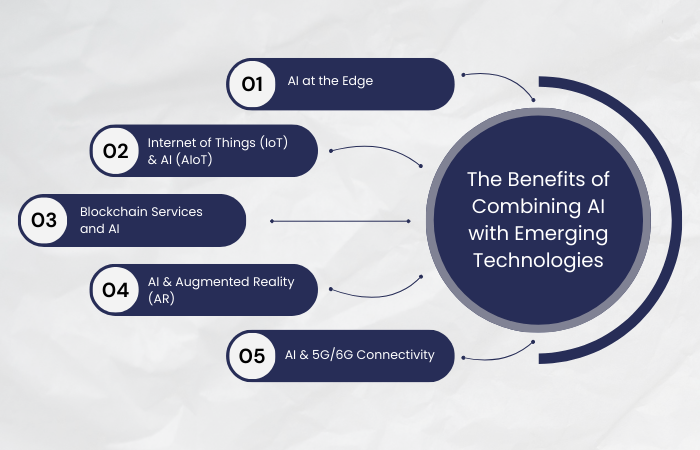
To reach the full potential of AI business technology trends, you must combine them with other technologies. This next generation of artificial intelligence services will assist you in creating massive possibilities.
AI at the Edge
Edge AI is another AI trend that pushes inference closer to where data is generated, reducing latency and bandwidth reliance.
This trend is accelerating in:
Autonomous vehicles
Industrial robotics
Smart retail stores
Energy infrastructure
Why It Matters
Not every AI task can rely on cloud connectivity. Real-time decisions require local processing.
For a manufacturing plant, an edge AI system detecting defects on an assembly line cannot wait for cloud roundtrips.
Strategic Consideration
Enterprises must balance edge autonomy with centralized governance. Distributed intelligence introduces new security vulnerabilities.
Internet of Things (IoT) & AI (AIoT)
The convergence of IoT and AI, often termed AIoT, transforms passive data collection into proactive environment management. In 2026, every sensor now acts as a localized node of intelligence that filters data before it ever reaches a central server.
This trend is accelerating in:
Smart City Infrastructure: Real-time traffic flow adjustment and energy grid balancing.
Predictive Facility Management: Buildings that adjust climate and lighting based on biometric occupancy patterns.
Precision Agriculture: Sensors that detect soil nutrient levels and trigger autonomous irrigation or fertilization.
Wearable Health Monitoring: Devices that predict cardiac events by analyzing subtle changes in physiological data.
Why It Matters
Data volume has become a liability. By late 2026, it is projected that over 26 billion IoT devices will be active globally. Sending all that data to the cloud is expensive and slow. AIoT allows the device to understand what data is a "signal" and what is "noise," reducing cloud storage costs by up to 40% for industrial users.
Strategic Consideration
Interoperability remains a technical hurdle. Organizations should prioritize open standards to prevent siloed data streams. As intelligence moves to the device level, physical security for these endpoints becomes as pivotal as digital firewalls.
Blockchain Services and AI
Blockchain provides the ledger of truth that AI systems lack. In 2026, the primary use case for this combination is Data Provenance and Algorithmic Accountability. As generative content floods the internet, blockchain serves as the cryptographic seal of authenticity for training data and model outputs.
This trend is accelerating in:
Intellectual Property Protection: Tracking the use of copyrighted material in LLM training sets.
Decentralized AI Marketplaces: Platforms where developers trade Small Language Models securely.
Supply Chain Transparency: AI agents verifying the ethical sourcing of raw materials via immutable ledgers.
Secure Medical Data Sharing: Allowing AI to train on patient data without actually seeing or moving the private records.
Why It Matters
Trust is the scarcest resource in 2026. Deepfakes and automated misinformation have made verification a business requirement. Blockchain ensures that an AI’s decision-making process is auditable. This is non-negotiable for sectors where a "black box" logic could lead to legal repercussions.
Strategic Consideration
The energy footprint of combining these technologies is significant. Leaders should look for Proof of Stake or other low-energy consensus mechanisms to keep the carbon cost of their AI infrastructure within ESG targets.
AI & Augmented Reality (AR)
AI serves as the eyes of spatial computing. In 2026, AR headsets and glasses rely on advanced computer vision to map physical spaces and overlay relevant business intelligence in real-time. This is not about entertainment; it is about Contextual Information Delivery.
This trend is accelerating in:
Industrial Maintenance: Technicians see a 3D overlay of internal machinery components while performing repairs.
Interactive Retail: Shoppers receive real-time, personalized pricing and reviews as they look at products on a shelf.
Surgical Assistance: Real-time projection of MRI data onto a patient during live procedures.
Corporate Training: Immersive simulations where AI characters react to the trainee's speech and body language.
Why It Matters
Human cognitive load is at an all-time high. AR powered by AI filters the world, showing only what is relevant to the task at hand.
Strategic Consideration
Privacy is the primary barrier to adoption. Devices that constantly "see" the environment raise concerns for both employees and customers. Organizations must implement strict "on-device" processing for visual data to ensure that sensitive surroundings are never uploaded to a cloud.
AI & 5G/6G Connectivity
5G and early 6G testbeds provide the high-speed “nervous system" that distributed AI requires. In 2026, Network Slicing allows enterprises to dedicate specific bandwidth to AI tasks, ensuring that a life-saving medical AI or an autonomous vehicle never competes for speed with a consumer streaming video.
This trend is accelerating in:
Remote Robotic Surgery: Zero-latency feedback loops for surgeons operating across continents.
High-Frequency Trading: AI agents executing moves based on global events in sub-millisecond timeframes.
Autonomous Drone Swarms: Coordination of hundreds of drones for search and rescue or agricultural spraying.
Cloud-Native Mobile AI: Offloading heavy inference tasks from a smartphone to a nearby edge-cloud server.
Why It Matters
The "intelligence" of an agent is limited by how fast it can receive and process information. 5G removes the tether. It enables Mobile Edge Computing (MEC), where the AI's brain is physically close to the user but not limited by the battery or heat constraints of a handheld device.
Strategic Consideration
Connectivity creates a larger attack surface. Every 5G cell can be a gateway for a breach. Investing in "Zero Trust" architecture is the only way to manage a 5G-enabled AI fleet without exposing the core corporate network to external threats.
Enterprise AI Trends of 2026 – Applications in Various Industries
Intelligence has moved from a lab experiment to the engine of industry. By mid-2026, the gap between companies using AI and those ignoring it has become a canyon.
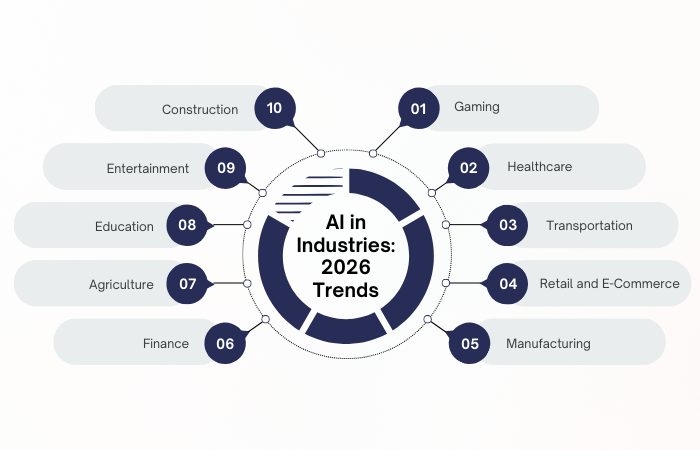
Many of the AI trends discussed in this article are already transforming industries by embedding intelligence directly into operational systems.
Here is how different sectors use these systems to win.
Gaming
Games in 2026 feel alive. Players no longer talk to puppets with three pre-set lines of dialogue.
Living NPCs: Characters remember your past insults or favors. They adapt their goals based on how you play.
Instant Worlds: AI builds massive maps in seconds. This cuts years off development cycles for major studios.
Perfect Balance: The game senses when you are bored or frustrated. It tweaks the difficulty on the fly to keep you engaged.
Healthcare
The shift in 2026 is moving from reactive care to keeping people healthy before they feel sick.
Early Warnings: AI spots a tumor before a human eye registers the pixel. This happens by scanning genetic markers and daily vitals.
Imaging Partners: Radiologists use AI to highlight anomalies in scans. In some diagnostic contexts, AI models now match or exceed human radiologist performance.
Always-On Triage: AI agents manage patient intake and post-op checks. This frees up nurses for the most urgent cases.
Transportation
The vehicle is now a computer that happens to have wheels. In 2026, the focus is on the intelligence of the fleet.
Trucking Autonomy: AI manages the routes and battery levels of electric truck fleets. They drive while a human oversees the data from a desk.
Self-Fixing Roads: Sensors on bridges tell an AI when a crack starts. Repairs happen before a failure occurs.
Traffic Flow: City signals change based on live car data. This keeps the streets clear and reduces idling.
MoogleLabs Insight: Our SleepBleep system uses Edge AI to watch driver alertness. It provides a safety layer that prevents accidents before they happen.
Retail and E-Commerce
Generic ads are dead. In 2026, the store knows what you want before you do.
Search by Sight: You take a photo of a jacket on the street. The AI finds the exact item in your size in seconds.
Smart Stocking: Retailers move products to local hubs based on predicted local demand. Items arrive almost as soon as you click "buy."
Virtual Fitting: AI-powered AR shows how a dress fits your specific body. It uses physics to show how the fabric moves.
MoogleLabs Insight: Our Screen Damage Detection tech automates quality checks for used phones. It makes sure customers get what they pay for.
Manufacturing
The factory in 2026 thinks. It manages the line from the moment raw steel arrives.
Smart Repairs: Machines flag their own wear and tear. They schedule a fix during a shift change so production never stops.
Efficient Design: Engineers give the AI a goal. The AI creates a part design that uses less metal but stays stronger.
Human-Robot Teams: Robots watch a worker and learn a new task in minutes. They don't need new code; they just need to see the job done.
Finance
Money moves at the speed of light. In 2026, AI handles math so humans can focus on the big picture.
New Credit Scoring: AI looks at real-time supply chain health to give a loan to a small business. It sees value where old banks see risk.
Instant Fraud Stop: Systems catch a "ghost" transaction the moment it starts. They spot patterns that traditional rules miss.
Personalized Wealth: Every customer has an AI "coworker" managing their portfolio. It reacts to global news in milliseconds.
MoogleLabs Insight: Our Multi-Asset Portfolio Platform uses LLMs to summarize market mood. It gives investors an edge in a fast-moving market.
Agriculture
Farming in 2026 is a tech business. Drones and sensors treat every plant like an individual.
Drone Scouts: Cameras identify a single bug-infested plant in a thousand-acre field. They spray only that spot.
Water Savings: AI looks at soil moisture and weather data. It delivers the exact drop of water needed, cutting waste by 30%.
Harvest Robots: Machines pick delicate fruit without bruising them. They know exactly when a grape is at peak ripeness.
Education
The "one-size-fits-all" classroom is gone. Tutors in 2026 never get tired and never lose patience.
Personal Paths: AI sees where a student is stuck. It changes the lesson to a video or a game to help them grasp the concept.
Instant Grading: AI handles the routine grading of essays. This gives teachers more time to mentor students.
Skill Maps: For companies, AI looks at the team's skills. It suggests exactly what they need to learn to stay ahead of the market.
Entertainment
You are part of the story. In 2026, media is a conversation, not a broadcast.
Custom Scores: Music apps create a unique track for your workout based on your heart rate.
Choose Your Film: Viewers pick the plot. The AI generates new scenes and dialogue to match the choice on the fly.
Mood Curation: The app sees you are stressed. It suggests content that helps you relax based on your psychological state.
Construction
Construction uses AI to make sure what is on the screen is what gets built on the ground.
Clash Detection: AI finds a pipe hitting a beam in the 3D model. It stops the error before a single brick is laid.
Site Safety: Cameras watch the site. They flag a worker without a helmet or a hazardous spill in real-time.
Autonomous Digging: Bulldozers move dirt with perfect precision using AI. They follow the digital plan without a human in the cab.
Leverage Custom AI Solutions to Take Your Business To New Heights
The Economics of 2026 AI: Efficiency over Scale
The "bigger is better" era of LLMs is over. As per the 2026 AI Trends dissection, the focus is on Parameter-Efficient Fine-Tuning (PEFT). We have reached the point of diminishing returns for model size. The cost of training a 10-trillion parameter model is no longer justifiable for most business cases.
Instead, we use LoRA (Low-Rank Adaptation) to take a highly capable base model and "tune" it for a specific industry using only 1% of the original compute power. This makes AI accessible to mid-market firms.
Token Economics has become a core discipline for Product Owners. You must understand your Inference Budget. Every query has a cost, not just in dollars, but in carbon and latency. By Q2 2026, we expect to see the rise of Carbon-Aware AI Schedulers that move heavy inference tasks to data centers running on renewable energy in real-time.
Technical Architecture for 2026
For the technical leaders, the architecture is no longer just a model and an API. It is a complex stack involving:
The Vector Layer: High-speed retrieval of multi-modal embeddings.
The Reasoning Layer: Chain-of-Thought prompting to ensure logical consistency.
The Execution Layer: Secure "sandboxes" where agents can run code and interact with APIs.
The Governance Layer: Real-time monitoring for bias, hallucination, and agentic drift.
At MoogleLabs, we recommend a Small-to-Large strategy. Start with the smallest model that can solve the problem. If the task requires more brainpower, the system should automatically escalate the query to a larger, more expensive model. This Inference Tiering is the only way to maintain a positive ROI.
2026 AI Readiness Checklist
Inventory Your Agents: Identify three workflows where a human is currently the bridge between two software systems. Replace that bridge with an autonomous agent.
Localize Sensitive Data: Identify any IP-sensitive data currently being sent to public APIs. Transition these to a Sovereign AI instance.
Vectorize Everything: Move beyond SQL and NoSQL. Start creating a unified vector database for your company's video, audio, and text archives.
Adopt PEFT Workflows: Stop trying to build from scratch. Establish a pipeline for fine-tuning open-source base models on your proprietary data.
Monitor for Agentic Drift: Implement a secondary Audit Agent that does nothing but watch your primary agents for deviations from corporate policy.
What is the Future AI Trends?
The coming years will see an increase in prominence of AI trends. As per Statista, the global AI market, which was valued at $254.50 billion in 2025 will expand to $1.68 trillion by 2031. So, the question becomes what factors will impact this rapid adoption and market growth in the near future. Here is the expert prediction:
Universal Presence: Ambient Intelligence
By the 2030s, AI vanishes into the background. It becomes Ambient Intelligence, a responsive layer in the physical world that anticipates needs through 6G and biometrics, rendering screens and manual commands obsolete.
The Intelligence Economy: Compute as Currency
Investment shifts from startups to Sovereign Intelligence. Compute power and high-quality data will replace traditional reserves like oil or gold, becoming the primary measurement of a nation’s economic and strategic strength.
Cognitive Evolution: The Move to AGI
We are transitioning from reasoning tools to Artificial General Intelligence (AGI). These systems won't just follow instructions; they will generate original scientific hypotheses and self-evolve their own code, accelerating centuries of innovation into months.
The New Social Contract: Alignment Science
Ethics will move from policy to Alignment Science. In this distant future, decentralized "Guardian AIs" will act as a permanent safety layer, ensuring super-intelligent systems remain hardcoded to human values and survival.
Final Thought: The Architecture of the Next Decade
The defining characteristic of AI trends in 2026 is not novelty. It is integration.
We have moved past the era of experimental chatbots and isolated prototypes. AI is now the fundamental fabric of enterprise systems, geopolitical strategy, and modern workforce design. In this landscape, the companies that treat artificial intelligence as core infrastructure, rather than a shiny add-on feature, are the ones that will define the market for the next decade. The rest will simply be playing catch-up.
As these shifts from Agentic Workflows to Sovereign Intelligence redefine the global economy, navigating the technical complexity requires a partner who understands the operational reality of AI.
At MoogleLabs, we specialize in turning these 2026 AI trends into your competitive advantage. Whether you are looking to deploy Autonomous Agents, implement Multi-modal RAG, or transition to a secure Sovereign AI stack, our team of experts provides the end-to-end artificial intelligence services needed to scale. We don't just build tools; we build the intelligent ecosystems that keep your business at the forefront of innovation.
The future of your industry is being written in code today. Let’s ensure your organization is the one holding the pen.
Loading FAQs
Please wait while we fetch the questions...