7 Most Impactful Business Technology Trends To Watch In 2026
The year 2026 is accelerating the shift toward autonomous enterprises. From Agentic AI to hyper-automation and intelligent operations, explore 7 key AI trends transforming businesses—and how AI development services can help you stay ahead.
2026 has become the year of disruption in only the first two months. Anthropic AI agents have put tech enthusiasts into frenzy for its expected impact on the world. On the other hand, the IT sector is grappling with the reality of these unprecedented changes in the AI development services.
The market share is there for the taking, but only for those ready to move. However, the ones that persevere will be awarded with exceptional growth.
The rise in initial curiosity of 2023, to pilot-heavy years of 2024 and 2025, IT companies have seen it all.
In 2026, the world is experiencing a rise in autonomous enterprises. MoogleLabs, a company conceptualized back in 2020, has seen these shifts upfront.
Keep reading to learn how you can leverage artificial intelligence services to stay ahead of the curve.
7 Impactful Business Technology Trends in 2026
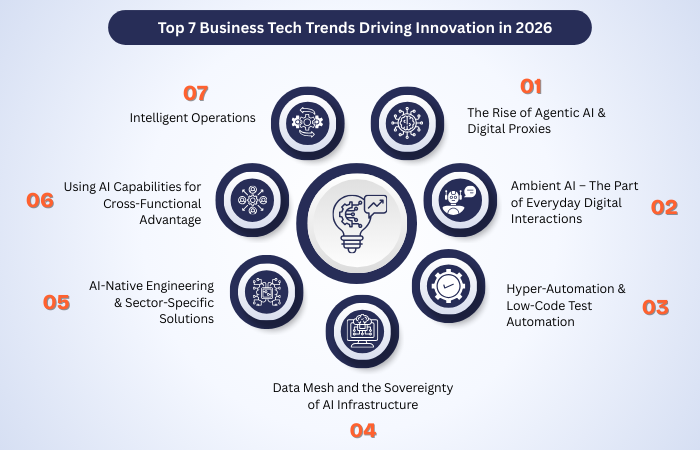
Now, let us discuss the various AI technology trends that will have an impact on 2026
Trend 1: The Rise of Agentic AI & Digital Proxies
AI assistants were 2025. In 2026, AI agents are going to be the only truth. They will not follow a rigid script. Instead, Agentic AI will reason, plan, and execute multi-step tasks independently.
What is an Agentic AI?
These are autonomous systems capable of:
Operating software tools
Triggering business processes
Making decisions with minimal supervision
Tomorrow, there is a possibility that your customers will be agents acting on behalf of humans. Hence, businesses need “agent-ready” infrastructure.
Gartner has forecasted that agentic AI will be responsible for 30% of the enterprise application software revenue by 2035.
Overcoming the Governance Barriers in Agentic AI Adoption
Agentic AI adoption will stall in 2026, till the time it can gain trust and become auditable. Agentic AI not hitting a technical wall. It is actually being impacted by the governance wall. Now, businesses need real-time oversight and audit trails, or several of these pilots will just quietly die.
To explore how these agents are driving ROI, you can check our detailed breakdown of Agentic AI Use Cases. Implementing these through professional AI development services allows you to rebuild your operating model around autonomy.
Trend 2: Ambient AI – The Part of Everyday Digital Interactions
We are moving towards ambient AI. So much so that it will be a part of every digital interaction in 2026. Efforts to make AI cheap, much like searching back in the 2000s, will be part of the year.
How it will impact society is yet to be seen. However, it is safe to assume that 2026 would be very interesting from both the technological as well as the societal point of view.
Trend 3: Hyper-Automation & Low-Code Test Automation
Efficiency is going to be the name of the game in 2026. Before, complex software came with higher cost of testing and maintenance. This is where AI automation and specifically low-code test automation will change the world.
Historically, testing needed engineers. Today, visual interfaces and self-healing scripts give non-technical stakeholders, like the product managers, the power to ensure software quality.
AI detects every shift in UI, be it color or position change. Then, the test script automatically updates to account for the new changes. Essentially, bringing to the end the era of flaky automation that breaks with every update.
However, these AI models also need testing for optimum results. You can find our full technical guide on how to test AI models to ensure your systems remain fair, stable, and reliable.
AI testing will assist with faster release cycles and a much lower technical debt. So, use AI development services that prioritize low-code frameworks. They will empower your team to innovate without being bogged down by manual QA processes.
Trend 4: Data Mesh and the Sovereignty of AI Infrastructure
Data is the lifeblood of any AI/ML Development project, but in 2026, the way we manage that data has matured. We are moving away from "Data Lakes" where information goes to die toward a Data Mesh architecture.
What is a Data Mesh?
It’s a decentralized approach that treats data as a product. Instead of one central team managing everything, individual business units (like Marketing or Finance) own and manage their own data pipelines. This ensures that the data used for artificial intelligence services is high-quality, relevant, and accessible in real-time.
Furthermore, AI Sovereignty is becoming a top-of-mind issue for boards. Businesses are increasingly wary of "black box" third-party models.
In 2026, the trend is toward hosting models within your own Private Cloud (VPC) to ensure data privacy and compliance with global regulations like the EU AI Act.
Our team often recommends this sovereign approach through our AI development services to ensure your intellectual property remains yours.
Trend 5: AI-Native Engineering & Sector-Specific Solutions
We are seeing a move away from "one-size-fits-all" AI. In 2026, the most impactful breakthroughs are occurring in sector-specific applications. For example, in the food industry, AI is being used for everything from predictive demand modeling (reducing waste by 20%) to farm-to-fork traceability.
In engineering, we’ve moved past simple coding assistants to AI-native engineering. This isn't just about writing code faster; it's about a fundamental shift toward "expressing intent." Technical teams are evolving into "Context Engineers" who manage the lifecycle of a model rather than just writing lines of syntax.
By partnering with experts in AI development services, businesses can build custom cores that understand their specific industry jargon, whether that’s in healthcare, fintech, or manufacturing. For a deeper look at these breakthroughs, read our insights on AI automation trends for 2026.
Trend 6: Using AI Capabilities for Cross-Functional Advantage
The world of tech will move away from “buy-versus-build” debate and move towards adaptation and orchestration. With AI models and infrastructure getting more and more commoditized, the benefit will come from how well companies assemble capabilities across, data, agents, and vendors.
It includes orchestrating these elements into real cross-functional actions and insights. Any company that wants to differentiate themselves would need to work on orchestration and adaptation.
Trend 7: Intelligent Operations
In 2026, automation has evolved from simple "if-this-then-that" rules into complex, self-healing systems. This AI automation helps machine learning models to analyze business processes continuously to find and fix bottlenecks in real time.
Moving Beyond RPA
Robotic Process Automation (RPA) was the first step, but it often failed because it automated "broken" processes. Modern AI development services now focus on Intelligent Operations, where the process itself is redesigned to be AI-native.
Why Businesses are Investing:
Cost Reduction: Strategic AI development services can reduce operational overhead by up to 30% through process optimization.
Error Elimination: AI-driven data entry and financial reconciliation remove the "human factor" from high-stakes tasks.
Scalability: Automation allows businesses to handle 10 times the volume without any increase in headcount.
To see the roadmap for the coming year, explore our latest insights on AI automation trends 2026.
Lead the Future with State-of-the-Art AI Development Services
In 2026, the technology landscape is offering exceptional opportunities for those who are interested in embracing the change. By adding AI development services into your strategy, you can turn your traditional operations into an intelligent and resilient enterprise.
The "Year of Truth" is here, make sure your business has the right answers.
Get in touch with MoogleLabs and begin your journey today.
Loading FAQs
Please wait while we fetch the questions...