How to Test AI Agents Before Enterprise Deployment: A Practical Quality Checklist
Enterprise AI agent testing ensures autonomous systems can handle real-world workflows securely and reliably. Explore a practical 10-step checklist covering accuracy, reasoning, API integrations, security, performance, error recovery, and human oversight before production deployment.
Deploying an autonomous agent into customer-facing operations is not the same as shipping a traditional software patch or rolling out a static chatbot. Traditional software executes deterministic branches. Standard language models generate static strings. Autonomous agents, by contrast, plan actions, maintain long-term state across cyclic graphs, query relational databases, and trigger irreversible API calls.
When an autonomous system fails in production, it does not just return a typo. It writes bad data to an enterprise resource planning (ERP) ledger, charges incorrect credit cards, or leaks proprietary data across customer sessions. Bridging this gap requires disciplined enterprise AI agent testing. Moving from experimental prototypes to mission-critical infrastructure demands a rigorous testing protocol that verifies reasoning paths, enforces schema boundaries, and governs runtime access.
The Autonomous Execution Gap: Why LLM Evals Fail on Enterprise Agents
Most engineering groups mistakenly evaluate autonomous agents with standard large language model benchmarks. They track perplexity, run pairwise text evaluations, or calculate BLEU and ROUGE scores. These metrics evaluate textual plausibility. They do not evaluate operational behavior.
An enterprise agent operates as a stateful, autonomous loop. It receives an objective, generates an execution plan, selects an external tool, inspects the payload response, and decides whether to continue or terminate. If an API returns an unhandled HTTP 500 error or a malformed JSON payload, an untested agent can enter an infinite retry loop, burning compute budgets within minutes.
When engineering squads build these systems, incorporating structured AI agent development practices prevents non-deterministic loops from degrading live production backends. Evaluating an agent requires verifying state transitions, payload schemas, and system side effects. Without targeted enterprise AI agent testing, you are gambling with live production records.
What Should You Test in an Enterprise AI Agent?
Reliable testing demands evaluating every operational layer before granting an agent write access to production backends. Engineering teams must validate six primary functional vectors:
Accuracy and Task Completion
Scoring output accuracy cannot rely on simple string matching. You must measure deterministic completion. Did the agent successfully reconcile the invoice? Did it write the correct row to Postgres? Did it verify all mandatory preconditions before closing the customer ticket?
Reasoning and Decision-Making
Agents make trade-offs under ambiguous conditions. Verification suites must evaluate reasoning traces across multi-step execution graphs. If an agent encounters contradictory customer instructions, it must know when to request clarification rather than guessing.
Tool Calling and API Integrations
Agents translate natural language intent into structured parameters. You need to verify that tool-call arguments match OpenAPI specifications and strict Pydantic schemas. When evaluating orchestration setups, reviewing foundational AI agent development tools helps engineering teams catch parameter-syntax errors before code moves to staging.
Security, Privacy, and Access Permissions
Every tool call represents an attack surface. Agents face prompt injection, data exfiltration attacks, and unauthorized privilege escalation. Test suites must confirm that agents operate strictly within the authenticated user's role-based access control (RBAC) boundaries.
Reliability, Latency, and Scalability
Multi-step reasoning introduces latency compounding. Three sequential model calls averaging 800 milliseconds each, plus two database lookups, can quickly create a 4-second delay. Stress tests must evaluate throughput limits, token consumption budgets, and connection timeouts under realistic concurrency.
Human Oversight and Error Recovery
Autonomous systems need graceful degradation. When model confidence drops below operational thresholds, the system must pause execution, preserve state, and escalate to a human reviewer.
The Enterprise AI Agent Testing Checklist Before Deployment
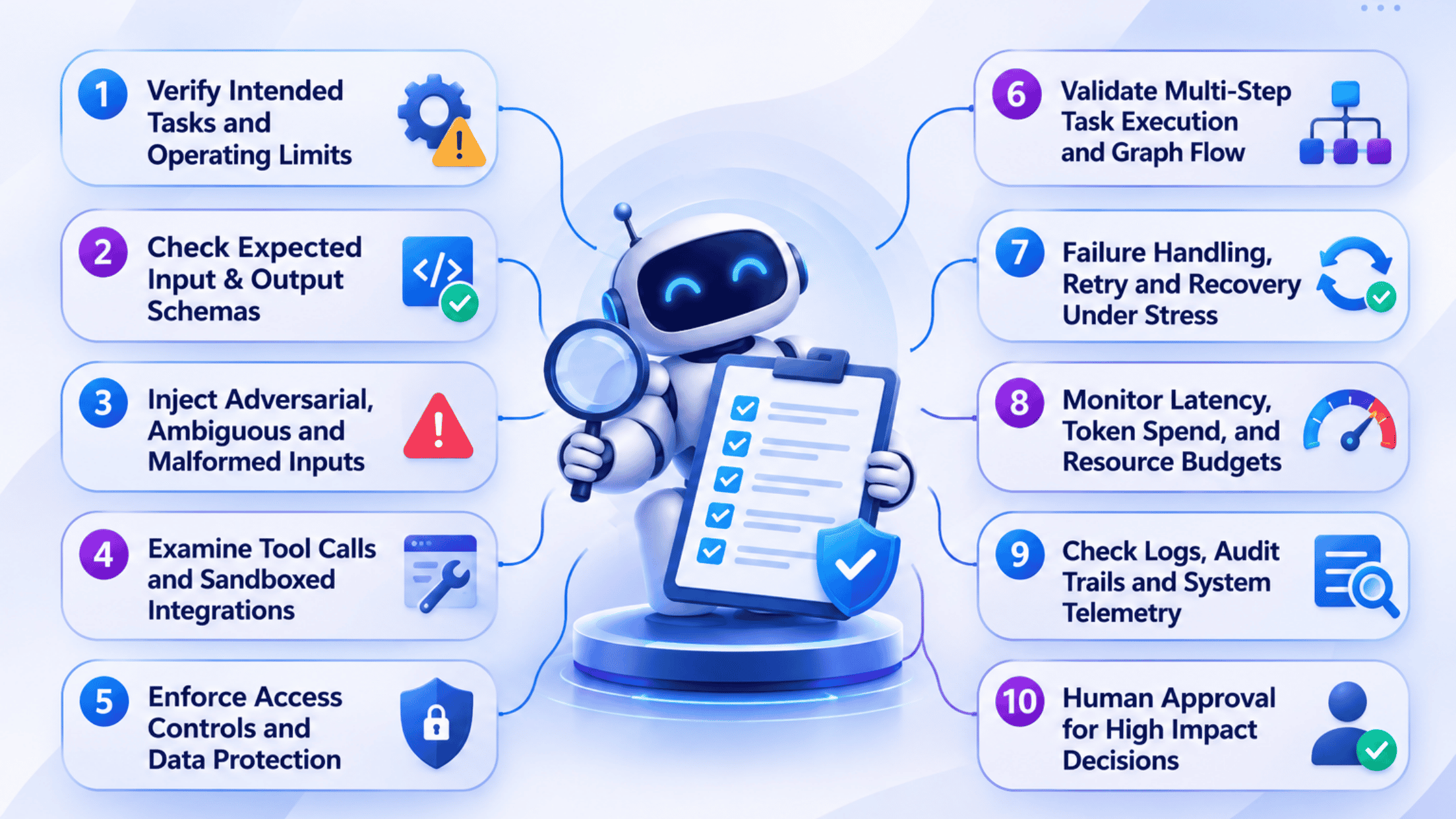
Use this practical checklist across your staging environments before clearing any autonomous agent for production traffic.
Step 1: Verify Intended Tasks and Operating Limits
Set firm operational boundaries. If the agent handles customer returns, ensure it rejects requests to change billing plans or access internal employee records. Make sure negative test cases result in nice, clean rejections, not unhandled model exceptions.
Step 2: Check Expected Input & Output Schemas
Test the system using selected historical data. Strictly check the schema for outputs. If the agent returns an object to an ERP pipeline, validate the payload against static data contracts. If an attribute is missing, the validation should be retried immediately.
Step 3: Inject Adversarial, Ambiguous and Malformed Inputs
Test the agent with messy inputs. Feed it contradictory instructions, malformed documents, and direct prompt injections. Make sure user inputs cannot override core system instructions or fool the model into executing unauthorized database commands.
Step 4: Examine Tool Calls and Sandboxed Integrations
Never test against live 3rd party systems. Connect your staging harness to containerized mock servers. Simulate slow network responses, missing headers, rate limits, and partial payloads returned. Ensure that the agent gracefully handles downstream service interruptions.
Step 5: Enforce Access Controls and Data Protection
Autonomous agents must not possess superuser credentials. If a junior clerk initiates an agent session, that agent must inherit only the clerk's specific database permissions. Test whether an agent can be manipulated into fetching restricted payroll records or sensitive customer records. To audit vulnerability exposure, organizations adopt specialized AI testing services that evaluate access perimeters against modern attack vectors.
Step 6: Validate Multi-Step Task Execution and Graph Flow
Directed graphs run complicated workflows. Test state persistence on each node. Say you have a five-step reconciliation flow and step four fails. You want to assert that the system can roll back to a known clean state without duplicating ledger entries. We stress test the enterprise AI agent on each node to maintain graph stability at high transaction volume.
Step 7: Failure Handling, Retry and Recovery Under Stress
Crash hard in the middle of multi-step operations. Make sure that the agent supports retry with exponential backoff. The system must fail safe in case of an unrecoverable error, isolate the session, write diagnostic logs, and notify on-call engineers.
Step 8: Monitor Latency, Token Spend, and Resource Budgets
Simulate concurrent user traffic in a load test. Measure p95 and p99 latency. Set token burn limits per interaction. An agent that requires 25 reasoning steps to solve a simple password reset will soon run out of operational budget.
Step 9: Check Logs, Audit Trails and System Telemetry
Every enterprise action must have an audit trail. Make sure your observability layer is capturing the user ID, input prompt, reasoning steps, tool payloads, execution latency, and token consumption per transaction. Deterministic audit logs are essential for regulatory compliance.
Step 10: Human Approval for High Impact Decisions
Identify actions with financial, operational, or legal liability. An agent can draft a payment for an invoice, prepare a customer refund, or calculate an insurance settlement. It should never do those things on its own above the set financial limits. Test that the execution loop stalls and forwards the ticket directly to human review queues.
How to Measure AI Agent Quality and Performance
Agents should be assessed by tracking balanced operational metrics instead of an overall aggregate score.
Task Success Rate: The ratio of workflows that are completed successfully, i.e., they reach their terminal goal without human intervention or execution faults.
Factual Consistency: The frequency with which an agent's reasoning matches source enterprise documentation. Grounding checks verify that the model does not fabricate database IDs or policy clauses.
Tool-call accuracy: The percentage of API calls that return a valid HTTP 200 response, without schema mismatches or parameter format errors.
Cost and Latency per Task: Average cost per token and processing time to complete a task. These metrics show spikes in cyclic reasoning loops.
Human Escalation Precision: The precision of the agent in identifying ambiguous or high-risk cases for specialist sign-off. High performers raise edge cases without burdening human teams.
Teams may use automated evaluation protocols to help keep performance consistent across changing datasets. We pair standard telemetry with systematic enterprise AI agent testing to keep operational anomalies visible before they cascade into core systems.
What Testing Methods Should Enterprises Use?
A complete quality assurance framework combines automated AI software testing with domain-specific AI evaluation methods.
Unit and Component Testing
Test individual agent capabilities in isolation. Verify that prompt templates format correctly, token counters calculate budgets accurately, and schema parsers reject invalid JSON strings.
Integration and End-to-End Testing
Test the agent against connected microservices. Validate full task lifecycles, from user request ingestion to database mutation. Use sandboxed environments to verify that webhooks deliver real-time updates.
Scenario-Based and Regression Testing
Build a golden evaluation set of enterprise scenarios. Every time system prompts, model weights, or underlying APIs change, run the regression suite. This prevents silent capability drift across releases.
Adversarial and Security Testing
Subject the system to red-teaming. Attempt to break guardrails using indirect prompt injection, prompt leakage attacks, and manipulated documents. For organizations operating under strict compliance, running continuous AI security testing ensures models remain defended against emerging threat vectors.
Load, Stress, and Concurrency Testing
Deploy test harnesses that simulate high transaction volumes. Track whether database connection pools, model rate limits, or message brokers degrade under heavy concurrent usage.
Human Evaluation and Expert Audits
Automated tests cannot evaluate nuanced domain judgment. Have business analysts, compliance officers, and underwriters review sampled reasoning paths to verify alignment with company policy.
How to Test Multi-Agent Systems and Complex Workflows
As businesses deploy specialized agent swarms, testing complexity increases exponentially. In multi-agent architectures, agents delegate sub-tasks, exchange contextual messages, and negotiate outcomes.
When building autonomous workflows, consult modern AI agent orchestration platforms to manage dynamic state transitions cleanly. In multi-agent environments, QA teams must address specific failure points:
Validate Communication Protocols: Assert that messages passed between agents adhere to standardized schemas. Never allow unstructured natural language to serve as the sole communication medium between microservices.
Test Task Delegation Logic: Verify that manager agents route tasks to the correct specialized worker. Ensure that workers do not re-delegate tasks in endless feedback loops.
Identify Cascading Failures: When a research agent produces a flawed data summary, observe how downstream writer and auditor agents react. Implement isolation gates that stop corrupted context from polluting downstream nodes.
Verify Cross-Agent Permissions: Ensure that agents cannot bypass security perimeters by delegating restricted tasks to higher-privileged peer agents.
Managing multi-agent verification requires continuous oversight. To avoid broken workflows, enterprises integrate specialized AI software testing protocols directly into multi-agent message buses.
Common AI Agent Testing Mistakes to Avoid
Engineering teams new to autonomous architectures frequently stumble into predictable pitfalls:
Testing Only the Happy Path: Agents work well under ideal conditions. True enterprise stability is proven when third-party APIs time out, user queries contain contradictions, and inputs include unreadable PDFs.
Relying on a Single Evaluation Metric: An agent that achieves a 95% task completion rate while running up a $40-per-transaction token bill is an architectural failure. Track completion, latency, and cost concurrently.
Ignoring Tool Permissions and Side Effects: Giving an agent direct write access to a database without testing its query parameters in a sandbox is a recipe for silent data corruption.
Skipping Continuous Regression Suites: A system prompt tweak designed to improve one edge case often breaks three existing workflows. Run automated regression harnesses on every pull request.
Addressing these risks early is vital. Performing disciplined enterprise AI agent testing across all failure modes protects system integrity before software reaches live environments.
Building Production-Hardened Autonomous Systems with MoogleLabs
Moving autonomous systems from early proofs of concept to dependable enterprise production requires disciplined systems engineering. At MoogleLabs, our engineers deploy high-throughput agentic AI services built for mission-critical operations. When organizations launch bespoke initiatives, our end-to-end AI agent development frameworks ensure every integration adheres to enterprise security standards.
We manage development with our proprietary Intelligent Software Lifecycle Control (ISLC™) framework. The operational architecture provides deterministic schema boundaries, embeds real-time observability telemetry, and provisions isolated VPC perimeters across AWS and Microsoft Azure. From day one, we protect and enforce compliance for your proprietary enterprise assets by isolating model logic and enforcing zero data retention.
If you are preparing to audit an existing autonomous architecture or planning a new deployment, our team delivers the engineering rigor you need to make sure your systems perform reliably in real-world conditions. Book a technical consultation with MoogleLabs today to review your architecture and discover production-ready AI agent solutions.
Loading FAQs
Please wait while we fetch the questions...