Autonomous AI Agents: How Enterprises Are Automating Complex Workflows in 2026
Accelerate software delivery with modern DevOps solutions that automate workflows, strengthen CI/CD pipelines, and improve cloud infrastructure. Discover how enterprise DevOps services enhance scalability, reliability, and operational efficiency for long-term business success.
The enterprise environment has reached a decisive turning point in 2026. The initial phase with generative models has matured into a disciplined focus on autonomous agents -systems designed to execute multi-step workflows rather than simply provide text responses. The difficulty is not discovering where automation is feasible but rather determining where it is actually responsible.
The goal is to go from experimental, fragmented automation to a unified framework in which these agents serve as predictable, auditable components of business strategy. Success now depends on combining high-level operational control with the technical rigor needed to ensure enterprise-grade stability.
In this blog, we'll explore the practical role of autonomous AI agents, the business functions they are transforming, and the frameworks needed to deploy them responsibly.
What Do Autonomous AI Agents Mean Inside an Enterprise?
An autonomous AI agent is software that can interpret a business objective, decide what to do next, call connected tools, and carry out a sequence of actions.
OpenAI’s function-calling guidance describes this pattern clearly: the AI model proposes an action, the application executes it, and the workflow continues with the result. That separation is important because enterprise work needs traceability, validation, and control, not improvisation.
Microsoft’s current security guidance defines autonomous agents as systems that can plan, execute, and adapt actions toward goals rather than answering a single prompt. It also notes that these systems can invoke tools, call APIs, access data, and coordinate across services, which is exactly why they can create real operational impact and real risk at the same time.
Where Are Enterprises Actually Using Them?
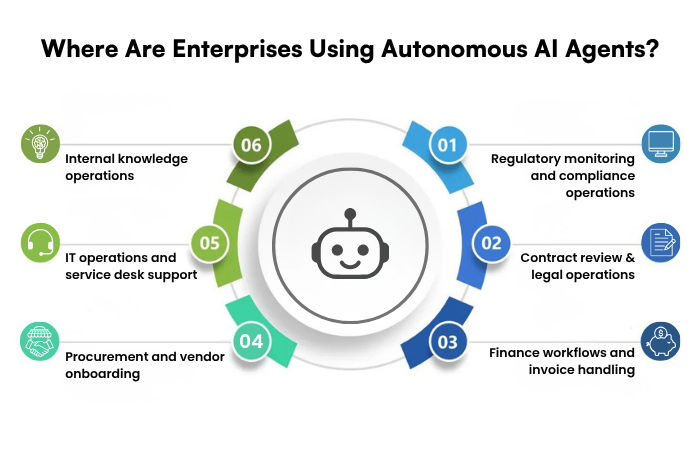
The strongest use cases are not broad “AI transformation” ideas. They are the workflows that involve documents, approvals, cross-system checks, and exceptions. Some of the top agentic AI enterprise use cases include:
1. Regulatory monitoring and compliance operations
Agents can monitor policy changes, extract the relevant updates, map them to internal controls, and prepare summaries for review. This is useful in regulated environments where teams need speed, but not at the cost of accuracy or traceability.
Microsoft’s current frontier guidance and security material both treat governance-heavy workflows as a practical area for agent deployment.
2. Contract review and legal operations
Legal teams spend too much time comparing clauses, checking version changes, and flagging deviations from approved language. Autonomous AI agents can draft first passes, compare against internal playbooks, and prepare a clean package for review.
The value is not replacing legal judgment - it is reducing the manual work around it.
3. Finance workflows and invoice handling
Finance is one of the clearest enterprise fits for autonomous AI agents. An agent can capture invoice data, compare it with purchase orders and receipts, route exceptions, and create structured entries for approval. The key is output discipline: the workflow needs reliable formats, not loosely written summaries.
4. Procurement and vendor onboarding
Procurement work often slows down because it involves documents, checks, approvals, and cross-team handoffs. Agents can collect vendor data, verify completeness, compare it against policy requirements, and prepare onboarding packets.
Secure interaction patterns such as controlled tool access and protocol-based communication are becoming important in this area because procurement systems touch both compliance and operations.
5. IT operations and service desk support
Current enterprise AI usage is strong in IT and knowledge management because the work is repetitive, but each case still needs context, prioritization, and escalation discipline. Autonomous AI agents solutions can help with ticket triage, context collection, routine follow-ups, and incident summaries.
6. Internal knowledge operations
A large share of enterprise time is still spent finding the right information, validating it, and handing it off in a usable form. Autonomous AI agents can pull context from internal systems, summarize it into a clean output, and prepare the next action.
MoogleLabs’ work across AI/ML and agentic automation also points in this direction: the real value is not just in model behavior, but in how well the system fits daily operations.
What Makes Enterprise Agents Safe Enough to Trust
This is the part many teams overlook. A useful agent is not the same as a safe agent.
Schema enforcement
If an agent is sending data into another system, the output needs to be structured. JSON-schema-based responses reduce broken handoffs and missing fields. That matters in enterprise environments because downstream systems do not tolerate loosely formatted output. They need predictable fields, valid values, and fewer exceptions.
Deterministic tool-calling
A production agent should not invent its own execution path. It should propose a tool call, let the application run it, and continue with the returned result. That separation keeps the business in control of what actually happens, which is especially important in finance, procurement, HR, and compliance workflows.
OpenAI’s tool-calling flow is built around that pattern, which is the safer design for enterprise workflows where permissions and auditability matter.
Input sanitization
Agents will read emails, documents, search results, logs, and retrieved content. Those inputs cannot be assumed to be safe.
Enterprise AI safety guidance now places strong emphasis on filtering inputs and outputs, defending against indirect prompt injection, and isolating untrusted content from system instructions. That is not a side issue anymore. It is part of the core design.
Observability that matches agent behavior
Traditional uptime metrics are not enough. Agentic AI software systems need AI-native signals, tracing, and governance because the system's behavior is not fully deterministic. In plain terms, enterprises need to know what the agent saw, what it decided, which tools it called, and what happened next. That is how teams make agents support operations instead of obscuring them. Without this layer, autonomy becomes difficult to manage once the workflow is live
Governance Cannot Be Treated as a Later Problem
The biggest challenge with enterprise autonomous AI agents is no longer building them. It is governing them once they begin making decisions across business systems.
Unlike traditional automation, autonomous agents can access enterprise applications, retrieve sensitive information, invoke tools, trigger workflows, and collaborate with other agents. As that level of autonomy increases, AI governance framework becomes part of the architecture rather than a post-deployment checklist.
For enterprise environments, governance should answer four questions before an agent is deployed:
What decisions is the agent allowed to make independently?
Which systems and data can it access?
Which actions require human approval?
How can every action be traced, reviewed, and audited?
Effective governance starts with defining clear operational boundaries. Every agent should have a specific purpose, limited permissions, and predefined approval thresholds for high-impact actions. Rather than relying on prompts alone, enterprises are introducing policy enforcement layers that validate tool calls before they are executed. This ensures the agent can recommend an action, while the enterprise retains control over whether that action is allowed.
A strong governance framework should include:
Role-based access controls so agents can only access the systems and data required for their function.
Runtime monitoring and audit trails to capture tool usage, decision paths, and policy violations for compliance and troubleshooting.
Input sanitization and output validation to reduce prompt injection risks and prevent unreliable responses from reaching production systems.
Human approval checkpoints for financial transactions, compliance decisions, or other business-critical actions.
Another growing challenge is agent sprawl. As different departments deploy AI agents independently, organizations can end up with inconsistent security policies, duplicate workflows, and limited visibility across systems. Managing agents through a centralized governance framework helps maintain consistent security, identity management, and operational standards across the enterprise.
At MoogleLabs, governance is treated as a core part of AI agent development rather than a post-deployment consideration. By combining secure architecture, controlled automation, and continuous monitoring, enterprises can scale autonomous AI agents with confidence while maintaining compliance, transparency, and operational control.
How Enterprises Should Roll Out Autonomous AI Agents?
The safest rollout is narrow at first.
Choose one workflow with clear business value
Define the agent’s scope before connecting production systems
Use structured outputs so data can move cleanly downstream
Keep sensitive actions behind approval gates
Test failures, exceptions, and prompt-injection paths before scale
Monitor accuracy, completion rate, and business impact after launch
This is also where MoogleLabs usually fits into the conversation.
MoogleLabs’ Agentic AI Solutions and Expertise
At MoogleLabs, we’ve been helping enterprises harness autonomous agents to automate complex workflows. Our AI specialists (with deep ML, NLP, and systems integration expertise) develop intelligent, autonomous solutions tailored to each client’s needs. We offer end-to-end solutions – from agentic AI strategic advisory services to custom agent development and deployment.
A notable example is the Enterprise AI Knowledge Assistant Platform, where we developed an AI-powered knowledge management system that reduced information retrieval time by 75% and increased workflow productivity by twofold. The result was faster decision-making and greater operational productivity across teams.
Similarly, through its AI-Powered Review Management Platform, MoogleLabs enabled businesses to automate customer review engagement at scale, delivering 60% faster response times, improved customer interactions, and significantly reduced manual workload.
We also emphasize collaboration between humans and agents. Rather than replacing workers, our AI agents remove drudgery so employees can focus on strategic tasks. These human-AI partnerships reflect a central promise of autonomous agents - amplifying human expertise to drive innovation.
Why 2026 Is a Different Moment for Enterprise Automation?
The market has moved past the stage where agents are only a demo feature. Adoption is rising across the enterprise, but the stronger signal in 2026 is that security, observability, governance, and integration are now part of the conversation from day one. That is a healthy shift. It means enterprises are asking the right question: not whether agents are possible, but where they can be trusted to work.
Conclusion
Autonomous AI agents are redefining enterprise automation by moving beyond task assistance to orchestrating complete business workflows across systems. The greatest value lies not in replacing people, but in enabling faster execution, better operational consistency, and more informed decision-making while keeping humans in control of critical outcomes. As adoption accelerates, success will depend on building agents with strong governance, secure integrations, and measurable business objectives from the outset.
Ready to build enterprise-ready autonomous AI agents? Partner with MoogleLabs to deploy secure, scalable, and governance-first AI solutions.
Loading FAQs
Please wait while we fetch the questions...