AI Governance Framework for Enterprises: Building Responsible Scale in the Age of Autonomous AI
AI governance is becoming a business necessity as AI adoption accelerates. Learn how enterprises can build secure, transparent, and compliant AI systems using proven governance frameworks, risk controls, and monitoring strategies to scale AI with confidence.
Artificial intelligence is no longer sitting at the edge of enterprise strategy. It is now inside workflows, customer operations, internal knowledge systems, risk functions, and decision-making layers. That shift has created a new reality - the value of AI is rising, but so is the cost of getting it wrong. The challenge today is no longer limited to AI adoption. It is about ensuring AI remains transparent, secure, and accountable as its role continues to expand.
In this blog, we'll discuss how enterprise AI governance is evolving from a compliance requirement into a strategic business capability, and what organizations should prioritize to build trusted, scalable AI systems.
Why Enterprise AI Governance is Becoming Non-Negotiable?
Stanford’s 2025 AI Index reported that U.S. private AI investment reached $109.1 billion in 2024, private investment in generative AI hit $33.9 billion, and 78% of organizations reported using AI in 2024.
That level of adoption changes the conversation. The question is no longer whether AI should be used. The real question is how to govern it well enough to trust it at scale.
For enterprises investing in artificial intelligence services or generative AI development, governance is becoming the layer that determines whether AI remains a pilot or becomes durable infrastructure. This is also the space where MoogleLabs has built its focus on helping organizations move from experimentation to structured, enterprise-ready adoption.
AI governance is not just a compliance issue. It is a business control system. Once AI begins influencing hiring, customer service, finance, forecasting, legal review, or operational decisions, organizations need clear rules for approval, monitoring, accountability, and escalation.
That urgency is showing up in regulation and standards. Regulatory bodies are moving quickly to manage these risks.
Under the European Union Artificial Intelligence Act (EU AI Act), compliance requirements for high-risk applications such as those used in recruitment, credit scoring, healthcare, and critical infrastructure become fully enforceable on August 2, 2026. Non-compliance carries severe penalties, with fines reaching up to 35 million EUR or 7% of global annual turnover.
To maintain compliance and protect their digital assets, organizations must move beyond reactive threat management and align their operations with established global frameworks:
ISO/IEC 42001
This represents the world’s first certifiable international standard for AI management systems. It provides a voluntary, structured approach to managing data quality, traceability, and human oversight across the entire model lifecycle.
NIST AI Risk Management Framework
Organized around the four key functions Govern, Map, Measure, and Manage, this framework provides the tactical tools needed to systematically catalog risks and implement precise technical controls.
MITRE ATLAS
This database maps 16 distinct attack tactics and 84 techniques, allowing AI security teams to model real-world vulnerabilities like prompt injection, model inversion, and data poisoning.
AI TRiSM
Establishing a robust Trust, Risk, and Security Management framework ensures continuous visibility, prevents shadow software sprawl, and monitors performance over time.
These developments point in the same direction that responsible AI now needs structure, evidence, and repeatable control.
For enterprises, that means governance can no longer live only in legal, security, or policy documents. It has to sit closer to architecture, operations, and product design.
What Effective AI Governance Framework Should Cover?
A practical framework does not need to be complicated. It needs to be complete. The strongest enterprise AI governance programs typically cover the full lifecycle of AI use, from idea to deployment to monitoring.
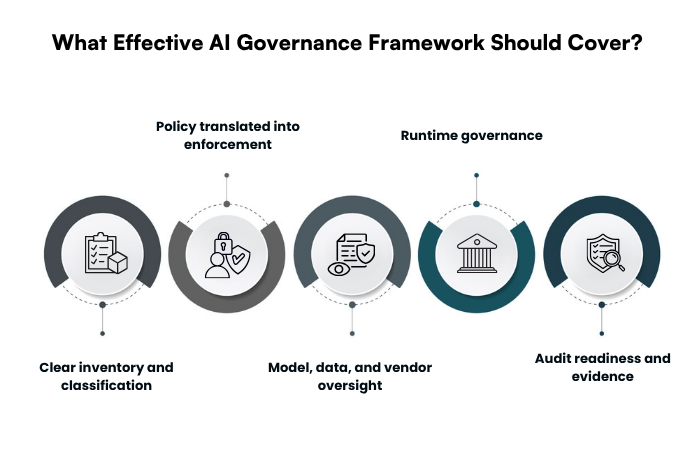
1. Clear inventory and classification
Every AI use case should be visible. That includes employee-built tools, vendor tools, embedded copilots, and agent-led workflows. If the organization does not know where AI is being used, it cannot govern risk.
2. Policy translated into enforcement
A policy on paper is not enough. Governance has to show up in the workflow itself through permissions, approval steps, content filters, logging, and human review where needed.
3. Model, data, and vendor oversight
Enterprises should know where models come from, what data they use, how often they are updated, and whether third-party tools are introducing hidden risk. This matters even more when generative AI solutions development touches regulated data, internal IP, or cross-border systems.
4. Runtime governance
The most important control is often the one that happens after launch. Runtime governance watches what the system is doing in live use including inputs, outputs, tool calls, policy violations, drift, and unexpected behavior.
5. Audit readiness and evidence
Organizations need records that show what was approved, what was tested, what changed, and who signed off. In an AI environment, audit readiness is not a filing exercise. It is a trust mechanism.
NIST’s AI RMF is helpful here because it organizes risk management around govern, map, measure, and manage. ISO/IEC 42001 complements that structure by giving organizations a management-system approach to continual improvement.
The Core Pillars that Make Governance Real
A governance framework becomes useful only when it is tied to day-to-day execution. In practice, five pillars matter most.
Inventory and risk-tier every AI system
Not every AI system carries the same risk. There is a significant distinction between AI that summarizes information and AI that drives customer experiences or operational workflows. Risk-tiering helps organizations focus on controls where they matter most.
Build guardrails before scale
Enterprises often make the mistake of scaling first and governing later. That creates friction, rework, and avoidable exposure. A stronger pattern is to build guardrails into design, testing, and deployment from the start.
Treat security and safety as separate, but connected
AI security and AI safety are not identical. Security protects systems from attack. Safety protects the business from harmful, biased, unstable, or unreliable outputs.
Prepare for multi-agent systems
Multi-agent workflows are changing the governance challenge. When one agent calls another, uses tools, or acts with partial autonomy, oversight becomes more complex. Current market discussion is already shifting toward agent inventories, autonomy levels, and stricter permission models for agentic AI.
Recent reporting on Gartner’s 2026 guidance points to 40% governance failures becoming a reason enterprises reconsider autonomous agents.
Use threat-informed security thinking
MITRE ATLAS (Adversarial Threat Landscape for Artificial Intelligence Systems) is a globally recognized framework that helps enterprises understand and defend against AI-specific security threats. By documenting attack techniques such as prompt injection, data poisoning, and model theft, it supports the development of secure, resilient, and well-governed AI systems.
Why is 2026 a Different Year for AI Governance?
The latest market shift is not just about better models. It is about more autonomous systems, regulatory pressure, and attention to sovereignty and control. In fact, many of the latest AI safety developments in 2026 are focused on improving transparency requirements, strengthening governance for autonomous agents, enhancing model monitoring, and establishing clearer standards for human oversight across enterprise environments.
At MoogleLabs, governance is treated as one of the defining AI shifts because enterprises now expect transparency and accountability from intelligent systems, especially as orchestration, multimodal systems, and sovereign AI become more important.
That is not a theoretical point. It reflects how modern enterprise stacks are evolving multiple models, agents, regions, and compliance boundaries.
Sovereign AI governance deserves special attention here. For global businesses, the issue is no longer just whether a system works. It is whether the system complies with local data residency, hosting, and regulatory expectations across jurisdictions. The EU AI Act and related compliance timelines are making that question more operational, not less.
Where Do Enterprises Usually Struggle?
Most organizations do not fail because they lack interest in governance. They fail because implementation gets complicated. Common issues include:
Fragmented ownership across departments
Shadow AI and unsanctioned tool use
Weak documentation and missing model lineage
Unclear rules for human review
Poor visibility into third-party AI tools
Limited testing for harmful or unreliable outputs
Difficulty keeping pace with changing regulations
This is where a governance framework becomes more than a policy artifact. It becomes a working discipline that connects leadership, security, legal, engineering, and operations.
The challenge becomes even more visible when AI is embedded in real internal workflows. For example, MoogleLabs’ enterprise AI knowledge assistant platform was built to connect with more than 40 internal systems while maintaining secure, self-hosted control. That kind of solution illustrates why governance, data access, and deployment architecture must be designed together rather than treated as separate workstreams.
How Governance Supports Business Growth, Not Just Risk Reduction?
Well-designed governance does more than reduce downside. It helps enterprises move with more confidence.
When controls are clear, teams can deploy faster because they know the approval path.
When monitoring is built in, issues are caught earlier.
When audit trails are complete, leadership can move from reactive caution to a measurable scale.
In that sense, governance becomes a growth enabler.
MoogleLabs’ AI-powered skill evaluation platform, for instance, improved scoring consistency by 85%, made evaluation cycles four times faster, and reduced training costs by 30%. That is a useful reminder that well-governed AI is not only safer, it is often more efficient and commercially credible.
The same pattern applies across other enterprise systems. A governance-first mindset supports cleaner automation, stronger trust, and better long-term adoption. That is why companies opting for artificial intelligence services often need more than model development. They need a framework that can support generative AI development, secure deployment, and ongoing oversight.
A Practical Way Forward
For enterprises planning the next phase of AI adoption, the next move should be straightforward:
Establish a central inventory of AI use cases
Classify systems by business risk and autonomy level
Set human approval rules for high-impact decisions
Add runtime monitoring and incident escalation
Document model changes, data sources, and test results
Align policies with NIST AI RMF, ISO 42001, and the EU AI Act
Build governance around agents, not only around models
That approach is especially important as AI shifts from assistance to action. The firms that will scale well are the ones that treat governance as part of architecture, not as a final review step.
Conclusion
As AI becomes more embedded across enterprise operations, governance is no longer a supporting function - it is the foundation that determines whether AI initiatives create sustainable value or introduce unmanaged risk. Organizations that establish governance early are better positioned to accelerate adoption, strengthen compliance, improve enterprise AI security, and unlock greater returns from their AI investments.
At MoogleLabs, we help organizations move beyond experimentation by designing secure, scalable AI ecosystems backed by practical governance frameworks, responsible AI practices, and enterprise-ready deployment models.
Ready to establish a governance framework that supports both innovation and control? Speak with the AI experts at MoogleLabs and start building a more resilient AI future.
Loading FAQs
Please wait while we fetch the questions...