AI Cybersecurity Integration: Transforming Enterprise Security with Intelligent Threat Detection
AI-powered cybersecurity enables real-time threat detection, automated response, and proactive risk management. Learn how intelligent security systems strengthen enterprise defenses against evolving cyber threats while improving resilience and operational efficiency.
Enterprise networks generate petabytes of raw telemetry every day. This scale poses a significant problem for traditional, rule-based SIEM designs, as they are unable to catch up with the "multi-stage" attacks that are characteristic of this form of operation. To protect existing cloud-native environments, integrating Deep AI cybersecurity needs to be at the heart of the data input pipeline.
Deploying effective artificial intelligence solutions requires moving past the concept phase. Engineering teams must understand the underlying algorithmic frameworks, data pipelines, and continuous validation workflows necessary to sustain an intelligent, resilient defensive posture.
Hybrid Inference Integration Layout
Instead of replacing established enterprise security platforms, custom AI ML solutions function as an intelligent analytics layer connected directly to existing data repositories. This hybrid design ensures fast deployment without requiring changes to underlying data pipelines or introducing operational latency.
The Ingestion Layer
The custom detection engine seamlessly integrates with your central security repository (like Snowflake, Databricks, or a cloud-native SIEM) via fast APIs, collecting telemetry from three main planes:
The Network Plane: Capturing raw packet data (PCAP), NetFlow records, IPFIX logs, and core DNS query streams.
The Cloud Infrastructure Plane: Ingesting AWS CloudTrail records, GCP audit logs, Azure Activity logs, and cross-cluster VPC flow measurements
Endpoint Plane: Extract Endpoint Detection and Response (EDR) agent data like kernel process trees and memory changes.
The use of artificial intelligence solutions in cybersecurity has given businesses a gateway to better protection from the ever-evolving cyber threats.
Feature Engineering & Deep Vector Embeddings
Before running machine learning models, the specialized feature engineeringengineering pipeline created during AI/ML development converts raw, unstructured JSON logs into multi-dimensional numerical matrices.
Advanced deep neural networks translate continuous event streams such as access schedules, API call paths, and network targets into dense vector embeddings. By evaluating spatial distances rather than searching for exact rule matches, the system surfaces structural variations in behavior. Normal routines cluster tightly, while rogue operations project as clear spatial outliers.
Real-Time Behavioral Detection Engine
The core analytical engine runs unsupervised machine learning models to identify zero-day threats without relying on pre-existing attack definitions or static indicators of compromise (IOCs):
Autoencoders (Deep Neural Networks): Trained on clean historical telemetry, these models compress and reconstruct event vectors. Anomalous attack paths deviate from the training baseline, leading to high reconstruction error and triggering an immediate alert.
Isolation Forests: This algorithm isolates anomalies by executing random partitions across feature value ranges. Because malicious anomalies occur infrequently and possess distinct attributes, they require far fewer random splits to isolate than does repeating background noise, thereby enabling instantaneous outlier identification.
Dynamic Risk Scoring Matrix
To eliminate alert fatigue, flagged anomalies undergo a real-time risk evaluation calculation: asset criticality rating, anomaly deviation metric, and threat intelligence weight. The architecture evaluates static resource importance alongside the magnitude of behavioral deviation and active global threat feeds, ensuring analysts triage true threats first.
Automated SOAR Remediation
Once the dynamic score exceeds a technical threshold, the AI safety and AI security architecture will push an encrypted alert payload to a SOAR platform through secure webhooks. The system performs targeted containment playbooks within milliseconds, like isolating an individual container pod or revoking a compromised JWT session, which prevents data exfiltration without bringing the network down.
Technical Comparison: Traditional vs. Machine Learning Defense
Architectural Vector | Signature-Based Perimeter Defense | Integrated AI Production Systems |
|---|---|---|
Detection Method | Exact string or hash matching against known Indicator of Compromise (IOC) databases. | Multi-dimensional vector space anomaly detection based on operational telemetry. |
Data Processing Capacity | Inefficient under heavy loads; high log volumes create storage bottlenecks and ingestion delays. | Scalable distributed parsing; handles massive parallel data processing across multi-cloud environments. |
Response Trigger | Delayed manual verification; requires analysts to triage alerts and write scripts. | Programmatic SOAR integration; executes automated containment playbooks within milliseconds. |
Handling of Unknown Threats | Incapable; zero-day exploits completely bypass signature filters until patches release. | Highly effective; captures architectural anomalies and zero-day deviations automatically. |
The Core Lifecycle: Continuous Validation and Model Testing
Deploying an AI ML company framework into corporate production is only 20% of the operational challenge. The true engineering hurdle lies in maintaining model reliability over time. Because corporate network landscapes constantly shift, automated defenses face severe degradation if left unmonitored. This operational reality makes AI testing services critical to long-term data security.
Data Drift and Concept Drift Calibration
Defensive software models degrade due to two primary shifts:
Data Drift: Happens when the produced data alters its structure. For example, migrating business infrastructure from on-premises servers to microservice containers changes the type and source distribution of incoming event logs.
Concept Drift: Changes in the meaning of data in the actual world. Say engineering teams deploy a new internal data sync tool. The resulting increase in internal data transfers might appear to be a data exfiltration attack, triggering a storm of false positives.
To prevent alert fatigue and maintain system accuracy, engineering teams must deploy rigorous AI/ML testing services. These validation frameworks continually run statistical tests to compare live production data streams against initial training baselines, automatically flagging model drift. Learn more about how to test AI models and the validation strategies that help maintain accuracy throughout the AI lifecycle.
Defending Against Adversarial AI
Modern attackers are aggressively using machine learning to uncover flaws in current business security strategies. They use specific methods to get over automatic defenses:
Adversarial Poisoning: Attackers subtly insert harmful data modifications into public threat intelligence feeds or target open network segments, gradually corrupting a model's training data until it labels hostile behavior as safe.
Evasion Maneuvers: Bad actors will make small, deliberate changes to malware binaries. The adjustments keep the main payload functionality intact, but just enough shuffling of its vector-embedding pattern to slide under anomaly-detection criteria.
To have a robust security posture, you need to establish continuous validation pipelines powered by specialist AI testing services. They execute automated red-team simulations, feeding adversarial data inputs and synthetic malware variants into production models to stress-test detection levels and verify defenses hold up.
Architectural Considerations for AI Security Deployment
Deploying intelligent analytics layers across complex enterprise networks requires balancing model performance with system constraints. Engineering teams must design for several core operational realities:
Data Preservation and Masking Pipelines
Training deep learning models requires large amounts of historical telemetry. To maintain strict data privacy compliance under frameworks like GDPR, systems must deploy automated data scrubbing pipelines at the ingestion layer. These pipelines use cryptographic hashing to mask sensitive identifiers, such as user names and specific asset fields, before data enters the training repository.
Model Explainability Integration
Complex deep learning frameworks often function as black boxes, calculating risk scores without tracing why an anomaly was triggered. To provide actionable data for compliance audits and security teams, architectures must integrate interpretability layers, such as SHAP or LIME. This layer breaks down the final reconstruction error into distinct, weighted values, showing analysts the exact inputs that drove the alert.
Adversarial Defensive Engineering
Mitigating the risk of evasion maneuvers requires implementing continuous validation pipelines driven by specialized AI testing services. These platforms run automated red-team simulations, injecting synthetic adversarial data inputs into the models to stress-test detection boundaries and ensure defenses remain stable under active attack.
Resource and Compute Optimization
Processing high-throughput vector embeddings in real time creates significant compute requirements. To balance hardware costs with low inference latency, systems utilize a two-tier architectural strategy. Isolation Forests run as a fast primary filter to quickly remove obvious data background noise, while resource-heavy Autoencoders process only the remaining complex event sequences.
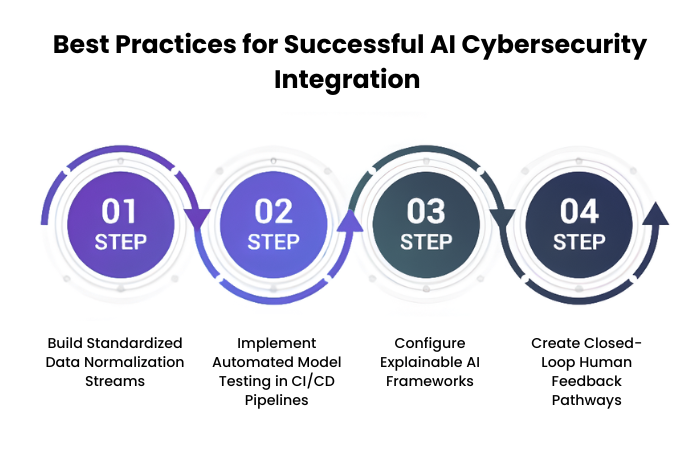
Best Practices for Successful AI Cybersecurity Integration
Successfully deploying AI ML solutions into a large-scale corporate environment requires a practical, code-first engineering roadmap:
Phase 1: Build Standardized Data Normalization Streams
Ensure all incoming log streams flow through an optimized processing tool before reaching storage blocks. Normalizing timestamps, IP addresses, and event names at the ingestion layer prevents bad or missing data from degrading the accuracy of downstream machine learning models.
Phase 2: Implement Automated Model Testing in CI/CD Pipelines
Treat machine learning models like core software code. Integrate comprehensive AI ML testing services directly into the continuous integration and deployment pipeline. Every new or updated model must pass automated regression checks, false-positive tests, and adversarial threat simulations before deploying to the live production network.
Phase 3: Configure Explainable AI Frameworks
Avoid using opaque algorithms for high-impact security choices. Integrate model explanation tools (such as LIME or SHAP) into the detection core. When the system flags an internal anomaly, it should show analysts explicit metrics detailing which features triggered the alert, allowing human teams to verify and act on the data quickly.
Phase 4: Create Closed-Loop Human Feedback Pathways
Design easy-to-use feedback channels within the analyst dashboard so teams can quickly mark alerts as verified threats or false positives. The platform should capture these human updates and pipe them back into the data repository, ensuring the system continually improves its detection accuracy based on real-world incident reviews.
Future Trends in AI Cybersecurity
Enterprise security architecture is moving rapidly toward fully autonomous, predictive data defense models. Many of these innovations are part of broader AI trends that are shaping the future of enterprise technology across industries.
Autonomous Security Agents
Future networks will rely on independent software agents that collaborate to manage security incidents. These systems will analyze alerts, trace root attack paths across multi-cloud environments, and change system setups without human intervention.
Predictive Cyber Defense Operations
Systems will shift from reacting to active attacks toward forecasting potential vulnerabilities. These networks will scan internal code updates, infrastructure configurations, and global threat intelligence to find and patch potential entry points before attackers can target them.
Dynamic Zero-Trust Infrastructures
Access permissions will continuously adjust based on real-time behavioral analytics. Instead of granting wide access after initial login, the network will reassess user trust scores with every action, minimizing data exposure risks.
Maintaining a secure, scalable network requires combining expert AI development services with continuous model validation to keep enterprise defenses fast, adaptive, and highly resilient.
Concluding Thoughts
The inclusion of intelligent technologies into corporate defensive systems is a necessary development in company security. Automated threat detection, behavioral analysis, and quick incident response playbooks help safeguard companies' digital perimeters from the increasingly automated current attacks.
To maximize these benefits, you need to balance automation with human skill. Enterprises need to implement organized deployment strategies, institute robust data governance, and conduct ongoing validation processes via specialist AI testing services. To create a robust digital organization, you need to blend scalable, intelligent automation with strategic oversight from seasoned security pros.
Loading FAQs
Please wait while we fetch the questions...