Deep Learning Services in Fraud Detection: A Practical Guide for Business Leaders

Learn how deep learning services for fraud detection enable smarter risk analysis, real-time monitoring, and protection against evolving fraud threats.
Fraud detection is one of those problems that looks simple on the surface and turns messy the moment you try to solve it at scale. A transaction either looks suspicious or it doesn’t. Until it does, and suddenly thousands of legitimate customers are blocked while actual fraud slips through quietly in the background.
This is exactly why many businesses are rethinking how their fraud detection systems are built. Deep learning solutions did not replace traditional fraud tools overnight. It earned its place because older approaches stopped working reliably once fraud became more coordinated, faster, and harder to predict.
If you are evaluating deep learning services for AI tools that can detect fraud, the important question is not whether the technology works. It does. The real question is how it fits into your business, your data, and your risk tolerance.
Where Deep Learning Actually Helps in Fraud Detection
Deep learning services are often described as “advanced machine learning services,” but that description misses the point. The real difference is not complexity. It is how the system learns.
Traditional models need features defined upfront. Deep learning models take a different route. They learn patterns directly from data, including interactions and behaviors that are difficult to describe in rules or equations.
In fraud detection, this matters because fraud is rarely obvious in isolation. One transaction may look fine. Ten transactions over three days might not be. Sudden shifts can mean fraud or that the customer is traveling. Deep learning models are better at separating those signals because they can learn from context and not just the thresholds.
Why Rule Engines and Classic Models Start Breaking Down
Most fraud systems still rely on a layered setup: rules first, models second, humans last. This works until it doesn’t.
Rules are predictable. Fraudsters learn them quickly. Every new workaround adds another rule, and over time the system becomes noisy and brittle. Teams spend more time maintaining rules than improving outcomes.
Classic machine learning solutions, like logistic regression, do better but still struggle with evolving behavior. They assume patterns stay relatively stable. Fraud does not behave that way.
Manual reviews fill the gap, but they introduce cost, delays, and inconsistency. At scale, they also become bottlenecks that limit growth.
Deep learning does not remove these components entirely, but it reduces how much you need to rely on them.
In financial security and fraud prevention, organizations face a continuous arms race against increasingly sophisticated fraudsters. This means that systems must constantly adapt to new attack patterns, learning from each interaction, and then act based on these learnings.
What are the Core Components of Modern Fraud Detection System & What They Needs to Do
Regardless of industry, fraud detection systems are judged on three things:
Can they spot suspicious activity quickly?
Can they tell real fraud from false alarms?
Can they act without disrupting legitimate customers?
Deep learning improves all three, but only when it is implemented as part of a broader system. Treating it as a standalone model is one of the most common mistakes businesses make.
However, current traditional systems struggle to manage this integrated challenge effectively, as:
Rule-based systems are too rigid and inflexible for the dynamic, evolving tactics employed by modern fraudsters.
Traditional machine learning development methods like logistic regression excel at structured data but lack the ability to capture complex, high-dimensional patterns in unstructured data.
Manual review systems are designed for a singular purpose: human investigation, and nothing more.
Attempting to rely solely on these approaches leads to significant operational challenges, including high false positive rates, missed fraud cases, and substantial manual review overhead.
How Deep Learning Is Used in Real Fraud Pipelines
In production systems, deep learning is rarely a single model making a final decision. It is usually a set of models working together, each responsible for a different view of risk.
Some models focus on behavior over time. Others focus on deviations from normal patterns. Some look at relationships between users and accounts. The final decision often combines these signals.
This layered approach helps deep learning systems scale without flooding fraud teams with false positives.
Fraud detection models typically follow a practical flow designed to balance accuracy and efficiency:
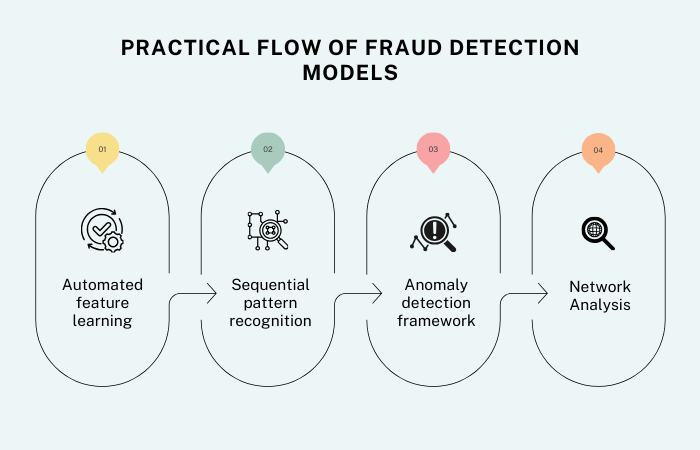
Automated feature learning
Deep neural networks learn useful features directly from raw data, reducing the need for hand-built rules and surfacing subtle signals that are easy to miss at scale.
Sequential pattern recognition
Models such as LSTMs and RNNs analyze transaction histories over time, making it possible to spot behavior that gradually shifts toward fraud across very large volumes of activity.
Anomaly detection framework
Autoencoders and other unsupervised approaches establish a baseline of normal behavior and flag meaningful deviations, allowing systems to scale while keeping noise under control.
Network Analysis:
Graph Neural Networks map relationships between accounts and transactions, effectively reducing fraud rings that operate across multiple entities.
Businesses can find the top tools of artificial intelligence to assist with fraud detection and prevention or invest in creating a new one through AI development services, that meets your bespoke demands.
The Deep Learning Ecosystem in Action
Deep learning services for fraud detection consists of a growing ecosystem of architectures tailored for different fraud scenarios:
Convolutional Neural Networks (CNNs)
Commonly used surface patterns directly from raw transaction fields or claim images, especially when manual feature engineering starts to hit its limits.
Recurrent Neural Networks (RNNs / LSTMs)
Well suited for tracking how behavior changes over time, making them useful for spotting accounts that slowly drift from normal activity into fraud.
Autoencoders
Often used when labels are sparse. They learn what typical behavior looks like and flag transactions that stand out rather than trying to predict fraud directly.
Graph Neural Networks (GNNs)
Built for problems where relationships matter. They help expose fraud rings by looking at how accounts, devices, and transactions connect to one another.
Transformers
Wondering what are transformers in machine learning? They are tools that take input and compute it to provide an output. In fraud detection space, they are being increasingly adopted for assessing long transaction histories, where attention mechanisms make it easier to focus on the few events that actually drive risk.
Generative Adversarial Networks (GANs)
Used selectively to generate realistic fraud scenarios, mainly to reduce class imbalance and stress-test detection models.
In practice, these models are combined across the pipeline, supporting everything from early anomaly detection to real-time decisioning.
Deep Learning in Fraud Detection: Benefits for Financial Security and Business Operations
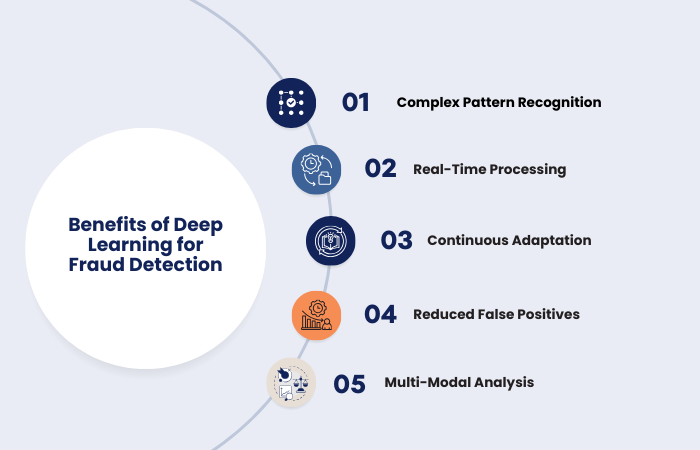
Benefits of deep learning services in fraud detection solutions:
Complex Pattern Recognition: Detects sophisticated fraud schemes that span multiple transactions, accounts, or time periods with high accuracy.
Real-Time Processing: Analyzes transactions in milliseconds, enabling instant blocking of fraudulent activities before damage occurs.
Continuous Adaptation: Learns from new fraud patterns automatically, staying ahead of evolving tactics through regular retraining.
Reduced False Positives: Achieves higher precision in fraud detection, minimizing legitimate transactions incorrectly flagged as fraud.
Multi-Modal Analysis: Processes diverse data types including transaction records, images, text, and network relationships simultaneously.
What This Means for Business Outcomes
From a business standpoint, deep learning fraud detection is less about technical sophistication and more about operational impact.
When done right, it reduces false positives, lowers manual review costs, and improves customer experience. It also makes fraud prevention more adaptable, which matters as transaction volumes grow and fraud tactics change.
One thing to be clear about: deep learning is not a silver bullet. It still requires data quality, monitoring, and retraining. But it shifts the effort from constant rule tuning to systematic improvement.
Implementation Realities Business Leaders Should Know
Deep learning projects fail when expectations are unrealistic. Models do not fix broken data pipelines. They do not compensate for unclear ownership or poor governance.
Successful implementations usually start small. A single fraud use case. A limited data scope. Clear success metrics. From there, systems expand gradually.
This is where working with an experienced deep learning service provider matters. The value is not just in model building, but in understanding how models behave once they are exposed to real traffic.
Why Deep Learning Changes the Long-Term Economics of Fraud Prevention?
Traditional fraud systems scale linearly with volume. More transactions mean more rules, more reviews, more cost.
Deep learning systems scale differently. As more data flows in, models generally improve rather than degrade. This does not eliminate cost, but it changes how cost grows over time.
For organizations planning long-term growth, this difference is hard to ignore.
The Future with Deep Learning
Deep learning's core capabilities, like automatic feature learning, sequential modeling, and network analysis, offer a powerful framework for next-generation fraud detection.
This flexible and adaptive foundation not only addresses current fraud challenges but also equips financial institutions to combat emerging threats in cryptocurrency fraud, deepfake identity theft, and AI-powered attack schemes.
Final Perspective
Deep learning services have earned its role in modern fraud detection not because it is complex, but because it reflects how fraud actually happens. Gradually, contextually, and often in coordination.
For businesses evaluating deep learning solutions, the goal should not be to replace everything at once. It should be to build smarter layers that reduce noise, improve accuracy, and grow with the organization.
When approached thoughtfully, and with the assistance of AI & ML Development Services USA, deep learning turns fraud detection from a reactive cost center into a more predictable, scalable capability.
Loading FAQs
Please wait while we fetch the questions...