AI Inference Infrastructure: The New Bottleneck in Enterprise AI
Enterprise AI success depends on efficient inference, not just powerful models. Learn how AI inference infrastructure, optimized runtimes, autoscaling, and modern deployment architectures reduce latency, control costs, and enable scalable AI applications.
Enterprise technology teams face a sharp operational transition when moving model workloads from evaluation environments into high-concurrency production systems. While model training commands the majority of industry headlines, practical deployment reveals that 80% to 90% of total lifetime compute budgets support daily execution.
When thousands of concurrent API calls reach fine-tuned 70 billion-plus parameter models, default cloud settings fail due to latency spikes and soaring hardware expenses. To address this operational limitation, a dedicated AI inference infrastructure must be designed specifically for low latency token distribution, high memory density, and cost-effective autoscaling.
Defining Enterprise AI Inference Infrastructure
Enterprise AI inference infrastructure represents the integrated ecosystem of hardware compute engines, model execution software, orchestration layers, and network routing mechanisms engineered to execute pre-trained machine learning algorithms under real-time production requirements.
Unlike training environments which prioritize raw mathematical throughput across massive batch sizes over days or weeks, inference platforms must process small, unpredictable batches of incoming requests with strict latency constraints. The complete operational stack comprises four distinct tiers:
Hardware Compute Tier: Specialized silicon including graphics processing units (GPUs), tensor processing units (TPUs), and application-specific integrated circuits (ASICs) optimized for low-precision linear algebra.
Execution & Runtime Tier: Inference engines and runtimes (such as TensorRT, ONNX Runtime, and vLLM) that compile model graphs, optimize execution paths, and implement memory management techniques like paged attention.
Orchestration & DevOps Tier: Platforms for container orchestration that make use of Kubernetes, automatic scaling rules, and unique service meshes overseen by specialist cloud DevOps services.
Observability & Guardrail Tier: Continuous monitoring platforms tracking latency percentiles (P95/P99), hardware saturation metrics, output accuracy, and operational risk factors as discussed in recent analysis on AI cybersecurity integration.
Building this stack requires deep expertise in modern artificial intelligence solutions, aligning computational architecture directly with long-term business objectives.
Root Causes of the Production Inference Bottleneck
Why does inference become a critical operational bottleneck as enterprise applications scale? The root causes stem from fundamental mismatches between traditional software infrastructure and the physical computational requirements of modern deep learning models.
High Hardware Acquisition and Operational Expenses
Enterprise-grade accelerator hardware remains capital intensive. Enterprise server nodes equipped with top-tier AI accelerators frequently exceed tens of thousands of dollars per unit, accompanied by significant electrical overhead. Data center electricity demands for running large language models full-time can account for significant operational costs. Misconfigured hosting environments lead to low hardware utilization rates, causing organizations to waste significant capital on idle compute nodes.
Exponential Growth in Model Parameter Sizes
Model architectures have expanded dramatically. Modern generative models contain tens or hundreds of billions of parameters. Loading a 70-billion-parameter model in 16-bit floating-point precision requires over 140 gigabytes of dedicated high-bandwidth memory (HBM) just to store model weights, before allocating memory for context windows or dynamic KV-caches. This memory capacity wall restricts how many parallel user sessions a single accelerator node can serve simultaneously.
Strict Real-Time Latency Requirements
Interactive software applications require rapid responses. Consumer-facing search tools, financial fraud detection systems, and autonomous customer service platforms demand sub-second query fulfillment. Training tolerates occasional delays or re-runs; live inference failures directly impair core business operations and customer satisfaction.
Scaling Autonomy and Workload Spikes
As enterprises adopt autonomous task workflows, a trend outlined in detailed research on agentic AI use cases, the total volume of model calls per single user request increases exponentially. Autonomous agents perform multi-step planning, reflection loops, and tool execution, generating dozens of internal inference requests per user query. This compound query model introduces unpredictable traffic bursts that swamp legacy infrastructure.
Architectural Differences: Training Infrastructure vs. Inference Infrastructure
Optimizing infrastructure requires distinguishing the unique operational profiles of model training versus production inference. Designing hardware clusters around training assumptions inevitably leads to inefficient, overly expensive inference deployments.
Operational Metric | AI Training Infrastructure | AI Inference Infrastructure |
|---|---|---|
Primary Goal | Minimize overall model convergence time | Maximize throughput with sub-second SLA latency |
Data Batch Sizes | Large fixed batches (e.g., 512–4,096 samples) | Small dynamic batches (e.g., 1–32 samples) or streaming tokens |
Precision Requirement | FP32 / BF16 (High numerical stability | INT8 / FP8 / INT4 (Optimized speed and memory efficiency) |
Memory Bottleneck | Compute-bound (FLOPS saturation) | Memory-bandwidth bound (HBM transfer speeds) |
Resource Utilization | Predictable, sustained 90%+ utilization | Fluctuating load following end-user traffic patterns |
Scale Direction | Scale-up/Scale-out across massive dedicated clusters | Elastic horizontal scale-out across multi-region nodes |
Enterprise teams partnering with structured AI development services build dedicated AI inference infrastructure around these specific operational profiles, avoiding the high cost of running live workloads on unoptimized training clusters.
Core Optimization Strategies for High-Throughput Inference
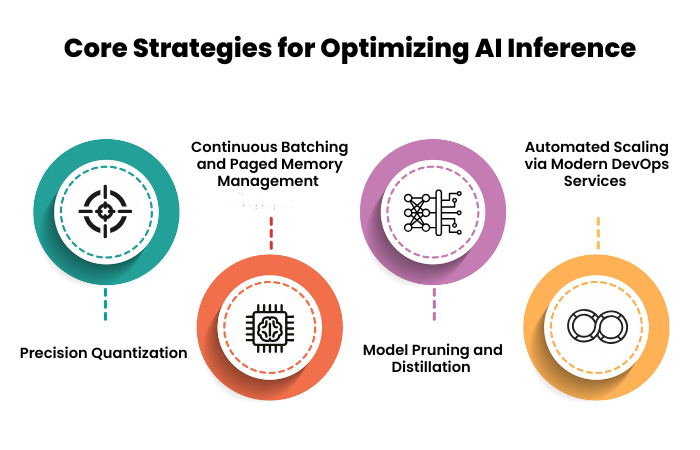
Targeted optimization approaches across software and hardware layers are employed by engineering teams to eliminate the inference bottleneck while keeping capital expenditure from rising.
Precision Quantization
Quantization is the process of converting high precision floating point weight values (e.g. FP16) to lower precision (e.g. INT8 or FP8). A 16-bit model becomes 8-bit, halving the memory footprint and doubling memory bandwidth performance on compatible accelerator cores, with typically less than 0.5% decrease in output accuracy.
Continuous Batching and Paged Memory Management
In the traditional static batching, the execution engine needs to wait until a batch of requests are completed before taking new inputs, causing significant GPU idle time. Modern runtimes with continuous batching inject new incoming queries into the execution queue at the token-level stages. Combined with virtual memory allocation algorithms that handle dynamic key-value caches without memory fragmentation, organizations report 2.5x to 4x gains in overall token throughput per accelerator node.
Model Pruning and Distillation
Structural trimming eliminates parameter routes that are duplicated and contribute little to the final predictions of the model. Knowledge distillation trains a tiny student model to mimic the output distributions of a large instructor model. Replacing a 70-billion parameter teacher with a distilled 7-billion parameter student significantly cuts inference compute costs while keeping a very high task-specific accuracy.
Automated Scaling via Modern DevOps Services
Traffic patterns change dramatically during the day. Automated pod autoscaling using specific hardware measurements allows for dynamic scaling up of resources during peak hours and scaling down during off-peak hours. Enterprise IT companies need full DevOps services to build robust automated deployment pipelines, immutable container images, and canary deployment methodologies for zero-downtime model upgrades.
Infrastructure Deployment Architectures: Cloud, Edge, and Hybrid
Choosing the right hosting topology directly shapes operational costs, data sovereignty, and end-user latency profiles.
Cloud-Native Hosted Inference
Hyperscale cloud platforms provide instant access to high-performance hardware clusters and managed endpoint services. Cloud deployments offer elasticity, enabling organizations to launch dynamic instances during peak traffic. Yet, continuous base-load running on cloud GPUs can become cost-prohibitive without reserved instance pricing or proactive instance management.
Edge and On-Premise Inference
Inference models are run directly on local edge hardware or on-premise private data centers to avoid the latency of external cloud networks and to meet strong data privacy requirements. However, edge deployment is still important for industrial automation, remote medical devices, and real-time smart surveillance systems where internet access might be inconsistent.
Hybrid Cloud Infrastructure
This hybrid AI inference infrastructure design provides reliable base-load execution on private cost-efficient servers, and automatically bursts into public cloud settings during unexpected traffic surges. Seamless hybrid orchestration demands standardized cloud orchestration, durable continuous integration pipelines, and advanced enterprise cloud DevOps services.
Such a hybrid stance is consistent with long-term technical planning, as discussed in strategic analysis on the generative AI roadmap 2026, where flexible infrastructure underpins sustained innovation.
Specialized Hardware Architecture and Future Inference Trends
Hardware for current AI inference infrastructure is shifting away from traditional GPU dominance. Silicon vendors are introducing specific microarchitectures for low-wattage, high-throughput inference applications.
Dedicated Neural Processing Units (NPUs): Custom silicon developed to run low-latency applications in laptops, cellphones, and edge devices without relying on cloud bandwidth.
High-Bandwidth Memory Integrations: The memory bandwidth limitation in processing enormous transformer contexts is immediately addressed by next-generation hardware with HBM3e memory chips, which enable transfer speeds of more than 1.2 terabytes per second.
Serverless AI Inference: On-demand cloud execution architectures where computational resources shrink to absolute zero when no queries come in, enabling enterprises to pay simply per created token or inference call.
Agentic Operations Integration: Integrating intelligent operational frameworks, such as the approaches described in AgenticOps, allows autonomous systems to monitor the health of the infrastructure, divert requests depending on the availability of regional GPU resources, and dynamically optimize cloud expenditure in real time.
Assessing these developing hardware possibilities is important to understand wider technology advancements outlined in AI trends, which may help firms create robust infrastructures to support next-generation models.
Building a Scalable AI Strategy for Enterprise Growth
To address the inference bottleneck, a well-balanced solution that includes software optimization, rigorous infrastructure management, and focused domain implementation is required. Organizations cannot overcome efficiency concerns only by increasing raw computing capacity; long-term scaling necessitates structural optimization at all layers of the operational technology stack.
Enterprise teams convert their AI inference infrastructure into a lean, robust production asset by collaborating with specialized teams to deliver tailored AI solutions. Using contemporary runtime optimizations, automated container orchestration, and multi-tier hosting solutions, enterprises may grow application capabilities while maintaining total budgetary control over their cloud infrastructure budgets.
Loading FAQs
Please wait while we fetch the questions...