Snowflake Data Engineering: Building Production Pipelines That Last
Build resilient Snowflake data pipelines with declarative transformations, automated freshness, open storage, DataOps, governance, and cost controls designed to support scalable analytics and AI workloads.
Enterprise leaders know the midnight alert that ruins weekends: broken data pipelines, silent table corruptions, and blank executive dashboards. These failures happen when squads connect brittle scripts and manual change-data-capture steps instead of treating data systems as managed software products.
Snowflake data engineering transforms these fragile setups into automated, production-grade pipelines. Moving beyond legacy storage, the platform provides declarative tools that eliminate orchestration debt, enforce cost guardrails, and secure data freshness.
Building durable pipelines requires architectural discipline from day one. You must replace imperative glue code with governed, scalable patterns that protect downstream reporting and support business growth without unexpected compute costs.
Layering the Modern Data Estate for Resilience
Production longevity begins with clear physical and logical boundaries. When pipelines collapse, it usually happens because extraction, business cleaning, and reporting logic were dumped into a single stored procedure. A durable approach to Snowflake data engineering separates concerns across three distinct platform zones:
The Ingestion Zone: Functions as an append-only historical record. Raw records land from external sources without transformations, preserving original JSON payloads, Parquet files, or transactional dumps. Schema evolution handles changing payload structures automatically, preventing landing tables from breaking when upstream development squads add new properties.
The Curation Zone: Contains core business rules and structural relationships. Here, engineers clean records, match composite keys, standardize timestamps, and validate referential integrity. Downstream dependencies query only this verified zone, never the raw landing layer.
The Consumption Zone: Represents production-ready data marts. Tables in this layer use dedicated clustering keys, optimized column projections, and strictly controlled access views. Structuring the platform this way protects downstream dashboards and customer applications whenever upstream extraction logic needs adjustments.
Modern enterprise requirements demand that these curated layers integrate with downstream analytics platforms, including the top AI tools for data analysis used by analytical squads. When the data layer remains consistent and structured, teams deploy predictive intelligence across departments without operational friction.
Ingestion Strategy: Batch Schedules vs. Continuous Streaming
Selecting how records enter the warehouse dictates platform stability, downstream latency, and ongoing cloud expenditure. Historically, teams scheduled batch cron jobs hourly or nightly. Today, the choice balances traditional file batching against direct row-level streaming within your data engineering solutions. Snowpipe provides managed, serverless file loading driven by cloud storage notifications.
When source applications drop micro-batches into Amazon S3 or Google Cloud Storage, event notifications trigger Snowpipe to automatically load records into landing tables. The compute footprint runs completely separate from your analytical virtual warehouses, keeping user query speeds steady during heavy data ingestion windows. Snowpipe streaming bypasses intermediate cloud storage staging files entirely.
By embedding the Snowflake Ingest SDK into event streams like Apache Kafka or AWS Kinesis, records stream directly into table partitions with sub-second latency. This architecture removes the operational burden of temporary object buckets and eliminates the per-file overhead of traditional micro-batching. Evaluating ingestion patterns requires balancing freshness against compute budgets:
File-Based Loading (Snowpipe): Best suited for application log archives, third-party vendor batch dumps, and transactional database bulk snapshots where five-minute latency is acceptable.
Row-Level Streaming (Snowpipe Streaming): Ideal for real-time security telemetry, clickstream user tracking, and financial fraud detection systems requiring immediate availability.
Establishing the right ingestion pattern prevents downstream bottlenecks and keeps compute utilization predictable across all data engineering services.
Pipeline Transformations: Moving from Fragile DAGs to Dynamic Tables
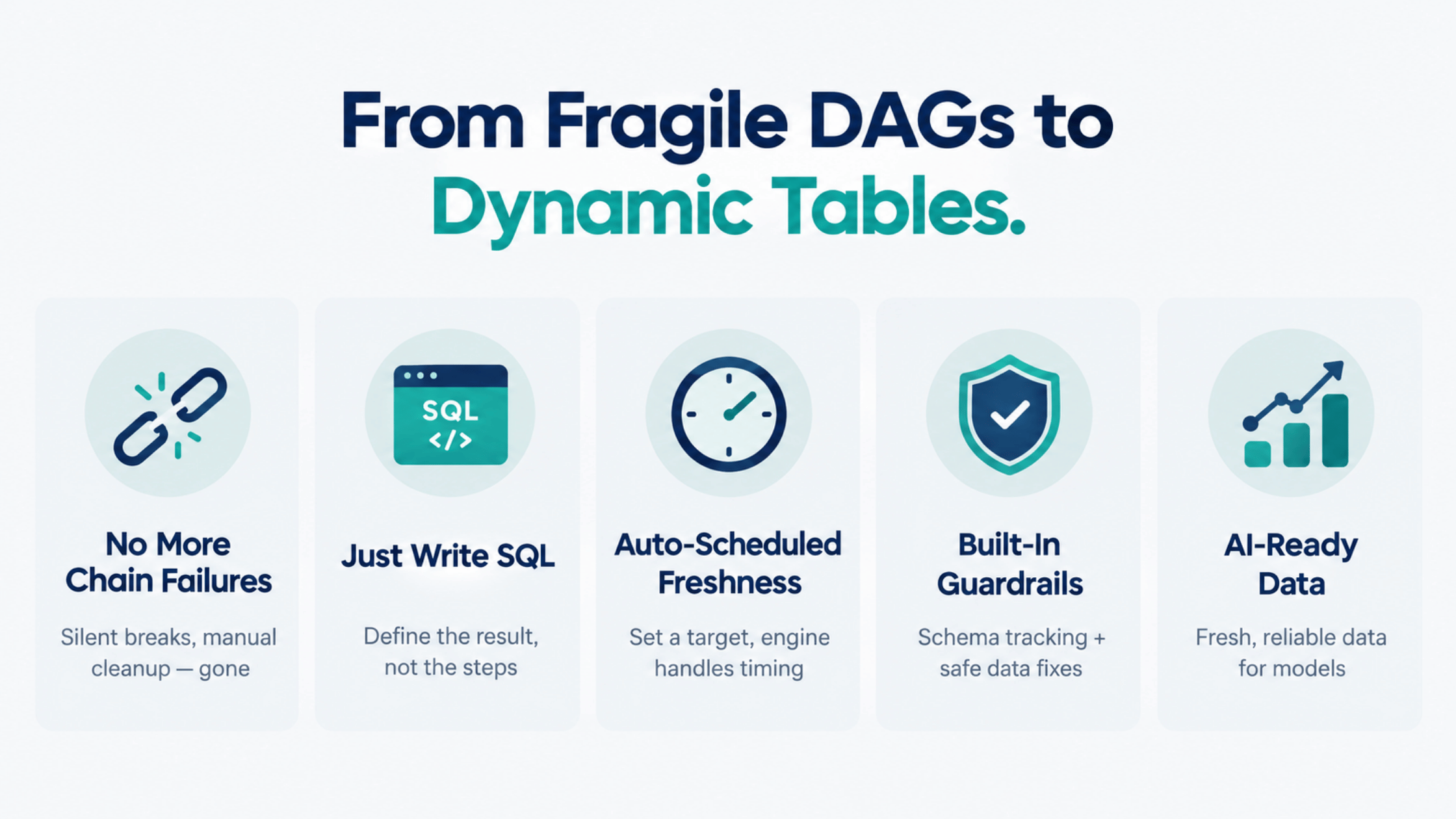
Building production transformations across Snowflake environments previously demanded an enormous amount of operational overhead:
Eliminating Chained Job Failures
Traditional setups required stitching together external orchestrators, native streams, and scheduled tasks. When an upstream step stalled, downstream tables failed silently, leaving teams with broken transactional logs and hours of manual cleanup.
Declarative State Over Procedural Execution
Dynamic Tables replace fragile procedural code by allowing engineers to define the target state using standard SQL queries. The internal execution engine calculates lineage graphs and executes incremental merges without manual merge scripts.
Automated Scheduling via Target Lag
Specifying a simple latency target sets the operational freshness threshold for each table. The platform continuously tracks dependency trees and determines the optimal refresh schedule to meet that service-level agreement.
Built-in Schema and Correction Controls
Recent engine updates allow complex joins across dynamic inputs, automated schema tracking, and direct data adjustments within frozen partitions for regulatory fixes.
Operational Readiness for Advanced Consumers
Declarative transformations deliver dependable feature consistency for downstream applications. High-quality structured tables provide the continuous context necessary for AI context engineering, supplying reliable inputs to internal models without manual data extraction overhead.
Declarative transformations elevate Snowflake data engineering by automating DAG scheduling and dependency resolution.
Storage Modernization with Apache Iceberg
Enterprise platform leaders actively work to eliminate storage lock-in. A durable data architecture should never trap proprietary data assets inside a single vendor's closed formats, creating massive egress expenses if operational requirements shift down the line.
Dynamic Iceberg Tables let organizations maintain data lakes stored as Apache Iceberg Parquet files inside client-owned cloud storage buckets. Snowflake acts as an open catalog and high-speed compute engine while the storage stays completely within your private cloud tenant. This decoupling provides immense architectural freedom:
Cross-Engine Interoperability: External compute systems can query the underlying Parquet files directly without running extraction scripts or moving data across networks.
Zero Storage Duplication: Analytics teams read identical data stores simultaneously without creating divergent copies that inflate cloud hosting bills.
Open Metadata Standards: Table snapshots, schema evolution history, and partition specs follow open-source specifications rather than proprietary rules.
Centralized Data Security: Access permissions configured at the catalog level persist across diverse computing frameworks accessing the storage pool.
This open foundation is especially valuable for organizations investing in external analytics and modeling engines. Training frameworks often require high-throughput file access directly from object storage. By standardizing on Apache Iceberg, teams curate reliable data pipelines inside Snowflake while external GPU compute clusters read the underlying Parquet files concurrently.
Integrating DataOps with Cloud DevOps Services
Building pipelines that survive team growth requires treating database components as software assets. Storing configuration details in isolated web consoles leads to configuration drift across environments and makes disaster recovery impossible. Managing virtual warehouses, user roles, database stages, and table access policies inside version-controlled repositories establishes repeatable infrastructure.
Working with an experienced DevOps service provider helps organizations implement infrastructure-as-code patterns across their data platforms. By codifying every infrastructure layer, teams verify changes in isolated development and staging sandboxes before deploying to live customer data.
Modern cloud DevOps services introduce continuous integration and automated testing into the data lifecycle. Teams adopt rigorous automated validation methods similar to those used when learning how to test AI models to protect data pipelines from bad updates. Pre-merge pipelines launch isolated, transient schemas and clone upstream dependencies with Snowflake's zero-copy feature. They run integration tests against real data distributions, then automatically delete the test environments.
This approach flags schema changes and failing transformations before bad records compromise downstream production dashboards. Bridging the gap between software delivery and data architecture produces a predictable operational environment:
Automated Environment Provisioning: Spin up identical sandbox environments in minutes using version-controlled code declarations.
Pre-Deployment Data Audits: Validate transformation accuracy on cloned production tables before approving merge requests.
Role-Based Access Automation: Provision fine-grained database roles and user permissions through declarative identity pipelines.
Zero-Downtime Releases: Deploy schema updates and new transformation logic seamlessly without interrupting active user queries.
Governance, Observability, and Cloud FinOps
A data platform that produces unmonitored compute bills will quickly lose executive support, regardless of how fast its transformation jobs run. Long-term pipeline resilience requires proactive cost governance and automated data observability built into the platform from day one. Data metric functions provide native, automated tools to evaluate data quality inside the warehouse.
Instead of running expensive external scraping jobs, these functions run serverless checks directly against table metadata to monitor row-count drops, null-value spikes, and duplicate primary keys. Automated notifications alert platform teams the moment data metrics diverge from expected thresholds. Cost management requires active guardrails rather than passive end-of-month invoice reviews:
Aggressive Warehouse Auto-Suspend: Configure virtual compute clusters to auto-suspend after sixty seconds of inactivity to eliminate idle credit burn.
Dedicated Resource Monitors: Set strict consumption boundaries across production compute pools to throttle or suspend workloads when credit limits approach thresholds.
Workload-Specific Warehousing: Separate ingestion compute from interactive business intelligence queries to prevent resource contention and runaway scaling.
Automated Data Quality Profiling: Schedule serverless metric functions to catch corrupted data payloads before they trigger expensive downstream reprocessing cycles.
Dynamic data masking and row access policies provide consistent data privacy controls for production tables. Security administrators configure centralized masking policies once, and the platform enforces them across analysts, customer dashboards, and internal services without requiring dozens of custom duplicate views.
Elevating Infrastructure with Comprehensive Data Engineering Services
Building scalable pipelines requires coordinating storage architectures, orchestration workflows, and runtime governance. Technical departments often struggle to balance day-to-day bug fixes with long-term platform modernization.
Enlisting outside specialists to deliver tailored data engineering services bridges internal talent gaps and accelerates deployment cycles. Experienced teams assess query patterns, streamline data ingestion boundaries, and eliminate unneeded computational spend.
Bringing in external experts to build custom data engineering solutions helps enterprises deploy resilient lakehouse patterns that scale alongside growing business demands. Whether migrating from legacy databases or optimizing live virtual warehouses, specialized engineers ensure that every pipeline layer remains observable, cost-effective, and fully documented.
Strategic Next Steps: Selecting Your Development Partner
Building production-ready software requires strict architectural boundaries, not unmonitored code generation. High-performing systems demand continuous observability, deterministic validation filters, and total ownership of private intellectual assets.
Matching your organizational objectives with a dedicated DevOps service provider prevents runaway infrastructure expenses and mitigates deployment delays. Technical leaders who prioritize operational governance over experimental promises deliver dependable software platforms that scale alongside the business.
If your team needs to map an upcoming engineering initiative, review lifecycle governance, or scope a custom deployment, connect directly with MoogleLabs' technical team to begin the conversation.
Loading FAQs
Please wait while we fetch the questions...