AI Models Explained: Types, Architecture, Use Cases & Future Trends 2026 Guide
AI models are powering the next wave of business transformation in 2026. This guide breaks down their types, architectures, real-world use cases, and emerging trends—helping organizations move from experimentation to scalable, ROI-driven AI adoption.
Ventures excited about the latest innovations dedicated to making business operations and outcomes better need to learn everything about AI models. These trained software programs that learn from data and can make decisions on various tasks, sometimes without any human intervention, are going to be the backbone of tomorrow’s successes.
The models are responsible for driving intelligent behavior in artificial intelligence solutions, allowing them to handle complex tasks and provide useful insights for human users.
Success in 2026 is increasingly dictated by an organization’s ability to move beyond general-purpose tools to vertical-specific architectures that integrate proprietary data with autonomous execution capabilities.
Understanding Intelligence: Defining the Modern AI Models
An artificial intelligence model is technically defined as a mathematical algorithm or computer program trained on specific datasets to recognize patterns, formulate decisions, or generate content without explicit human intervention for every output. These models function as the ‘brain’ of modern intelligent systems, converting raw inputs into actionable insights through statistical inference.
Example of an Algorithm
Google Search is one of the most familiar AI models most people interact with daily, though few think of it that way. When you type a query, you are not retrieving a pre-written answer. You are triggering a system that has learned from billions of searches to predict which results will be most useful to you, right now, given your location, search history, and how other users with similar queries behaved.
A rule-based alternative would require Google's engineers to manually decide which webpage answers which query. At a few thousand queries, that is manageable. At 16.4 billion searches per day across hundreds of languages, regional dialects, and constantly shifting topics, it is impossible. No human team can write rules fast enough to keep up with how people actually search.
The model learns instead. When users consistently skip the first result and click the third, the system registers that signal and adjusts. When a new term enters public conversation like a breaking news event, a cultural moment, a newly launched product, the model adapts without anyone rewriting its instructions. That capacity to generalize from patterns rather than follow pre-written rules is the defining characteristic of an AI model, and it is what makes the technology useful at scale.
Primary Learning Methodologies
To grasp the current sector, it is necessary to categorize these models based on their learning methodologies, functional goals, and the nature of the tasks they perform.
The mechanism by which AI models acquire its predictive capacity determines its suitability for various business applications.
Learning Methodology | Technical Mechanism | Strategic Business Application |
|---|---|---|
Supervised Learning | Utilization of human-labeled training data to establish ground truth relationships. | Predictive lead scoring, sentiment analysis, and image classification. |
Unsupervised Learning | Detection of inherent patterns, clusters, and latent variables in unlabeled data. | Customer segmentation, anomaly detection in cybersecurity, and recommendation engines. |
Reinforcement Learning (RL) | An agent learns through environmental interaction, receiving rewards for correct actions and penalties for errors. | Algorithmic trading, autonomous logistics, and dynamic inventory management. |
Deep Learning | A subset of machine learning using multi-layered artificial neural networks to mimic human cognitive processing. | Natural language processing, computer vision, and speech recognition. |
Functional Classification: Generative vs. Discriminative Models
Beyond the learning method, AI models are distinguished by their functional output. Discriminative models focus on the boundaries between data classes to predict the likelihood of a specific category. These are the AI models for classification tasks, such as identifying a fraudulent transaction. Generative models predict the joint probability of data points to create entirely new artifacts, including text, images, and synthetic data.
The introduction of ‘Foundation Models’ has transformed this space. These are large-scale, pre-trained models like GPT-4, Llama 4, or Gemini 3 that serve as a versatile base for specialized fine-tuning.
Use of foundational models gives enterprises the chance to reduce the time needed to build highly accurate, and domain-specific tools.
Important Comparison
In the current market, Generative AI and Large Language Models (LLMs) are often used interchangeably.
However, they are fundamentally different in scope and capability.
To understand the nuances between creative generation and linguistic prediction, read our deep dive: LLM vs. Generative AI.
Architecture and the Evolution of Knowledge Integration
AI architecture is responsible for information processing and external environment interactions of the models. Previously, the AI systems worked alone, but now there are architectures that let these AI models use static training with real-time execution for best results.
The Transformer Revolution and Attention Mechanisms
Most modern Large Language Models use transformer architecture with attention techniques to check how different data elements influence each other.
This enables the AI models to maintain context, a necessity for tasks like contract analysis, or complex technical support.
Retrieval-Augmented Generation (RAG) vs. Model Context Protocol (MCP)
A major strategic pivot in 2026 involves how AI models access proprietary corporate data without the need for constant, expensive retraining.
The two primary competing frameworks are Retrieval-Augmented Generation (RAG) and the newer Model Context Protocol (MCP).
A RAG VS. MCP comparison is necessary to choose the right framework for your business.
Feature | Retrieval-Augmented Generation (RAG) | Model Context Protocol (MCP) |
|---|---|---|
Operational Paradigm | Information retrieval acting as a Librarian. | System integration acting as a Team Member. |
Core Capability | Read-only; fetches relevant document snippets. | Read and Write; interacts with live APIs and tools. |
Data Type | Unstructured (PDFs, manuals, articles). | Structured (live databases, CRM records, SQL). |
Update Frequency | Periodic updates to vector databases. | Real-time access to current system state. |
Strategic Benefit | Grounding responses in verified facts to reduce hallucinations. | Enabling autonomous agents to execute tasks and workflows. |
RAG relies on vector databases, specialized storage systems that represent data as numerical vectors to perform similarity searches. When a user asks a question, the RAG pipeline retrieves the most relevant text chunks and feeds them to the LLM to ground its response. This is ideal for knowledge-centric applications like HR assistants or legal research tools.
But RAG is fundamentally passive; it cannot order more stock or update a client’s address.
The Model Context Protocol (MCP), an open standard popularized by Anthropic and GitHub, addresses this by standardizing the plug between AI models and external systems.
MCP allows the model to understand the schema of a database and invoke specific tools to perform actions in real-time. This architecture facilitates the development of Agentic AI systems that do not just provide answers but roll up their sleeves and finish tasks across multiple software platforms.
Key Types and Applications of AI Models
Choosing the right structure depends on your business goals. Below is a breakdown of the most impactful AI models in 2026.
Model Type | Primary Use Case | Business Benefit |
|---|---|---|
Large Language AI Models (LLMs) | Content creation, customer support | |
Computer Vision | Quality control, facial recognition | Automated attendance and defect detection |
Predictive AI Models | Financial forecasting, supply chain | Better accuracy in demand prediction |
Agentic AI | Autonomous procurement, workflows | Reduces manual intervention in complex tasks |
MoogleLabs provides specialized Machine Learning Services to help businesses identify which of these architectures fits their existing data infrastructure.
The Model Development Lifecycle: From Data to Deployment
Creating an enterprise AI solution is a multi-step process that needs excellence in data science, software engineering, and operational discipline.
Technical Execution Stages
The first step to model development is data ingestion and preprocessing. Here, the raw material is labeled to create high-quality training inputs. Then, developers start with model selection, finding an architecture that can balance intricacies and performance to avoid underfitting and overfitting.
After model selection, training phase begins. Here, the data is given to the model and then the developers adjust the internal parameters to minimize error rate. Afterward, hyperparameter tuning is performed to optimize settings like learning rate and batch size.
Once the training is complete, the model undergoes testing using separate validation dataset, which the model has never seen before to evaluate its ability in real-world scenarios.
Expert Insight:
Reliability starts with rigorous verification.
Learn the essential steps on how to test AI models to ensure performance and safety.
Operational Integrity: MLOps VS ModelOps
Production integrity means your AI models perform predictably every single day. While MLOps builds the engine, ModelOps manages the fleet. Both are necessary to prevent model decay, the loss of accuracy as real-world data shifts away from training assumptions.
Feature | MLOps | ModelOps |
|---|---|---|
Primary Focus | Technical development and deployment pipelines. | Governance, compliance, and lifecycle management. |
Used For | Creating the custom model. | Consuming and governing all AI models. |
Model Scope | Primarily custom-built machine learning models. | Includes custom, 3rd party, and foundation models. |
Integrity Role | Ensures technical reliability via CI/CD/CT. | Ensures business trust via safety and audits. |
Core Drivers | Automated training, versioning, and testing. | Compliance, ethical guardrails, and risk control. |
MLOps prioritizes three core principles to maintain this integrity:
Continuous Integration (CI): Automates the testing of code and data to reduce human error.
Continuous Delivery (CD): Streamlines the movement of updated models to end-users.
Continuous Training (CT): Automatically retrains AI models as new data arrives to keep them accurate.
Measuring Success: Evaluation and Validation
A model's metrics are not just engineering scorecards — they are the language in which you hold an AI system accountable. Understanding what each number actually measures helps leaders ask better questions before and after deployment.
The right metric depends entirely on the cost of being wrong in a particular direction. That framing is more useful than memorizing formulas.
Classification Models: When the output is a category
Classification AI models answer yes/no or category questions: is this transaction fraudulent? Will this customer churn? Does this X-ray show an anomaly?
Indicator | What It Measures | When It Matters Most |
|---|---|---|
Accuracy | Overall share of correct predictions | Useful only when both outcomes are equally common in your data |
Precision | Of all positive predictions, how many were actually positive | When a false alarm is costly, e.g., flagging legitimate transactions as fraud |
Recall | Of all actual positives, how many did the model catch | When missing a real case is dangerous, e.g., a missed cancer diagnosis |
F1-Score | A single number balancing Precision and Recall | When you cannot afford to optimize one at the expense of the other |
Specificity | How well the model identifies true negatives | When correctly clearing safe cases matters as much as catching risky ones |
A practical example: a fraud detection team at a bank will prioritize Recall to ensure they catch as many fraudulent transactions as possible, accepting that some legitimate ones get flagged for review. A marketing team running a promotional campaign will prioritize Precision — they would rather reach fewer people confidently than waste budget on uninterested audiences.
Regression Models: When the output is a number
Regression AI models predict continuous values: next quarter's revenue, a property's market price, tomorrow's energy demand.
Indicator | What It Tells You | Strategic Use |
|---|---|---|
RMSE (Root Mean Square Error) | Average error size, with large errors penalized more heavily | Use for budgeting and forecasting where big misses are disproportionately damaging |
MAE (Mean Absolute Error) | Average error size, treating all errors equally | Use when you want a straightforward read on typical prediction error |
R-Squared | How much of the variation in outcomes the model explains | Use to judge whether the model has actually found signal or is guessing |
Organizations use AI testing services to verify these figures, ensuring systems are fair and secure .
The choice of metric often reflects the organization's tolerance for different types of errors.
A pharmaceutical company prioritizing safety will focus on high specificity to minimize wrong diagnoses, but an attrition model for a subscription service may prioritize sensitivity to catch every potential canceling customer.
Monitoring After Deployment: Drift and Decay
A model that performs well at launch will not automatically stay that way. Two issues are responsible for most post-deployment failures.
Data Drift occurs when the real-world inputs arriving at your model start to look different from the data it was trained on. A model trained on pre-2022 consumer behavior, for instance, will struggle to predict accurately in an inflationary environment it has never seen.
Model Decay is the gradual erosion of predictive accuracy as the relationship between inputs and outcomes shifts over time. In fast-moving sectors like financial markets or e-commerce, a model can meaningfully degrade within weeks without active monitoring.
For any system where accuracy carries real stakes, medical diagnostics, credit decisioning, demand forecasting, monitoring for drift and decay is not optional. It is the operational discipline that separates a durable AI investment from an expensive one-time experiment.
AI Testing and Audit Services
Enterprise-grade systems require specialized testing to confirm they are fair, secure, and compliant with emerging regulations such as the EU AI Act. These services include:
Bias and Fairness Testing: Identifying and mitigating skews in data that could lead to discriminatory outcomes.
Explainability Testing (XAI): Evaluating how transparent and interpretable the model's decision-making process is for human regulators.
Security and Adversarial Testing: Probing the system for vulnerabilities against attacks designed to trick the model or extract private data.
Jailbreak and Injection Resistance: Verifying that Large Language Models cannot be manipulated through clever prompting to bypass safety filters.
MoogleLabs Case Studies: Real-World Value Creation
MoogleLabs has demonstrated the efficacy of these architectures across diverse industries, focusing on high-precision applications that solve difficult operational challenges.
Healthcare: AI-Powered Meal and Health Tracking
Smart meal tracking application that automates calorie counting from photos is a major development in the wellness sector.
Challenges:
The model had to overcome visual ambiguity (e.g., distinguishing between different regional gravies) and solve 2D-to-3D volumetric estimation to determine portion sizes without a reference object.
Technical Solution:
Integrating advanced Computer Vision with real-time inference optimization.
Results:
The application achieved 92% calorie tracking accuracy (up from a 75% baseline) and scaled to 500,000+ active users within six months.
Finance: Real-Time Portfolio Management
For the FinTech sector, MoogleLabs developed a unified AI-driven dashboard for multi-asset portfolio management.
Mechanism:
The platform uses Amazon Bedrock and customized LLM ecosystem to provide real-time tracking and predictive insights across diverse investment classes.
Outcome:
This allows investors to identify hidden market patterns and optimize capital allocation through automated data-driven suggestions.
Strategic Business Decisions: Budget, Sovereignty, and ROI
As AI spending becomes a standardized part of the operating budget, leaders face critical decisions regarding infrastructure and the Buy vs. Build dilemma.
Budget and the Economics of Inference
A major debate in 2026 is balancing inference costs with accuracy.
Though AI models like DeepSeek may offer lower initial token costs, higher-tier models such as GPT-5.2 might provide superior reasoning that reduces the need for human oversight, eventually saving money.
Decision-makers must evaluate "Inference Cost" against "Accuracy Value" to find the optimal fiscal balance.
AI Sovereignty: A Critical Requirement
For 93% of surveyed executives, AI sovereignty, maintaining control over AI systems, data, and infrastructure, is a critical part of their 2026 strategy.
Since dependence on a single cloud provider introduces risks ranging from outages to compliance challenges, many organizations in regulated industries like healthcare and finance are opting for open-source AI models (e.g., Llama 4) hosted on private clouds to verify data sovereignty.
Proving ROI in the Trough of Disillusionment
Regardless of the massive investment in AI, fewer than 1% of C-suite executives reported a significant ROI of over 20% in profitability in 2025.
In 2026, the real test begins: proving that AI is not just a party trick but a driver of operational value. The leaders who succeed will be those who:
Orchestrate agents thoughtfully across workflows rather than deploying them in isolation.
Connect AI investments directly to business performance metrics and OKRs.
Build governance and human-in-the-loop safeguards into the design process.
How do you create AI models?
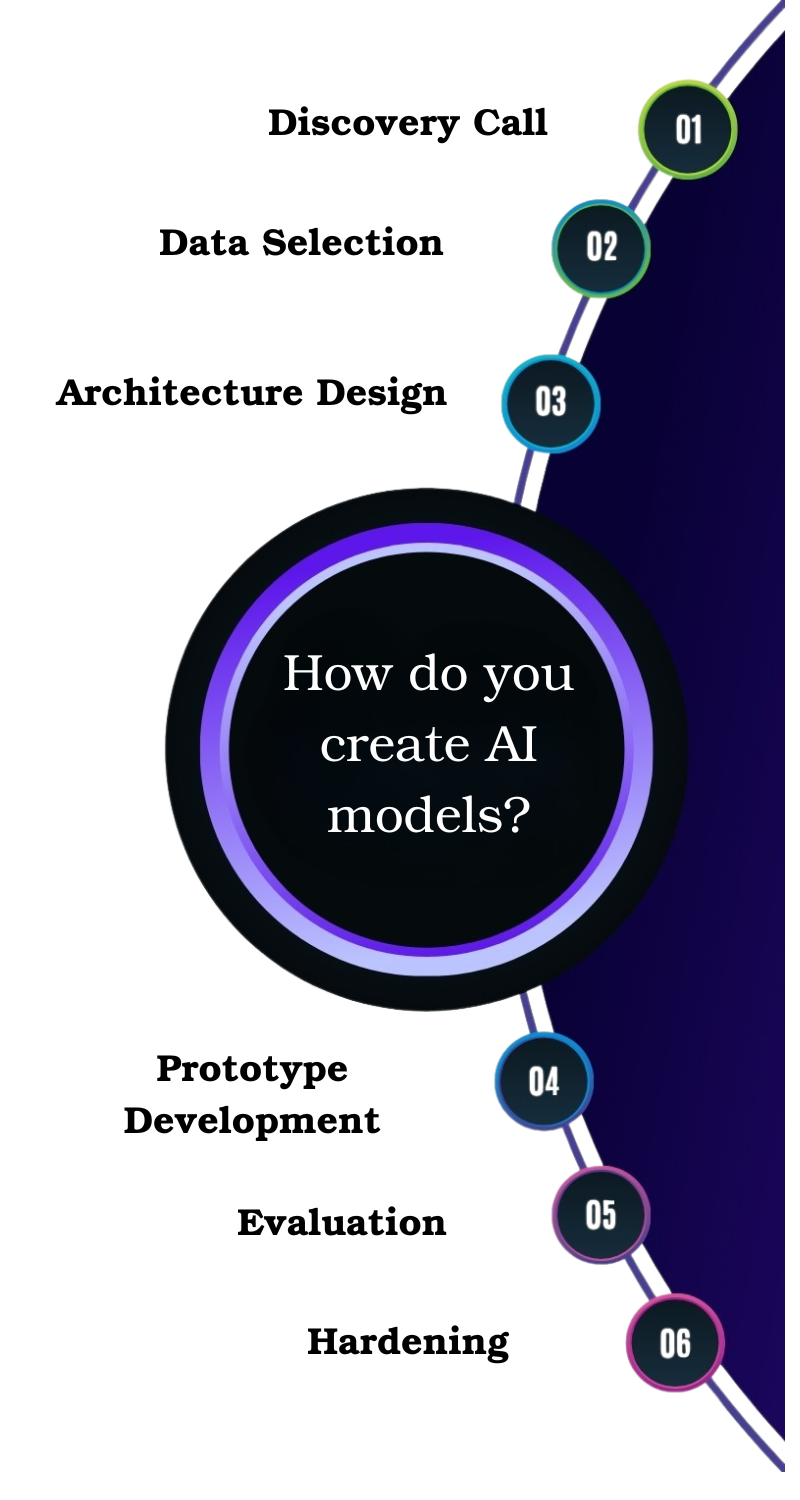
Creating a model starts with identifying a specific business problem rather than just the technology. Organizations move through a structured process to confirm value:
Discovery Call: Define KPIs like reducing churn or cutting support time.
Data Selection: Clean and prepare historical data to remove bias.
Architecture Design: Pick a model based on the problem type and data scale.
Prototype Development: Build a Minimum Viable Product (MVP) to validate the vision.
Evaluation: Testing the output against real-world metrics to ensure accuracy.
Hardening: Secure the tech stack and verify compliance with standards like the EU AI Act.
Generally, you need to get in touch with AI/ML solutions providers to help you create the appropriate AI model for your business.
Benefits of Using AI Models
Productivity: They help improve productivity by automating the repetitive tasks.
Decision-Making: Thorough data analysis helps businesses make decisions that lead to better business outcomes.
24/7 Operations: As AI models do not need sleep, your business can keep working even when you are asleep.
Revenue Growth: Use of AI in sales and operations leads to better revenue for businesses.
Cost Efficiency: Automating repetitive tasks allows human talent to focus on high-value strategy.
The Future of AI Models: 2026 and Beyond
As we move deeper into 2026, two major shifts are occurring:
From Assistants to Agents: AI is moving from a tool you ‘talk to’ to an agent that ‘works for you.’ These agents can call APIs, negotiate terms, and manage workflows without constant prompts.
Inference Intelligence: While model training was the focus of 2024, the priority now is ‘Inference Intelligence, ’ which includes optimizing the cost and energy required to run AI models at scale.
If you are planning to build or scale your next project, our AI Consulting Services can help you navigate these shifts.
Guiding Through the 2026 AI Sector
Treating artificial intelligence as a collection of standalone tools has become a mistake in 2026. Now, it is a strategic infrastructure layer. Business leaders need to know the types, architecture, and importance of disciplined development lifecycle to move from the Acceleration to the Accountability phase.
The greatest gains of artificial intelligence services come from specialization. So, the goal should always be to align AI capabilities with core business performance. As the IT field continues to evolve, those who integrate governance, prioritize sovereignty, and promote human-AI collaboration will be the ones to turn AI potential into profitable reality.
Loading FAQs
Please wait while we fetch the questions...