Agentic AI for Data Science: Build Models, Not Cleanup Scripts
Agentic AI is transforming data science from rigid, manual pipelines into autonomous, self-correcting workflows. Learn how to build resilient data systems through governance, secure tool integration, multi-agent orchestration, and human-in-the-loop validation.
Enterprise analytics in 2026 moves beyond static scripts and copilot tools. Deploying Agentic AI for data science creates a fundamental shift, moving machine learning from manual human execution to autonomous decision systems.
Within MoogleLabs' enterprise AI practice, production deployments build upon a standardized architecture: isolating agent execution in sandboxed environments while managing state through deterministic orchestration graphs.
Modern organizations rely on goal-oriented software agents that plan analytical tasks, evaluate intermediate code outputs, and correct execution errors independently. Corporate leaders seek these adaptive system structures to shorten product release cycles and maintain complete governance.
Defining Agentic AI in Enterprise Systems
Agentic AI describes autonomous software units that perceive digital environments, formulate multi-step plans, execute actions through external tools, and adjust behavior based on feedback loops. Generative Agent systems operate independently to reach assigned goals.
Key structural elements of agent systems include:
Reasoning and Planning:
The capability to break complex goals into logical processing steps. Agents move beyond linear chains by utilizing graph-based state machines, such as LangGraph or CrewAI, which support cyclical decision loops, state checkpointing, and branch rollbacks.
Tool Integration:
The capacity to run SQL queries, execute Python code, and query vector repositories. Agents execute Python transformations and SQL queries inside sandboxed, isolated runtimes (e.g., Docker microVMs or WebAssembly / Wasm containers) connected to read-only database replicas via Pydantic structured schemas, preventing accidental destructive mutations.
Contextual Memory:
Storing prior experiment outcomes to refine subsequent analysis runs. Working memory is managed through hybrid retrieval architectures, combining in-memory state stores like Redis for short-term scratchpads with vector and relational stores (such as Vespa or PostgreSQL with pgvector) for episodic experiment history.
Self-Correction:
Detecting processing errors during script execution and rewriting code to fix issues.
Applying Agentic AI for data science allows enterprise teams to transition from interactive notebook building to supervisory pipeline management. Modern software architectures leverage agentic AI software to coordinate background tasks, giving analysts time to focus on strategic business metrics.
How Agentic AI for Data Science Replaces Traditional Pipelines
Traditional data pipelines use rigid, step-by-step scripts that break whenever data schemas shift or missing values occur. Engineers spend a lot of their time writing cleanup logic, configuring model parameters, and checking deployment logs.
Integrating Agentic AI for data science transforms these linear tasks into continuous self-correcting loops. Autonomous agents monitor incoming data streams, propose semantic feature candidates, construct baseline models, and coordinate release processes within governed parameters.
Lifecycle Metric | Legacy Machine Learning Workflows | Agentic Data Science Workflows |
|---|---|---|
Pipeline Architecture | Rigid scripts requiring human fixes during failure | Dynamic autonomous loops with self-correction capabilities |
Feature Extraction | Manual statistical transformations in Jupyter notebooks | Semantic feature proposals tested on held-out datasets |
Model Selection | Analyst-driven trial and error across limited algorithms | Automated search across diverse model classes with budget awareness |
Experiment Tracking | Manual logging across isolated management tools | Continuous capture of code changes, performance metrics, and decision reasoning |
Model Maintenance | Scheduled manual retrainings or static threshold alerts | Active drift tracking with automated retraining proposals |
Autonomous agents reduce feature validation cycles by integrating automated drift detection with declarative data platforms like Snowflake and Databricks. By integrating semantic response caching (via Redis or GPTCache) and prompt compression on repetitive data profiling queries, enterprise data science teams can reduce token consumption and inference costs across large-scale feature evaluation workflows. Modern setups link agentic RAG architectures to pull business logic directly into feature creation steps.
Model selection shifts from manual script runs to agent-led execution. Agents build end-to-end baseline pipelines within hours, evaluate hyperparameters under explicit financial bounds, and summarize results for review. In production, agents track inference latency, distribution shifts, and prediction drift, submitting validated retraining proposals directly to engineers through modern MLOps services.
Overcoming Governance and Risk Barriers in Agentic AI for Data Science
Scaling autonomous execution across core enterprise systems requires rigorous operational guardrails. Uncontrolled agents risk executing unverified database queries, incurring runaway cloud costs, or producing biased algorithmic decisions. Establishing disciplined risk management protocols guarantees that autonomous workflows remain secure, compliant, and cost-effective.
Enterprise governance frameworks rely on three foundational security layers:
Granular Permission Boundaries: Restrict agent execution rights through least-privilege API keys, sandboxed runtime containers, and strict read/write database permissions.
Deterministic Budget Caps: Enforce hard cost limits on token usage, cloud compute consumption, and API call volume to eliminate unexpected operational billing spikes.
Comprehensive Audit Trails: Capture full execution logs, including prompt histories, intermediate code generations, tool calls, and model evaluation metrics.
Integrating Agentic AI for data science requires structured oversight rather than total autonomy. Enterprise leaders protect core assets by deploying agent systems within isolated development environments before expanding access across production systems. Utilizing targeted business automation tools guarantees that automated workflows maintain compliance and deliver predictable operational speed.
How-To Implement Autonomous Data Workflows in 4 Steps
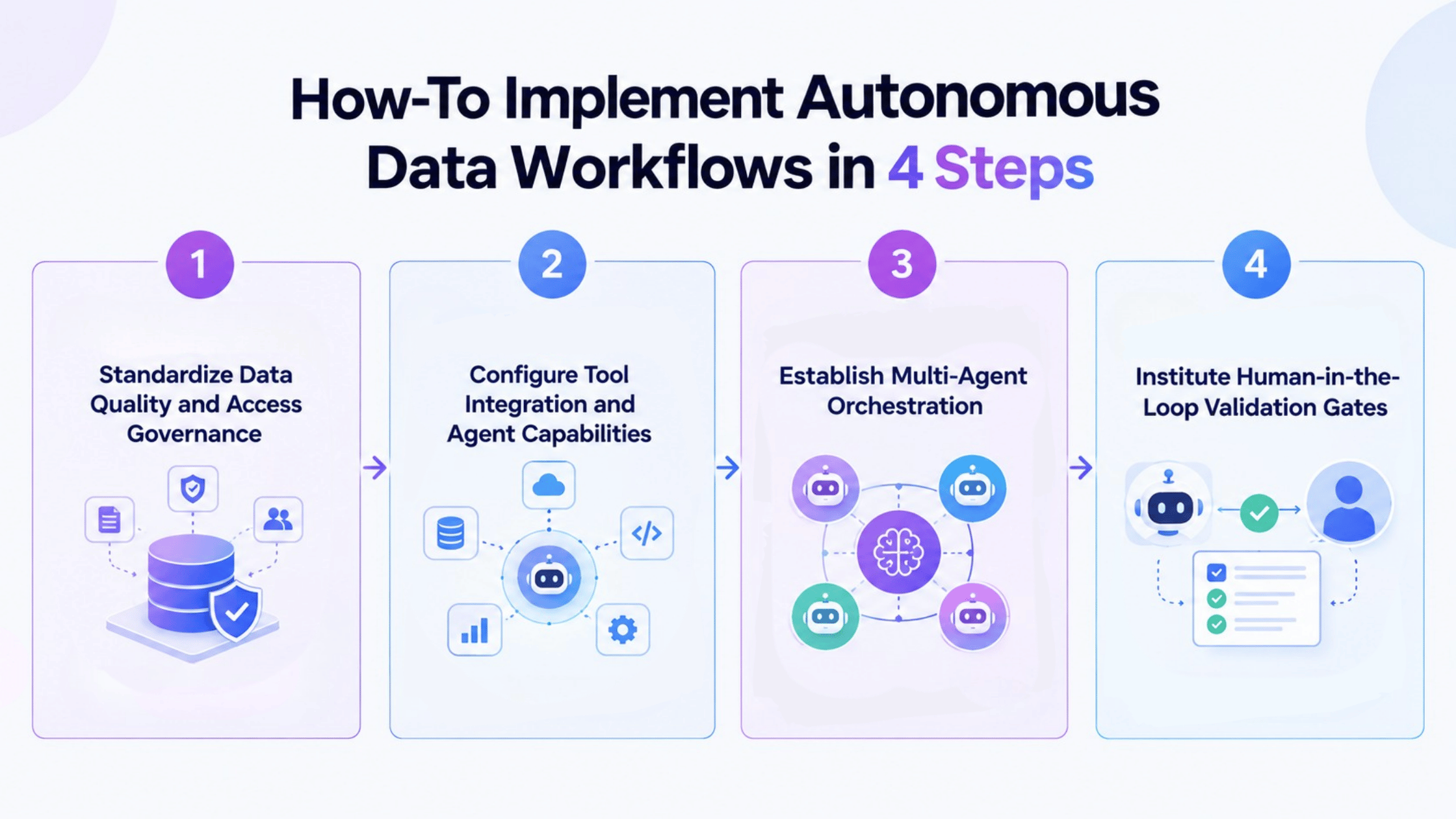
Transitioning an enterprise analytics infrastructure to autonomous agent execution requires a structured setup. Follow these four steps to build resilient operational pipelines:
Step 1: Standardize Data Quality and Access Governance
Clean data access forms the foundation of autonomous processing. Missing fields or unvalidated schemas cause agent processing loops to fail or generate flawed models. Establish clear metadata standards, enforce centralized access controls, and create validated data lakes across all business units.
Step 2: Configure Tool Integration and Agent Capabilities
Provide agents with access to necessary execution interfaces. Connect agent frameworks to SQL engines, code execution sandboxes, and vector databases. Organizations use modular AI agent development tools to equip agents with secure API connectors and execution permissions.
Step 3: Establish Multi-Agent Orchestration
Complex workflows demand specialized agent collaboration rather than single monolithic models. Assign distinct roles: one agent manages feature engineering, another runs model hyperparameter searches, and a third evaluates validation safety. Connecting these roles through structured orchestration platforms keeps multi-agent task execution coordinated.
Step 4: Institute Human-in-the-Loop Validation Gates
Maintain human governance over high-risk decisions. Set explicit evaluation gates where agents submit model proposals, drift reports, or deployment packages to human engineers for review. This structure speeds up background preparation and protects live production systems.
Real-World ROI and Enterprise Case Evidence
Data from Gartner indicates that 40% of enterprise software applications incorporate task-specific agents by 2026, up from less than 5% in 2025. At the same time, end-user spending on artificial intelligence platforms reaches $64 billion in 2026, growing 63.4% year-over-year.
Market projections from Mordor Intelligence value the global agentic AI market at $9.9 billion in 2026, reaching $57 billion by 2031. Industry reports in Forbes emphasize that enterprise scaling requires solid infrastructure design to prevent system bottlenecks.
Businesses deploying enterprise AI solutions capture distinct advantages in operational speed and resource efficiency. Integrating Agentic AI for data science yields measurable ROI across software development, predictive analytics, and edge deployment.
The table below highlights real enterprise outcomes across diverse sectors:
Enterprise Domain | Engineering Solution Implemented | Measured Business Outcome |
|---|---|---|
Enterprise Knowledge & Context Retrieval | Unified enterprise search engine using Vespa, Redis, and FastAPI for contextual data retrieval. | Sub-250ms contextual query response times; enabled unified document discovery across distributed enterprise databases. |
Cloud-Native Data Infrastructure Automation | Declarative Terraform and AWS container orchestration for data and MLOps deployment pipelines. | 99% reduction in environment provisioning time; achieved zero-downtime automated deployment pipelines. |
Automated Natural Language Pipeline | Real-time sentiment classification and LLM response automation with PostgreSQL and FastAPI. | 60% faster response times; 70% improvement in cross-system output consistency and tone alignment. |
Production Data Warehouse Engineering | Snowflake declarative data pipelines with automated data freshness checks and schema validation. | Automated pipeline drift detection, cutting batch failure recovery timelines from hours to minutes. |
Deploying autonomous data pipelines relies heavily on production-grade infrastructure. Whether deploying hybrid search architectures using Vespa and Redis, or automating containerized environments with Terraform, establishing foundational pipeline automation directly dictates agent stability and inference velocity.
Conclusion
Deploying Agentic AI for data science transforms legacy processing into autonomous, self-correcting pipelines that scale with business demands. Combining clean data foundations, multi-agent frameworks, and human oversight allows organizations to maximize engineering velocity and manage risk.
Ready to modernize your enterprise data pipelines?
Transitioning to autonomous data workflows requires balancing agent autonomy with strict cost and security controls.
Schedule a Two-Week Agentic Pipeline Feasibility Audit with MoogleLabs: Our engineering leads evaluate your data warehouse readiness, review sandboxed tool execution architecture, and provide a customized token-cost optimization roadmap.
Loading FAQs
Please wait while we fetch the questions...