How AI Agents Are Changing Business Automation in 2026
.png&w=3840&q=75)
AI agents are transforming business automation in 2026 by enabling goal-driven workflows, multi-system execution, adaptive decision-making, and controlled autonomy while keeping governance and human oversight at the core.
Business automation is evolving beyond fixed rules, static scripts, and basic chat copilots toward fully autonomous execution. Today, AI agents can interpret high-level business objectives, map out necessary steps, and execute multi-system workflows by calling external APIs and seamlessly escalating complex edge cases whenever a decision exceeds set governance parameters.
Consequently, business automation is shifting from isolated task processing to connected, end-to-end workflows. The AI agents actively combine real-time judgment, data retrieval, and continuous monitoring to manage operational processes dynamically.
Why AI Agents Have Become Necessary for Business Automation
Traditional automation excels in controlled, highly predictable environments, where RPA executes rigid sequences, and standard workflow engines trigger pre-approved actions. However, real-world enterprise processes are rarely static. Data arrives in inconsistent formats, supplier portals update without notice, internal policies shift, legacy software lacks APIs, and unstandardized exceptions constantly interrupt operations.
Autonomous AI agents resolve this operational friction by bridging the gap between rigid rules and unpredictable real-world workflows. Unlike conventional automation, an agent dynamically combines:
Reasoning: determine what needs to happen next.
Context: retrieve relevant enterprise data and business rules.
Tool use: interact with APIs, applications, databases, documents, and other systems.
Planning: break a broad objective into multiple actions.
Execution: complete steps rather than simply recommend them.
Escalation: hand over sensitive or ambiguous decisions when human approval is required.
Deploying this capability requires an enterprise-grade architectural foundation rather than simply dropping an LLM into an existing process. MoogleLabs delivers agentic AI services built around this holistic framework - integrating knowledge bases, persistent memory, task prioritization, dynamic tool routing, and multi-agent orchestration. By linking cognitive intelligence directly to core enterprise systems, MoogleLabs enables organizations to transform isolated task execution into resilient, fully autonomous end-to-end operations.
The Paradigm Shift: From Fixed Sequences to Goal-Driven Automation
The defining shift in enterprise automation is not merely that AI agents perform more tasks, but that automation now begins with a defined outcome rather than a rigid, step-by-step sequence.
Consider a standard procurement workflow as an example. Traditional automation strictly moves a pre-approved purchase request through fixed administrative steps.
In contrast, an agentic workflow dynamically evaluates the request, retrieves vendor records, compares approved suppliers, identifies missing documentation, executes the required system actions, and escalates to human leadership only when a transaction exceeds established policy thresholds.
This fundamental transition from static execution to dynamic adaptability is already reshaping enterprise strategy. According to McKinsey’s global AI survey, 62% of organizations are actively experimenting with AI agents, while 23% have scaled agentic systems within at least one business function.
However, because most enterprises have deployed agents in isolation, the primary challenge is no longer technology adoption - it is organizational redesign. The next phase of digital transformation requires restructuring workflows around where AI agents can safely execute decisions and drive autonomous operations.
Where Enterprises Are Applying AI Agents in 2026
Agentic automation is moving into functions where large volumes of information, multiple systems, and repetitive decisions intersect.
IT and software operations
AI agents are increasingly being used for incident investigation, code generation, testing, documentation, troubleshooting, and routine system maintenance.
AWS, for example, expanded its DevOps Agent in June 2026 to support custom SRE agents, reusable sub-agents, scheduled workflows, and interoperability through MCP and A2A protocols. This enables agents to investigate logs, monitor production environments, and work with other agents rather than operating as isolated assistants.
This represents an important change in IT automation - the agent becomes part of an operating workflow rather than an interface sitting beside it.
Customer service and operations
AI copilots are evolving into execution-oriented service agents.
Instead of only summarizing a customer's conversation, an agent can retrieve account information, determine the next operational step, update records, initiate a workflow, and escalate exceptions.
ServiceNow and Google Cloud announced in April 2026 that their AI platforms would allow agents to collaborate across networking, retail, and IT systems, with the aim of detecting, diagnosing, and resolving issues across operational environments.
Finance and compliance
Finance is another strong area because many processes involve documents, rules, checks, and repetitive review.
Demonstrating this trend, Anthropic introduced specialized, ready-to-run financial agent templates designed to automate key operations, including KYC compliance screening, pitchbook generation, and month-end financial reconciliation workflows.
However, deploying agents in highly regulated functions does not mean granting total autonomy. The emerging operating model does not replace governance with automated approvals, instead, the agent conducts the preliminary data retrieval, cross-referencing, and analysis, while defined organizational policy strictly dictates which high-value or risk-sensitive actions require explicit human authorization.
Legacy-system automation
One of the most practical developments in 2026 is computer-use automation.
Many enterprises still depend on ERP systems, proprietary applications, mainframes, and desktop software that cannot be easily modernized. Microsoft made AI agents generally available in Copilot Studio in 2026, allowing them to interact with websites and desktop applications through the interface itself.
AWS has taken a similar direction with Amazon WorkSpaces for AI agents, enabling agents to operate desktop applications inside a managed environment while retaining identity, network, and audit controls.
Multi-Agent Systems Are Changing Workflow Architecture
A single agent can perform a task. A multi-agent system can divide a complex workflow into specialized responsibilities.
For example, an enterprise revenue workflow could use:
Research Agent → Qualification Agent → Pricing Agent → Compliance Agent → CRM Agent
Each agent has a defined role, toolset, access level, and operating boundary.
This architecture is becoming more practical as enterprises adopt interoperability standards and orchestration mechanisms. Microsoft has added guidance around multi-agent orchestration patterns, while AWS is adding support for agents working with other agents through A2A and MCP.
For organizations deploying agentic AI solutions, this creates a more modular architecture. Instead of redesigning an entire automation system every time a model or process changes, individual agents can be upgraded, evaluated, or replaced.
AgenticOps: Establishing the Governance and Operations Layer
As autonomous agents transition from passive advisors to active operational entities capable of executing system-level changes, traditional application monitoring rapidly becomes obsolete. Managing these dynamic systems requires granular enterprise visibility into several critical operational questions:
Attribution & Authority: Which specific agent executed the action, and under what permission parameters?
Reasoning & Lineage: What specific data, prompts, or context influenced the underlying decision?
Tooling & Execution: Which downstream APIs or enterprise applications were invoked?
Financial & Functional Control: What compute costs were incurred, did the output meet quality standards, and was the task terminated safely?
This operational complexity has catalyzed the rise of AgenticOps - a foundational discipline dedicated to the orchestration, deployment, observability, security, and cost control of autonomous AI agents functioning as critical enterprise infrastructure.
Industry leaders are aligning their service offerings to meet this operational demand. MoogleLabs’ AgenticOps framework directly addresses this transition by embedding robust governance, continuous monitoring, and security controls directly into agent lifecycle management.
Similarly, IBM introduced the Agentic Control Plane for watsonx Orchestrate, establishing a centralized framework to catalog, govern, and observe enterprise AI agents at scale.
AI Cybersecurity Integration Is Becoming Part of Automation
The security model also changes when software can act autonomously.
A chatbot reading a document has a limited blast radius. An agent with access to production systems, customer information, financial records, or cloud infrastructure can potentially create much larger operational consequences.
Deloitte reported in April 2026 that only 21% of surveyed organizations had a mature governance model for agentic AI, based on a survey of 3,235 technology and business leaders across 24 countries.
That gap is why AI cybersecurity integration is becoming part of the automation architecture itself.
Controls increasingly need to cover:
Identity → Permissions → Tool access → Data boundaries → Runtime monitoring → Human approval → Auditability
MoogleLabs’ enterprise AI security framework similarly focuses on securing agents and copilots through governance, visibility, access controls, and AI-specific security measures.
This is not a secondary IT concern. Security becomes part of whether an agent is allowed to act.
Enterprise Automation Is Shifting from Pilots to Controlled Execution
The market is also changing how AI investments are evaluated.
Early enterprise AI initiatives often emphasized adoption, usage, time savings, and perceived productivity gains. Agentic automation introduces harder business measures:
cycle-time reduction
straight-through processing
exception rates
cost per completed workflow
conversion or resolution rates
human intervention frequency
agent accuracy
infrastructure and inference cost
IBM’s June 2026 study found that only 11% of surveyed organizations said they were completely prepared for the scale of AI-agent deployment, while 70% said business teams were deploying technology faster than IT could track.
That helps explain the rise of agent inventories, control planes, evaluation systems, identity controls, observability, and governance tooling across the enterprise market.
The objective is shifting from “Can we build an agent?” to “Can we prove that this agent creates measurable value under controlled operating conditions?”
What the Next Generation of Business Automation Will Look Like
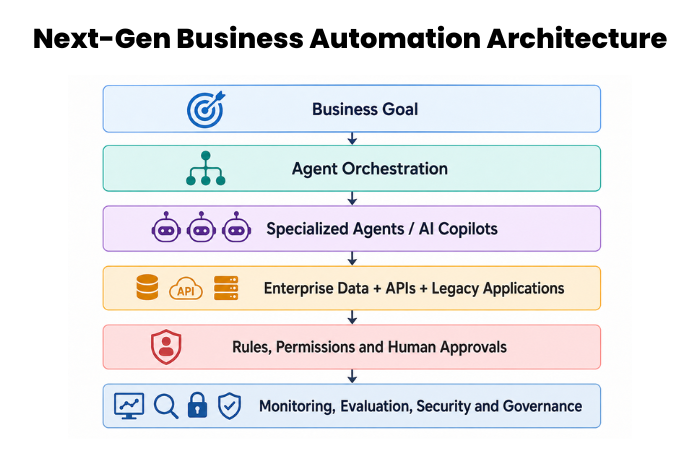
The next enterprise automation stack is likely to combine deterministic and agentic technologies rather than replace one with the other.
A useful architecture looks like this:
Business Goal
↓
Agent Orchestration
↓
Specialized Agents / AI Copilots
↓
Enterprise Data + APIs + Legacy Applications
↓
Rules, Permissions and Human Approvals
↓
Monitoring, Evaluation, Security and Governance
Deterministic workflows remain valuable where consistency matters. Agents add flexibility where interpretation, context, or adaptation is required.
This hybrid model is also closer to how enterprise AI services are being deployed in practice. The strongest systems are not “fully autonomous” by default. They apply different levels of autonomy according to risk, process criticality, and business policy.
MoogleLabs’ emphasis on adaptive workflows, scalable AI infrastructure, knowledge systems, and continuous lifecycle governance fits this direction because enterprise agent deployment needs an operating model around the intelligence - not just the intelligence itself.
What 2026 Signals About Business Growth
AI agents are beginning to affect growth through operational capacity rather than automation savings alone.
When agents shorten a sales cycle, reduce manual review, improve service availability, accelerate software delivery, or allow a smaller operations team to handle greater transaction volume, the business can absorb more activity without increasing human workload at the same rate.
That creates a different economic proposition for AI.
The strongest opportunity is not replacing an employee with software. It is redesigning a process so that human expertise is concentrated on decisions that require accountability, judgment, relationships, and strategic thinking, while agents handle the surrounding execution.
That is the point at which Agentic AI services move from an experimental technology investment to an operating capability.
Conclusion
AI agents are changing business operations in 2026 by moving automation from fixed task execution toward adaptive, goal-driven workflows. Enterprises are connecting agents with applications, data, APIs, legacy systems, and other agents while investing heavily in governance and control. The winners will not be the organizations with the largest number of agents, but those that can connect agent capability to measurable business outcomes without losing operational control.
Loading FAQs
Please wait while we fetch the questions...