Stop Automating Tasks, Start Automating Judgment: The Rise of Agentic AI Workflows
_2.png&w=3840&q=75)
The shift to Agentic AI workflows marks a new era of automation where systems don’t just execute tasks but think, plan, and self-correct—helping businesses achieve smarter and more scalable outcomes.
Standard automation has hit a structural ceiling. Traditional Robotic Process Automation (RPA) relies on rigid "if-this-then-that" sequences, which inevitably break when confronted with the messy unpredictability of modern business data.
In 2026, enterprises are shifting toward Agentic AI Workflows- systems that can reason, plan, and adapt autonomously, transforming automation from execution to decision-making.
This shift marks the transition from task automation to intelligent orchestration.
Shifting to Agentic AI Workflows means moving beyond tools that follow instructions to systems that solve problems autonomously. These workflows act as digital coworkers capable of handling complex, multi-step operations with minimal human intervention.
What Are Agentic AI Workflows?
Agentic AI Workflows are autonomous systems that can plan, execute, and optimize multi-step tasks using AI agents, tools, and memory- without constant human input.
Most interactions with AI feel like a game of catch: you throw a prompt, and it throws back an answer. Agentic AI Workflows change that interaction into a collaborative process. Instead of a single response, the workflows created using agentic AI services enable a system to plan its own steps, review its own performance, and fix errors as it goes. Here is how it works:The architecture analyzes a high-level business objective and autonomously maps out a logical, prioritized sequence of sub-tasks.
Then, the specialized agents proactively interface with diverse software environments via APIs to retrieve live data and execute cross-platform actions.
Afterward, the system employs a "self-reflection" layer to audit its own logic and fix reasoning errors before finalized data reaches the user.
Lastly, logic loop integration allows the system to maintain a continuous reasoning cycle, validating results against original intent and re-routing actions until a specific goal is achieved.
The primary reason for higher adoption rates of agentic AI workflow is its ability to question its own results. It checks if the data it found makes sense. It decides if it needs to reach out to another software tool for more details before it considers a job done.
From Efficiency to Effectiveness: The Goal-Bound Shift
Traditional automation was built for efficiency: Doing the thing right. If you gave an RPA bot a broken process, it would simply execute that broken process faster.
Agentic AI shifts the focus to effectiveness: Doing the right thing. Because these systems are Goal-Bound rather than Task-Bound, they prioritize the outcome. If an agent encounters a blocked path, such as a missing database entry or a shifting API endpoint, it doesn't simply fail. It reasons through the obstacle, pulls in alternative data, and adapts its plan to ensure the ultimate business objective is met. That is why Agentic AI has the potential to generate up to $650 billion in additional annual revenue by 2030.
Why These Workflows Stand Out
The strength of Agentic AI Workflows lies in its three main abilities:
Core Intelligence:
Planning: The system views a large objective and maps out the necessary steps to reach it.
Autonomous Decision-Making: The agents analyze data to make decisions, adapting to evolving context.
Memory: It keeps track of previous decisions, so it avoids repeating mistakes or losing context.
Execution Layer
Workflow Orchestration: The system manages end-to-end processes by connecting siloed departments and managing the data flow between them.
Dynamic Tool Usage: Agents proactively interface with internal databases, APIs, and third-party software to retrieve live information and execute cross-platform actions.
Multi-agent Collaboration: Allows coordination among various AI agents to execute complex workflows.
Optimization Layer
Self-Correction: If the logic fails or the data is messy, the agent identifies the mistake and tries a different path.
Iterative Reflection: The system reviews its own logic cycles, ensuring that every output is verified against the original intent before the process is considered complete.
The Anatomy of Autonomy: Key Differentiators
Understanding the shift to an agentic enterprise requires distinguishing between legacy automation and the new reasoning-based paradigms. Below are the critical breakdowns that separate "business as usual" from "AI-native operations."
1. Traditional Workflows vs. Agentic Workflows
Traditional workflows are deterministic. They follow a set path. Agentic workflows are probabilistic, and hence can navigate through uncertainty.
To understand the shift, here is a comparison table of traditional rule-based automation with agentic, reasoning-driven workflows:
Feature | Traditional Workflows | Agentic Workflows |
|---|---|---|
Logic Structure | Linear and Hard-coded (If-Then) | Iterative and Reasoning-based |
Handling Exceptions | Stops or requires human intervention | Self-corrects or finds an alternative path |
Scalability | Limited | Scale easily |
Interactivity | "One-and-done" execution | Continuous loops (Plan → Act → Reflect) |
Outcome | Predictable but rigid | Dynamic and adaptable |
2. AI Agents vs. Agentic AI
While many people use these terms interchangeably, they represent the "Who" versus the "How" of the system.
AI Agents (The "Who"):
These are the individual autonomous actors designed to perform specific tasks. Think of an agent as a digital specialist (e.g., a "Researcher Agent" or a "Billing Agent") that has a specific identity, toolset, and persona. They:
Carry out tasks like data retrieval, communication, and task automation.
Only operates in specific domains
Carries out predefined or learned behaviors, based on rules, algorithms, or training data.
Examples include customer support bots, voice assistants like Alexa, and chatbots.
According to Forrester’s latest research, the next big leap is “role-based” AI agents that act as specialized digital employees, capable of orchestrating and completing complex processes across multiple enterprise systems.
Agentic AI (The "How"):
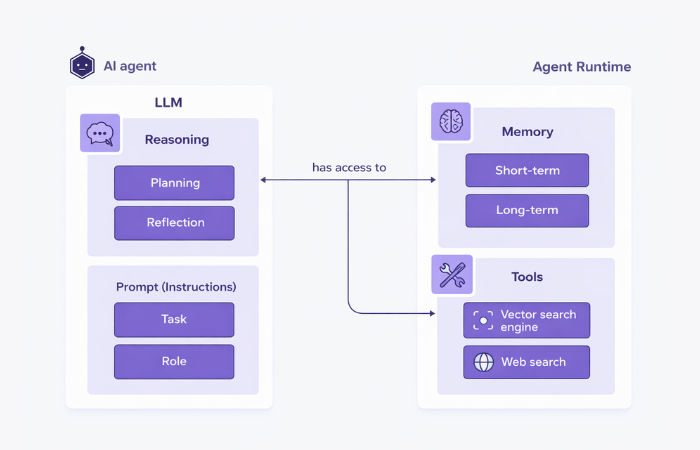
This is the broader architectural philosophy or reasoning framework. It is the intelligence layer that allows agents to collaborate. You can have an AI model (like an LLM), but it only becomes Agentic when you wrap it in a workflow that allows it to plan, use tools, and maintain memory over time. It is:
Responsible for orchestration of tasks
Involves multiple agents acting together to achieve an objective
Can self-organize, learning from context, and dynamically adapt to changes.
Examples include multi-agent systems in enterprise workflow, like in supply chain management.
Key Differences
Aspect | AI Agent | Agentic AI |
|---|---|---|
Scope | Limited to specific tasks or domains. | Broader, versatile, and involves multi-facet orchestration. |
Complexity | Handles individual, well-defined tasks. | Manages complex, multi-step workflows. |
Collaboration | Operates as a single entity or isolated system. | Involves multiple AI agents and non-AI systems working together. |
Autonomy Level | Reactive to commands or inputs. | Proactive decisions and actions; features self-learning and optimization. |
Examples | Chatbots, FAQ bots, and virtual assistants. | Enterprise workflow systems and multi-agent collaboration frameworks. |
AI agents are the actors responsible for carrying out the task. Agentic AI is the system that orchestrates them.
3. RPA vs. APA (Agentic Process Automation)
The industry is currently moving from Robotic to Agentic Process Automation (APA). This is the difference between mimicking human actions and mimicking human judgment.
RPA: Robotic Process Automation
RPA is essentially a digital "macro." It records a sequence of clicks and keystrokes to move data from Point A to Point B.
The Limitation: It requires structured data and a static environment. If a UI button moves 10 pixels to the left or a form field changes names, the RPA bot fails. It is "Action-Bound."
APA: Agentic Process Automation
The "What": APA uses LLMs as the "brain" to drive the automation. It doesn't care where a button is; it understands the intent of the task. If it needs to "process an invoice," it can read a messy PDF, identify a discrepancy, and decide to email the vendor for clarification before updating the ERP.
The Advantage: It excels at unstructured data and variable environments. APA is "Outcome-Bound."
The Evolution of Enterprise Automation (2026 Model)
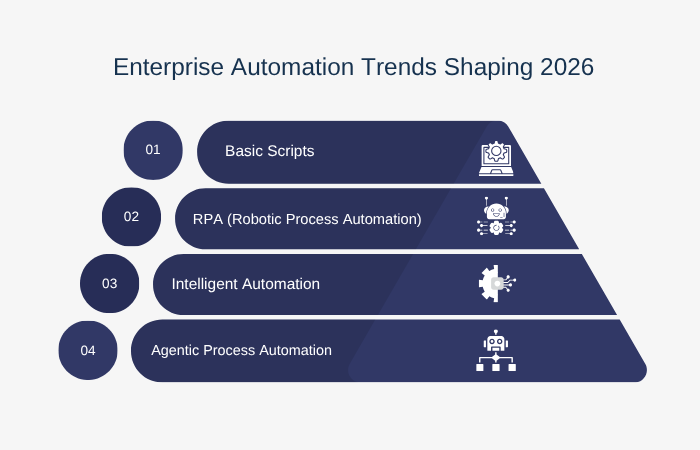
To help the writer anchor these concepts, visualize the progression as a ladder of sophistication:
Level 1: Basic Scripts (Simple data entry, zero reasoning).
Level 2: RPA (Cross-application data movement, rule-based).
Level 3: Intelligent Automation (RPA + OCR/ML for basic data extraction).
Level 4: Agentic Process Automation (Autonomous reasoning, tool-use, and cross-functional decision making).
RPA was about cutting costs on repetitive tasks; APA is about increasing the "velocity of intelligence" across the entire organization.
The Shift from Linear Bots to Agentic Systems
Most chatbot development services rely on linear workflows. They take an input and provide a pre-programmed or retrieved output. If the user’s request falls outside the script, the bot fails.
In contrast, Agentic AI Workflows introduce adaptive reasoning, enabling systems to evaluate outcomes and adjust dynamically.
Think of a standard bot as a calculator and an agentic system as a junior analyst. The analyst knows how to use the calculator, but they can look at the results, realize the numbers seem wrong, and re-run the calculation with different data. This level of autonomy is why AI agent development is becoming the new standard for enterprise efficiency.
Forbes reports that roughly 64% of businesses expect AI to increase their overall productivity. This jump in efficiency isn't coming from simple text generation but from the integration of Agentic AI Workflows into core business processes.
Why Your Business Needs AI Agent Development Now
For many business owners, the core challenge of 2026 is scaling operational capacity without a linear increase in overhead. AI development services that prioritize agentic architectures offer a strategic solution: the ability to offload high-volume, high-logic tasks to autonomous systems.
This shift empowers your workforce to step away from routine data handling and move toward high-level strategy, driving the creative and analytical work that machines cannot replicate.
Enterprises will not be the only organizations leveraging AI agents. Gartner predicts that 80% of governments will deploy AI agents to automate routine decision-making by 2028. Implementing Agentic AI requires both technical expertise and strategic alignment. This is where specialized AI development partners play a critical role.
At MoogleLabs, we see how these systems transform departments. Our team specializes in AI development services that bridge the gap between simple automation and true autonomous operation.
The Multi-Agent Orchestration Layer: Moving Beyond Silos
In 2026, the most significant shift in AI architecture is the move from monolithic, "all-purpose" models to Multi-Agent Orchestration. This mimics a high-performing human department where specialized agents collaborate under a "Lead Orchestrator."
The Orchestrator: Manages the overall objective and delegates tasks.
The Worker Agents: Specialized entities (e.g., a "SQL Agent" for data, a "Research Agent" for web scraping, and a "Compliance Agent" for risk checking).
The Conflict Resolver: A dedicated logic layer that handles discrepancies when two agents provide conflicting data points.
Major enterprise platforms have moved toward autonomous coordination layers. For example, Salesforce’s Agentforce platform demonstrates this orchestration in action. By utilizing an "Atlas" reasoning engine, the system can autonomously trigger specialized agents to handle everything from lead qualification to complex billing disputes, ensuring that disparate departments operate as a single, cohesive intelligence unit.
The Governance Layer: Balancing Autonomy with Accountability
As we move toward an agent-first enterprise, the goal is not to remove humans from the loop, but to elevate them to the role of "Agent Orchestrators." Agentic AI requires a Guardrail Framework, which is a set of pre-defined boundaries that the system cannot cross without explicit human authorization.
For instance, while an agent can autonomously handle a routine refund, a high-value transaction exceeding a specific dollar amount would trigger a Human-in-the-Loop (HITL) intervention. This ensures that while the agent handles 95% of the reasoning labor, the human retains oversight on high-stakes decisions, maintaining the Ethical North Star of the organization.
Agentic RAG: Why Traditional Retrieval Isn’t Enough
Traditional Retrieval-Augmented Generation (RAG) is often a passive process: the user asks a question, and the system fetches the most relevant document snippet. Agentic RAG is proactive. If the initial search doesn't yield a definitive answer, the agent reasons that it needs more context. It might decide to browse a different database, query a legacy ERP system, or even generate a clarifying question for the user.
Core Components of Agentic AI Solutions
.png)
Building effective AI agents Solutions requires a combination of several technical patterns. Understanding these helps decision-makers choose the right path for their projects.
Reflection
The agent looks at its own work and critiques it. This pattern ensures high-quality outputs by forcing the AI to double-check its logic before presenting a final result to the user.
Multi-Agent Collaboration
In some Agentic AI Workflows, different agents take on specific roles. One agent might act as a researcher, another as a writer, and a third as a reviewer. They work together to complete a task, mimicking a human team.
Tool Usage
Modern agentic AI services give the AI "hands." The agent can write code, execute SQL queries, or browse internal documents to find information. This is a significant step up from standard artificial intelligence services that only rely on the data they were trained on.
Planning and Decomposition
The AI creates a roadmap. If you ask it to "analyze the quarterly sales and compare them to our competitors," the workflow plans the data retrieval, the comparison logic, and the final report generation as distinct steps.
The Continuous Feedback Loop: Plan → Act → Learn
One of the most profound differentiators of Agentic AI is its ability to improve through experience. Unlike "one-and-done" scripts, these workflows operate on a Continuous Learning Loop.
By utilizing Reinforcement Learning from AI Feedback (RLAIF) and reflection cycles, agents can review their own performance logs. If a specific reasoning path led to an error, the agent logs that context into its long-term memory. Over time, the system becomes more adept at navigating the messy unpredictability of enterprise data, effectively training itself to handle edge cases that would have previously required manual developer intervention.
Real-World Use Cases for Agentic AI Workflows
The applications for these systems are vast. You can find a detailed list of agentic ai enterprise use cases 2026 on our blog, but here are some primary examples.
Supply Chain Optimization
Agentic AI Workflows can monitor inventory levels, predict shortages based on weather patterns or shipping delays, and automatically contact suppliers to adjust orders. Since the system can reason through trade-offs, it makes better decisions than a simple rule-based program.
Financial Fraud Detection
Instead of just flagging a transaction, an agent can investigate it. It can check the user’s history, look for similar patterns in the network, and even prepare a summary for a human auditor. This depth is what separates modern AI agents Solutions from older detection models.
Customer Support Evolution
We are moving beyond simple chatbot development services. An agentic support system can verify a customer's identity, look up their order status, determine if a refund is allowed under company policy, and initiate the refund through the billing API, all without a human clicking a button. This is the core of the B2A business to agent strategy we advocate for.
The MoogleLabs Approach: AI and Blockchain Integration
MoogleLabs stands out because we combine AI development services with deep blockchain expertise. Why does this matter for Agentic AI Workflows?
In an autonomous system, security and transparency are paramount. If an agent is making financial decisions or handling sensitive data, you need an immutable record of its actions. Blockchain provides that "audit trail." Our work in case studies highlights how we build secure, transparent, and intelligent systems that business owners can trust.
When you look for Agentic AI Solutions, you aren't just looking for code. You are looking for a strategy that integrates with your existing tech stack. We focus on creating Agentic AI Workflows that deliver measurable ROI, as explored in our guide on Agentic Artificial Intelligence Solution, making your business operations faster.
Implementing Agentic AI Workflows: A Step-by-Step Guide
Moving toward an agentic model requires a structured approach that prioritizes data integrity over simple model deployment.
As highlighted in a recent report by Harvard Business Review Analytic Services, there is a widening gap between enterprise ambition and readiness; while 84% of leaders believe agentic AI will transform their business, only 13% feel their data architecture is truly equipped to support it.
To ensure your organization falls into the latter category, follow this 2026 implementation roadmap:
Step 1: Identify "Reasoning-Heavy" Tasks
Look for processes where employees spend time checking data across multiple screens or making simple "judgment calls" based on company policy. These are prime candidates for Agentic AI Workflows.
Step 2: Define the Toolset
What data does the AI need? What software must it interact with? Successful AI agent development depends on giving the agent the right access to internal APIs and databases.
Step 3: Select the Right Architecture
Decide if you need a single agent or a multi-agent system. Complex tasks often benefit from multiple agents checking each other's work. This is a common strategy in high-end agentic ai services.
Step 4: Build, Test, and Iterate
Start with a pilot program. Monitor how the Agentic AI Workflows handle edge cases. Refine the reasoning loops based on performance data.
Step 5: Scale and Integrate
Once the pilot is successful, integrate the workflow into your broader operations. Ensure your team understands how to supervise these agents rather than just doing the work themselves.
The "FinOps" of Autonomy: Managing Inference Economics
As agentic workflows scale, Inference Economics becomes a critical concern for leadership. Every thought or reflection cycle consumes tokens, which translates to cost.
Tiered Reasoning: High-authority workflows use a "Small Language Model" (SLM) for routine routing and classification, only escalating to a massive LLM when complex reasoning is required.
Token Efficiency: Strategic architecture now focuses on reducing the number of steps an agent takes to reach a conclusion, ensuring that autonomy doesn't become a "black box" of spiraling cloud costs.
Strategic Benefits for Decision-Makers
The choice to implement Agentic AI Workflows isn't just a technical one; it is a strategic move.
Cost Reduction: Replacing manual review teams with autonomous reasoning reduces operational overhead by 30% to 70% on high-logic tasks.
Speed: Agentic AI Workflows Agentic systems operate 24/7, completing complex, multi-step workflows in minutes that traditionally took days of human coordination.
Scalability: You can deploy dozens of agents to handle 10X workload surges without hiring and training new staff.
92%+ Accuracy Rate: Integrated reflection and self-correction cycles identify and fix reasoning errors in real-time, significantly outperforming legacy RPA.
As a provider of artificial intelligence services, we recognize that the biggest hurdle for most businesses is the initial setup. That is where professional AI development services come in. We handle the technical path so you can focus on the business results.
Final Thoughts on Enterprise Automation
The transition to Agentic AI Workflows represents the next phase of the industrial revolution. We are no longer just automating physical labor or simple data entry; we are automating logical processing.
For business owners, the goal is clear: build systems that can think. Whether you are looking for chatbot development services that actually solve problems or comprehensive AI agent development, the focus must remain on the workflow. A single AI model is a tool, but Agentic AI Workflows are the engines that drive modern enterprise.
MoogleLabs is here to help you build those engines. From blockchain-secured data layers to advanced Agentic AI Workflows, we provide the expertise needed to turn AI potential into business reality.
Loading FAQs
Please wait while we fetch the questions...