Custom AI Model Development: When to Build, Buy, or Fine-Tune
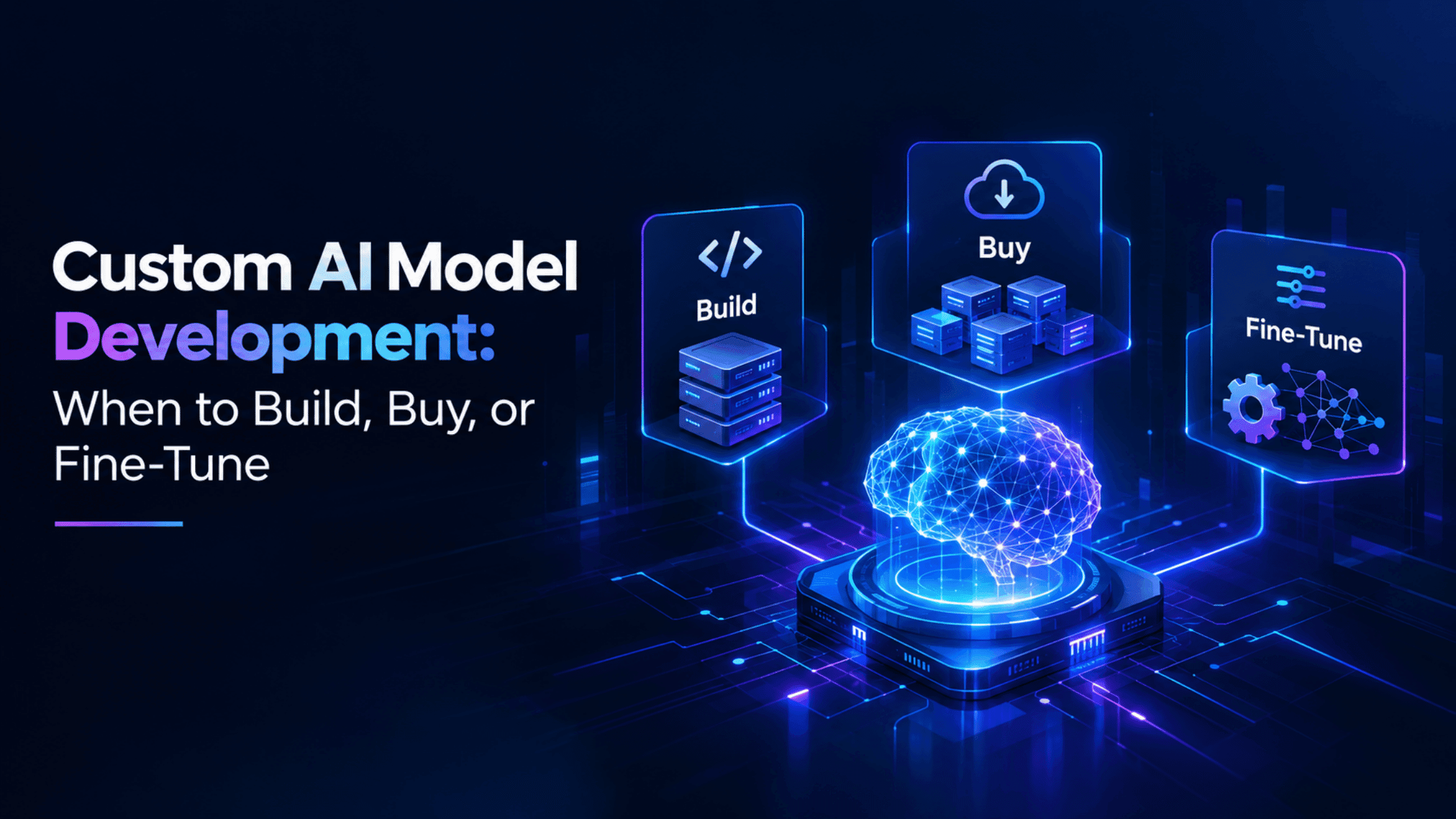
Custom AI model development decisions can shape cost, data control, and competitive advantage. Explore when enterprises should build AI models from scratch, buy commercial solutions, or fine-tune pre-trained models for better ROI, security, and scalability.
Standard off-the-shelf software promises fast AI adoption. But commercial models often fail when handling proprietary data, complex industry workflows, or strict compliance rules. Paying recurring API fees for generic tools creates long-term financial drain without building intellectual property. Business leaders face a direct choice: construct custom architectures, purchase third-party software, or adapt pre-trained models.
Strategic Custom AI Model Development allows enterprise leaders to control operational expenses, protect internal data assets, and establish durable competitive advantages. Here is how to evaluate each approach for your technical roadmap.
Defining Custom AI Model Development for Business Leaders
Custom AI Model Development refers to the technical process of designing, training, and adapting artificial intelligence architectures to suit specific business operations. Third-party commercial software automates basic administrative tasks, but specialized enterprises require dedicated AI solutions integrated into internal databases.
Data published in the McKinsey 2025 State of AI Report shows 88% of organizations deploy artificial intelligence in at least one business function. High-performing organizations select deliberate technical strategies to embed Generative AI Services directly into production systems.
Strategic Options for Custom AI Model Development: Build, Buy, or Fine-Tune
Decisions surrounding Custom AI Model Development shape how corporate data generates long-term commercial value. Executive teams evaluate three primary avenues based on financial costs, time-to-market targets, and strict security requirements.
Strategic Vector | Build From Scratch | Buy Commercial Software | Fine-Tune Open-Source |
|---|---|---|---|
Upfront Capital Expense | High ($1,000,000+) | Low Subscription Fees | Moderate ($50,000 - $200,000) |
Time to Deployment | 9 to 18 Months | Immediate to 30 Days | 30 to 90 Days |
Data Privacy & Control | Complete Data Ownership | Third-Party API Exposure | Complete Self-Hosted Control |
Domain Precision | Perfect Alignment | Standard Baseline | High Specialization |
Maintenance Overhead | Heavy In-House Engineering | Vendor Managed | Moderate MLOps Pipeline |
Competitive Differentiation | Maximum Proprietary IP | Minimal Advantage | Strong Proprietary Layer |
Option 1: Custom AI Model Development From Scratch
Constructing a model from the ground up involves designing neural network topologies and training parameters exclusively on internal datasets. This strategy yields complete ownership over model weights, source code, and strategic patents.
Full development requires substantial investments in high-performance computing clusters, massive dataset preparation, and specialized data science teams. Building from scratch fits organizations operating in specialized domains where off-the-shelf foundation models offer zero pre-existing knowledge.
Option 2: Buying Commercial Off-the-Shelf AI Software
Purchasing commercial software provides immediate deployment with minimal internal engineering effort. Software vendors handle cloud server infrastructure, model retraining, and system security maintenance.
This option carries trade-offs. Organizations pay continuous user subscription fees or token usage charges that expand as transaction volumes grow. Product features rely on third-party vendor roadmaps, limiting specialized process customizations. Moreover, you are sending sensitive records through external vendor APIs. This can create regulatory compliance challenges in healthcare, finance, and legal sectors.
Option 3: Fine-Tuning Open-Source Pre-Trained Models
Fine-tuning modifies base open-source models by updating network parameters on targeted internal data. Combining base models with AI context engineering and AI agent development tools connects foundation capabilities directly to enterprise knowledge management systems.
Fine-tuning delivers high contextual accuracy without multi-million-dollar compute budgets. Integrating agentic AI services helps businesses automate multi-step operational workflows securely.
Financial Metrics, Talent Costs, and Technical Infrastructure
Planning Custom AI Model Development requires analyzing expenses across the entire software lifecycle. Data indicates 59% of companies invest over $1 million annually in artificial intelligence. Sustainable budgeting accounts for initial engineering costs, data pipeline construction, and long-term model maintenance.
Building internal data science departments requires significant payroll allocation. A senior machine learning engineer commands an average annual compensation of $215,000, with typical pay ranges extending from $172,000 to $274,000. Average technology job tenure stands at 3.9 years, creating operational risk if key technical personnel resign during mid-stage development.
Model accuracy relies directly on data pipeline engineering. Fragmented or unorganized data sources produce inconsistent outputs and model hallucinations. Modern deployments rely on structured data environments like Snowflake data engineering production pipelines to automate data extraction, maintain governance standards, and maintain feature freshness.
Maintaining production safety requires structured operational testing. Enterprise systems require Continuous AI security testing inside DevSecOps workflows to prevent adversarial manipulation, protect sensitive data, and monitor model actions. Working alongside professional AI development services allows organizations to implement enterprise deep learning services without overextending internal engineering teams.
Operational Evidence and Enterprise Case Studies
Applying Custom AI Model Development to open-source foundation models delivers measurable returns and controls compute expenses. Real-world deployments illustrate distinct business performance improvements.
An educational technology firm replaced static logic with an automated machine learning recommendation system engineered by MoogleLabs. Recommendation accuracy increased from 25% to 85%, cutting manual counseling time by 50%. In cloud management infrastructure, deploying Terraform-based automation reduced environment provisioning time by 99%.
In customer service operations, an automated speech analysis system processed call audio to measure compliance metrics. This implementation reduced manual quality assurance workloads by 98%. These technical outcomes show how targeted machine learning engineering creates clear financial savings.
Step-by-Step Framework for Strategy Selection
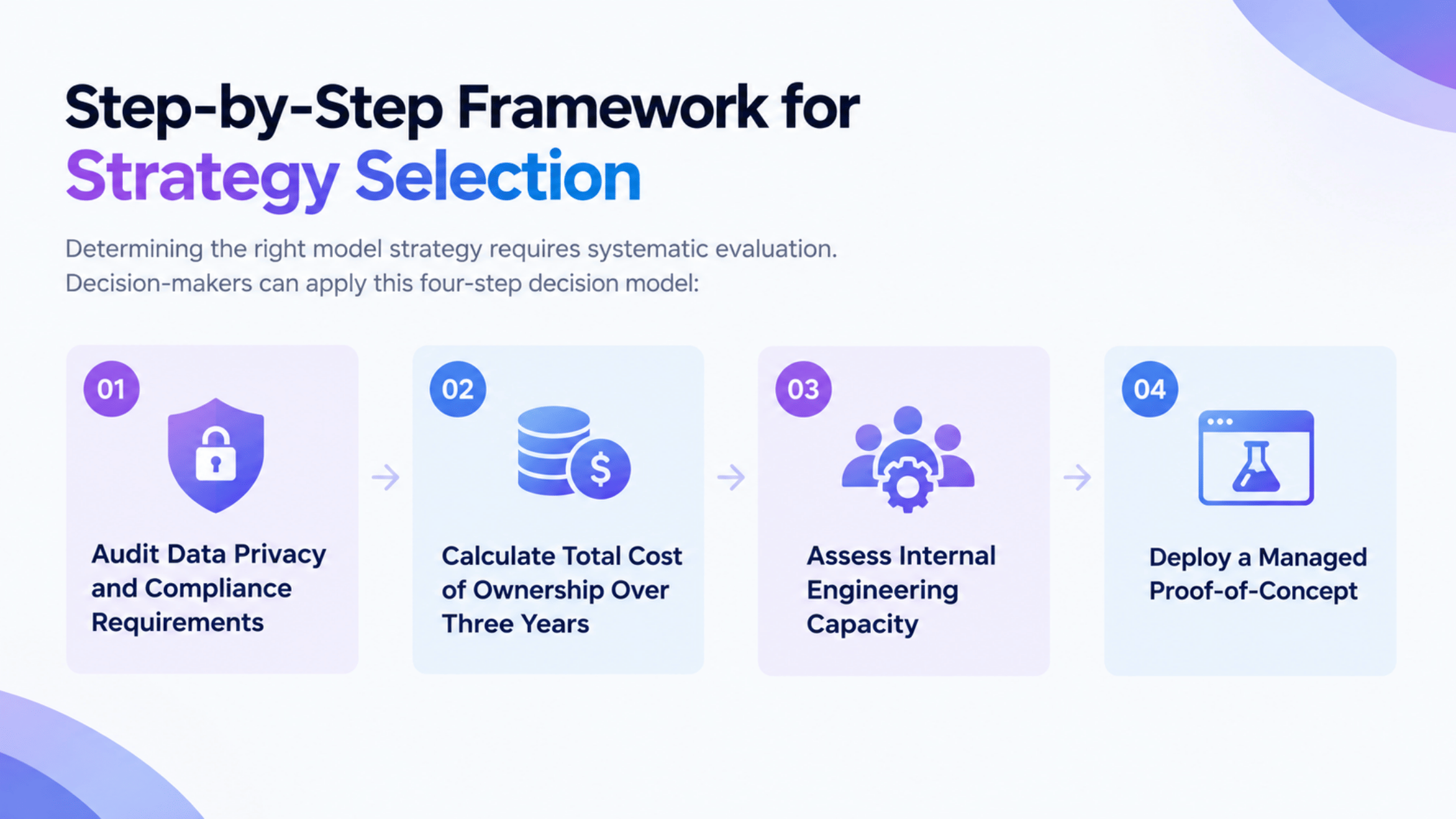
Determining the right model strategy requires systematic evaluation. Decision-makers can apply this four-step decision model:
Audit Data Privacy and Compliance Requirements: Identify whether candidate workflows handle sensitive customer data or protected intellectual property. Strict regulatory standards require private, self-hosted model hosting.
Calculate Total Cost of Ownership Over Three Years: Compare projected third-party API usage fees against initial fine-tuning budgets, cloud hosting expenses, and engineering maintenance.
Assess Internal Engineering Capacity: Evaluate if internal software teams maintain the specialized skills needed to manage models long-term. Partnering with external technical experts speeds initial implementation.
Deploy a Managed Proof-of-Concept: Test the chosen model architecture on a controlled pilot process to validate output accuracy, latency, and system integration before full deployment.
Strategic Partner Selection for Enterprise AI Success
Executing Custom AI Model Development aligns AI investments directly with core business goals. Fine-tuning open-source models secures domain accuracy, data privacy, and proprietary technical assets.
Partnering with MoogleLabs provides the senior talent, data pipelines, security, and MLOps frameworks needed to advance your deployment strategy.
Contact MoogleLabs today for a technical consultation.
Loading FAQs
Please wait while we fetch the questions...