AI Evaluation in Production: Metrics That Determine LLM Reliability
Discover how businesses evaluate LLMs and AI agents using performance metrics, continuous testing, observability, and governance to improve accuracy, control costs, and build reliable production-ready AI systems.
Deploying language models without measurement creates operational liabilities. Unmonitored LLM agents fail silently, generate incorrect statements, and consume massive cloud budgets without delivering business value.
Decision-makers need concrete technical metrics rather than guesswork to guarantee system reliability. Implementing systematic AI Evaluation allows software teams to identify failure points, control inference spend and deploy autonomous workflows with full operational confidence.
Beyond Static Benchmarks: Why Production LLM Performance Demands New Metrics
Traditional LLM benchmarking relies on static test datasets like MMLU or HumanEval to rate foundation models. These offline scores evaluate isolated text generation in controlled environments. Modern software relies on active agents that query databases, invoke APIs, and run multi-step actions across complex environments. Static scores fail to reflect operational reality once autonomous systems handle live user inputs.
Multi-step execution creates compounding risk across agent workflows. According to a Forbes analysis on enterprise AI reliability, an agent with a 95% single-step accuracy rate sees overall success drop to roughly 60% over a ten-step process. Errors accumulate across tool interactions, causing tasks to stall or fail completely.
System failures in live deployments stem from three primary causes:
Context contamination, where irrelevant retrieval chunks degrade reasoning.
Tool parameter mismatches during API payload construction.
Uncontrolled reasoning loops that exhaust maximum token allocations.
Addressing these failure modes requires moving past periodic offline evaluation. Software teams need continuous telemetry tracking every step, tool call, and generated response against defined performance standards. Aligning model architecture selection with operational monitoring strategies forms the core foundation of building long-term value, as outlined in our breakdown of LLM ecosystems for enterprise AI strategy.
Modern Frameworks for Quantitative AI Evaluation
Quantifying production performance requires specialized AI evaluation metrics that isolate failure points across data retrieval, response generation, and agent reasoning. Engineering teams deploy an AI evaluation framework to track performance across separate operational layers.
Evaluation Layer | Key Performance Metric | Technical Focus | Target SLA |
|---|---|---|---|
Data Retrieval | Context Recall & Precision | Verifies retrieved context contains target information without irrelevant noise. | > 92% Retrieval Precision |
Generation Quality | Faithfulness & Answer Relevance | Audits model responses for factual grounding against context source texts. | < 1% Hallucination Rate |
Agent Reasoning | Tool Call Syntax Accuracy | Measures correct API selection, function execution, and parameter formatting. | > 98% Valid Executions |
Trajectory Path | Step Count Efficiency | Evaluates the ratio of executed steps against optimal task completion paths. | < 1.1x Ideal Trajectory |
Financial Cost | Cost-Per-Task Ratio | Tracks token consumption, compute utilization, and API expenses per task. | Predictable Unit Costs |
Selecting target LLM evaluation metrics begins with understanding fundamental structural differences between base models and autonomous agents. Choosing appropriate metrics depends heavily on whether your stack utilizes raw text generation or autonomous tool execution.
Evaluating factual grounding requires scoring context relevance alongside answer accuracy. Automated pipelines calculate faithfulness by comparing output claims against retrieved documents, flagging hallucinated facts before responses reach end users.
Agentic tracking monitors tool selection accuracy, execution latency, and error recovery behavior. When an agent selects an invalid API endpoint or submits malformed JSON payloads, the evaluation system logs the anomaly, triggering immediate rollback routines.
System monitoring requires persistent diagnostic visibility. Teams track model behavior using real-time AI observability solutions to detect prompt drift, performance decay, and resource bottlenecks before errors impact business operations.
Processing diagnostic streams at scale demands resilient data infrastructure. High-throughput production environments construct reliable data engineering pipelines to stream event logs directly into scoring engines without adding system latency.
System Architecture: Automated Evaluators and Agent Governance
Modern enterprise governance architectures pair real-time observation with active compliance controls to prevent unauthorized behavior. Integrating continuous evaluation mechanisms allows organizations to audit autonomous decision paths while maintaining predictable operational outcomes across active deployment environments.
Mitigating Bias with Multi-Agent Evaluation Panels
Automating LLM testing relies on LLM-as-a-judge patterns to score unstructured outputs at scale. Single-judge setups exhibit systematic self-enhancement bias. Empirical research highlighted in Forbes reporting on automated LLM judges reveals that GPT-4 displays a 10% self-preference margin when scoring model outputs.
Deploying multi-agent evaluation systems solves single-model bias through structured consensus. Multi-agent panels run specialized judge models in parallel to score responses across three core categories:
Factual Grounding: Verifies output assertions directly against retrieved source documents.
Instruction Following: Checks response formatting against target system prompts.
Safety Protocols: Identifies unauthorized actions or policy violations before output rendering.
Architectural Spend Control and Model Routing
Controlling compute expenditures requires strict autonomous agent governance. Uncontrolled reasoning loops consume massive token budgets without completing assigned tasks. Production platforms integrate intelligent routing logic alongside semantic caching layers to regulate operational spend:
Model Routing: Directs standard queries to lightweight open models, reserving frontier reasoning engines for complex multi-step workflows.
Semantic Caching: Stores vector representations of frequent queries, serving instant cached responses without triggering fresh model inference.
Linking operational metrics directly to infrastructure expenditures guarantees long-term financial accountability. Aligning real-time governance with financial tracking follows the methodologies detailed in our guide to AI FinOps strategies.
Policy Boundaries and Access Rules
Enforcing policy boundaries prevents unauthorized action execution, protects sensitive enterprise data assets, and caps overall API expenditures. Guardrails enforce strict token quotas, request timeouts, and rate limits across active multi-tenant environments, preventing runaway spending during high-traffic execution spikes.
Constructing granular permission boundaries restricts agent actions to approved API endpoints and database tables. System administrators define role-based access privileges, sanitizing user queries before execution and blocking prompt injection attempts. Implementing rigorous validation filters guarantees that autonomous agents execute actions only within verified administrative parameters.
Establishing clear access controls for enterprise AI copilots secures internal data repositories while maintaining reliable system performance across business units.
How to Implement Continuous AI Evaluation in Production
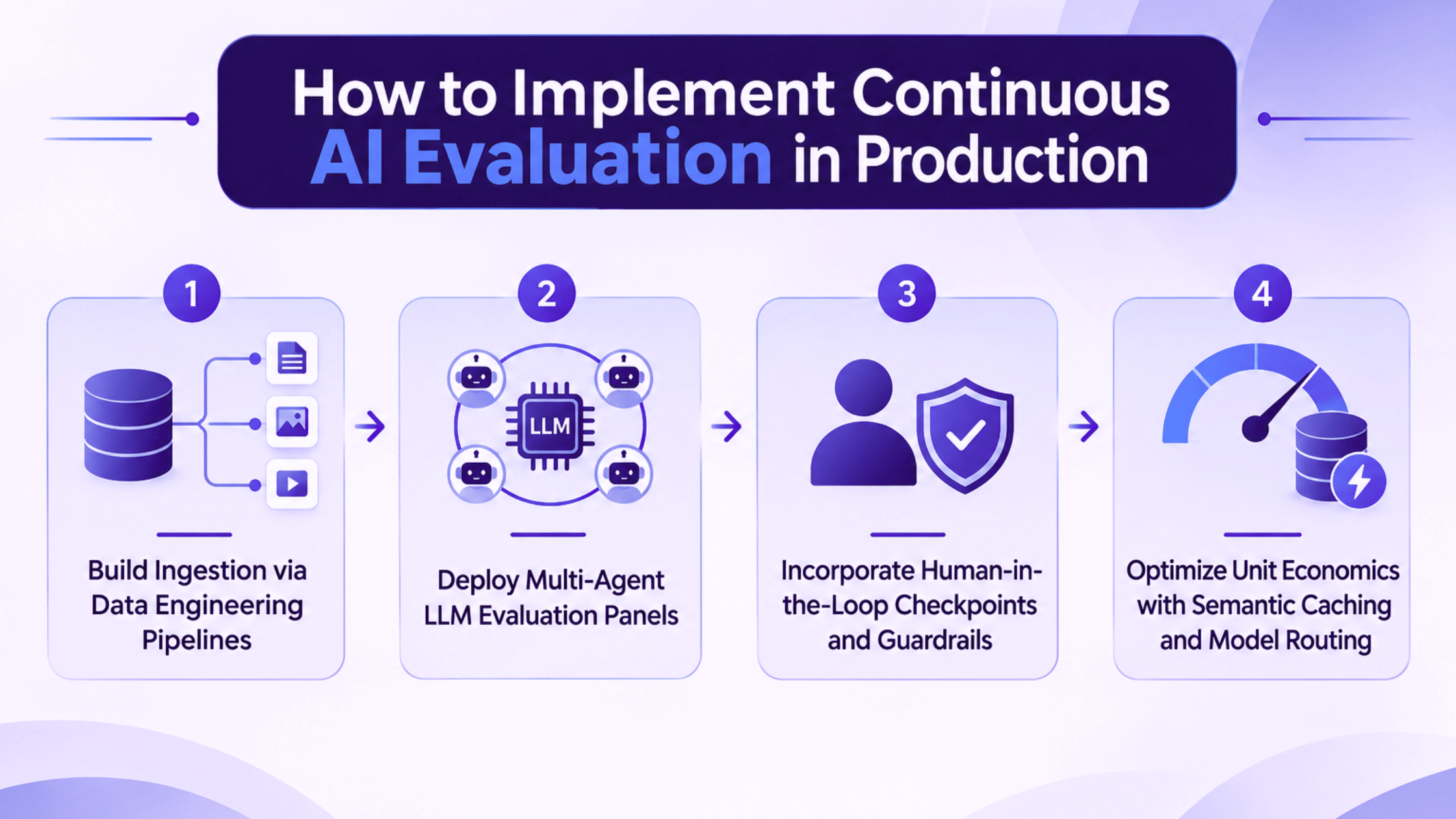
Establishing continuous evaluation requires an organized engineering workflow. Organizations implement production testing using four structured steps:
Build Ingestion via Data Engineering Pipelines
Construct centralized telemetry channels logging inputs, outputs, context chunks, and token usage in real time. Complete visibility across infrastructure prevents hidden compute costs.
Deploy Multi-Agent LLM Evaluation Panels
Set up automated scoring workflows using ensemble LLM judges. Prompts for judge agents evaluate distinct criteria including factual adherence, answer precision, and API schema validation.
Incorporate Human-in-the-Loop Checkpoints and Guardrails
Establish runtime assertion rules pausing execution when confidence scores drop below defined thresholds. Human reviewers audit borderline outputs to maintain high quality standards.
Optimize Unit Economics with Semantic Caching and Model Routing
Implement semantic caching layers to bypass inference for repeated queries. Apply model routing logic to balance workload distribution, lowering token consumption while preserving quality.
Building production testing infrastructure requires specialized expertise. Organizations scale deployment speeds by partnering with expert MLOps development services to build automated testing systems.
Long-term success depends on matching architectural capabilities with strategic business goals. Senior leaders gain rapid execution clarity by collaborating with an established AI consulting services company.
Enterprise Case Studies: Driving Measurable ROI Through Evaluation
Deploying evaluation frameworks converts experimental software into dependable, revenue-generating enterprise assets. Organizations offering agentic AI services, AI agent development, and best AI agent services embed real-time testing layers into operational platforms.
Automated Call Quality Audit: An enterprise client automated customer call evaluation using multi-criteria scoring models. The system audited 100% of support interactions, identifying service defects and reducing compliance risks without manual supervisor review.
Multi-Asset Portfolio Analytics: A financial platform implemented agentic workflows to analyze complex portfolio data. Adding retrieval checks and hallucination guardrails eliminated factual errors in client reports while reducing document processing times.
Enterprise Knowledge Discovery: A multi-tenant platform integrated automated prompt testing and semantic caching. The team cut token expenses by 38% while improving response precision across internal documentation search.
Measuring technical performance alongside business value guarantees sustainable operational growth.
Scaling High-Performance Autonomous Systems
Building autonomous systems without systematic evaluation creates financial and operational liabilities. Business leaders who prioritize comprehensive AI Evaluation maintain full control over system accuracy, response latency, and cloud infrastructure costs.
Establishing automated judge panels, real-time observability, and strict governance layers bridges the gap between experimental pilots and enterprise deployments. Ready to transform your autonomous systems into reliable, high-performing software?
Connect with the engineering specialists at MoogleLabs to construct custom evaluation pipelines, implement production guardrails, and maximize return on your technology investments.
Loading FAQs
Please wait while we fetch the questions...