Enterprise AI Security Framework: Securing AI Agents, Copilots, and Autonomous Systems
Enterprise AI is transforming business operations, but it also introduces new security challenges. Learn how organizations can secure AI agents, copilots, and autonomous systems with governance, compliance, visibility, and AI-specific security frameworks for safe AI adoption.
Sandboxes and initial pilot programs are behind us. Today, enterprise AI runs quietly in production environments - processing customer tickets, optimizing supply chain routes, generating codebase updates, and querying massive internal databases.
But this massive jump in operational capability introduces a completely different kind of corporate exposure. When you transition from a passive chat window to an autonomous agent that can read sensitive files, trigger external API calls, and alter live system states, your old security stack is out of its depth.
For organizations scaling artificial intelligence solutions, the conversation has shifted. It is no longer about if your teams should adopt these automation tools, but whether you can map out their actions with absolute visibility, precise permissions, and clear accountability. This requires a dedicated enterprise AI security framework.
MoogleLabs positions its AI/ML and agentic AI services around this broader enterprise reality, with governance, compliance, testing, and DevSecOps already built into its offering stack.
In this blog, we break down the essential pillars of enterprise AI security, and the strategies organizations need to mitigate emerging AI risks.
The Blind Spot in Traditional Cybersecurity
Traditional network defense is designed around explicit boundaries. Businesses secure endpoints, authenticate users, monitor applications, and block rogue traffic.
Autonomous AI architectures do not fit into this model. They handle unstructured, conversational data. They interpret context, create novel outputs on the fly, and pull instructions from dynamic prompts, uploaded PDFs, or third-party webhooks.
Because their operations are fluid, standard firewalls cannot see what is going wrong inside an LLM workflow. The Open Web Application Security Project (OWASP) maintains a live tracking index of these unique system vulnerabilities, but for a business, they boil down to three practical risks:
1. RAG Vulnerabilities & Indirect Injection
Most enterprises secure their core LLM but ignore the security profile of the underlying retrieval pipeline. This creates an implicit trust paradox: user queries are treated as untrusted input, but documents pulled by Retrieval-Augmented Generation (RAG) engines enter the model's context window with system-level authority.
This exposes systems to indirect prompt injection, where malicious code hidden in an invoice or document manipulates the model, as well as retrieval poisoning, which manipulates vector search rankings to surface corrupted files.
2. Model Inversion & Embedding Exfiltration
Vector databases and text embeddings introduce unique cryptographic and data privacy challenges. In a model inversion attack, advanced threat actors analyze model API responses to reverse-engineer the neural network and reconstruct the sensitive data used during fine-tuning.
Similarly, data exfiltration through embeddings allows attackers who gain read access to vector databases to use inversion models to accurately reconstruct confidential corporate documents directly from raw coordinate vectors.
3. Multi-Agent & Tool Exploitation
As architectures move from standalone copilots to connected multi-agent networks, systems communicate directly with other systems without human intervention, creating fresh points of failure:
Agent-to-Agent Attacks: Compromising a low-privilege agent to issue natural language commands to an over-privileged orchestrator agent, tricking it into executing restricted actions.
Tool Poisoning: Altering underlying tool servers or API documentation (like Model Context Protocol configurations), so the agent acts on falsified responses as if they were true.
Memory Poisoning: Feeding an agent malicious instructions during a standard conversation to corrupt its long-term context logs, permanently altering how it behaves with future users.
The Shift: Standard cybersecurity blocks unauthorized traffic. Enterprise AI security governs autonomous behavior and semantic interfaces. If your machine identities, retrieval boundaries, and tool integrations are not isolated, an automated pipeline can easily turn into an unmonitored insider threat.
Shadow AI and the Friction Facing Leadership
The speed of market adoption has outpaced internal governance, creating a massive wave of Shadow AI - the unsanctioned use of public or unvetted artificial intelligence tools by employees without IT oversight.
Industry data from IBM underscores the scope of this trend: while enterprise generative AI adoption has climbed past 96%, nearly 38% of workers admit they have pasted proprietary corporate files or sensitive customer data into external AI tools without explicit approval.
This behavior exposes your company to regulatory penalties, intellectual property loss, and unexpected data leaks. In fact, roughly 20% of companies have already recorded data exposure events directly tied to employees utilizing unsecured consumer AI platforms.
At the same time, regulatory pressure is mounting:
NIST Guidance
The National Institute of Standards and Technology continues to expand its AI Risk Management Framework (AI RMF), publishing updated directives that focus on embedding trustworthiness into critical infrastructure applications.
EU AI Act
Across the Atlantic, the enforcement schedule for the EU AI Act is moving quickly toward its next major milestone on August 2, 2026, which will introduce heavy financial penalties for non-compliant systems operating within the European market.
The Blueprint: A Practical Enterprise AI Security Framework
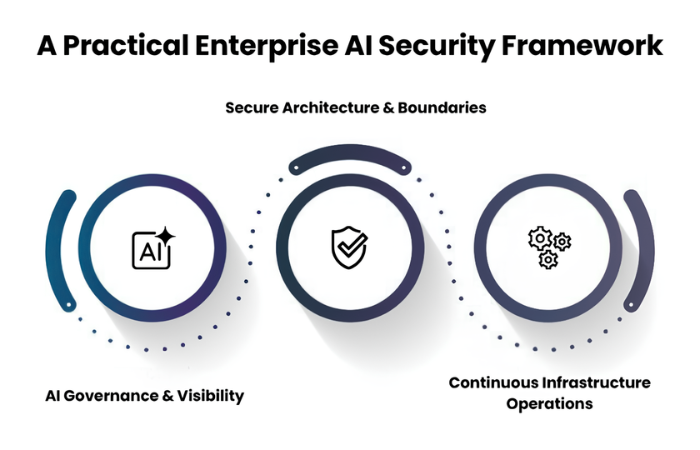
A functional enterprise security framework cannot just rely on software tools - it must set up clear control points across your entire operations. A resilient AI safety architecture splits these controls into three functional areas:
To bridge the gap between abstract policy and production-grade protection, MoogleLabs operates through its proprietary Intelligent Software Lifecycle Control (ISLC™) framework. Rather than acting as a passive security plugin, ISLC™ serves as an interlocking intelligence overlay. It embeds security protocols, guardrails, and compliance checkpoints into every phase of the software lifecycle, ensuring autonomous agents cannot bypass corporate governance.
ENTERPRISE AI SECURITY PILLARS
Governance | Architecture | Operations |
|---|---|---|
Shadow AI Discovery | Machine Identity for Agents | Continuous Threat Modelling |
Transparency & Audit Logs | Human-in-the-loop Guardrails | Posture Management |
Pillar 1: AI Governance & Visibility
Automated Shadow AI Auditing: Run continuous discovery passes across your corporate network and cloud perimeter. This process scans outbound API traffic, cloud endpoints, and enterprise single sign-on (SSO) logs to identify unauthorized corporate data moving into external, unvetted AI models. By continuously mapping the flow of text and files, security teams can pinpoint exactly which teams are bypassing compliance baselines before data exposure occurs.
Granular Audit Trails: Maintain immutable, timestamped logs of every transaction. You need to verify exactly what input the agent received, what information it retrieved from your data layer, what response it generated, and why it decided to execute a specific action. Every generative AI solution deployed in production environment should include auditability, governance, and continuous monitoring controls.
Pillar 2: Secure Architecture & Boundaries
Identity & Access Management (IAM) for Agents: Treat every autonomous agent as a privileged service account. Every autonomous bot requires a unique machine identity bound by role-based access controls (RBAC) and strict system-level scopes. If an agent is designed to summarize internal product metrics, it must lack the programmatic permissions and API access tokens required to communicate with sensitive corporate databases like HR payroll or core legal repositories.
Human-in-the-Loop Guardrails: Establish strict operational thresholds where autonomous execution stops, and manual validation is mandated. High-impact operational moves such as routing vendor invoices over a set financial threshold, updating infrastructure configuration files, or altering legal client contracts must trigger a hard asynchronous pause. The system must hold execution until an authorized human operator reviews and signs off on the agent's proposed action.
Pillar 3: Continuous Infrastructure Operations
AI Security Posture Management (AISPM): Treat your AI infrastructure with the same operational rigor you apply to cloud security, shifting focus from static perimeter defenses to continuous, behavior-driven runtime assurance. This is where AI solutions in cybersecurity become operational rather than theoretical. A comprehensive AISPM protocol requires deep visibility into four critical infrastructure layers:
Data Pipeline & Ingestion Governance: Sanitize all files entering vector stores and RAG pipelines by stripping executable code from inbound documents to block indirect prompt injections at the ingest layer.
Vector Store & Embedding Access Controls: Implement row-level security on vector indexes to prevent unauthorized bulk extractions designed to reverse-engineer sensitive corporate text directly from raw embedding coordinates.
Model Endpoint & Interface Integrity: Mandate mutual TLS (mTLS) authentication and real-time inference monitoring across all model endpoints and Model Context Protocol (MCP) connections to detect structural anomalies like model inversion attacks.
Supply Chain Verification: Run automated scanning pipelines to verify open-weight foundation model signatures, tokenizer packages, and third-party orchestration dependencies before introducing them into a production software stack.
Continuous Threat Modeling & Red Teaming: AI risks change every time you update your prompt templates, expand your training pools, or attach new software connectors. Because AI systems are non-deterministic, evolving prompts, pipelines, and integrations require an active, scenario-driven testing cadence:
Continuous Semantic Red-Teaming: Launch automated adversarial simulations to test system boundaries against adaptive jailbreaks, prompt injections, and logic manipulation.
Multi-Agent Threat Simulation: Stress-test collaborative bot networks against multi-step exploits like persistent memory poisoning and inter-agent message spoofing.
MITRE ATLAS & OWASP Mapping: Correlate security findings with the MITRE ATLAS matrix and OWASP Agentic Top 10 to systematically prioritize vulnerability remediation.
Why Do Copilots Need Special Protection?
Copilots feel safer than autonomous agents because they are “assistive,” but they still create risks. A copilot connected to internal documents, customer records, or business systems can expose sensitive data if retrieval, permissions, or output controls are weak.
The main risks include oversharing internal knowledge, summarizing confidential content into unsafe outputs, and giving confident but incorrect recommendations that sound operationally valid. For business users, that means copilot security must cover both data access and output governance.
Why Do Autonomous Systems Need a Different Security Mindset?
Autonomous systems go one step further because they do not just suggest actions - they may execute them. That makes approval of workflows, guardrails, exception handling, and rollback plans essential.
The deeper the autonomy, the stronger the security model must be. This is where governance becomes a business safeguard, not an IT afterthought.
Operationalizing AI Safety with AI TRiSM
To transform these pillars from abstract concepts into daily operational practices, forward-thinking enterprises are building their systems around AI TRiSM (Artificial Intelligence Trust, Risk, and Security Management).
AI TRiSM is not an optional software add-on or an industry buzzword. It is a structural methodology for keeping your workflows, models, and underlying data within acceptable business and regulatory boundaries. For organizations heavily investing in AI/ML solutions, AI TRiSM is becoming an essential component of the standard software delivery lifecycle.
Operationalizing AI TRiSM involves baking four core layers directly into the standard software development lifecycle:
Explainability: Leveraging tools like SHAP or LIME to make complex algorithmic and LLM decisions fully auditable.
ModelOps: Automating lifecycle management, version control, and live performance tracking to capture concept drift early.
AI-Specific Security: Actively neutralizing novel vectors like data poisoning, model inversion, and prompt manipulation.
Data Privacy & Compliance: Enforcing strict data governance to guarantee compliance with shifting legal boundaries like the EU AI Act.
Integrating these controls early allows organizations to confidently scale autonomous systems without exposing themselves to catastrophic financial, legal, or brand liability.
Moving from Strategy to Execution: The MoogleLabs Approach
As enterprises shift from initial AI experimentation to production-scale automation, security cannot be a retrofitted afterthought. MoogleLabs bridges the gap between raw model capabilities and enterprise-grade compliance by embedding governance directly into every stage of development.
The ISLC™ Governance Framework
We integrate governance, risk mitigation, and compliance into our AI/ML services and Agentic AI solutions through our proprietary ISLC™ framework. Operating as an intelligent governance overlay, ISLC™ enforces safety boundaries without disrupting developer velocity:
Secure AI Model Deployment: We isolate runtime environments and implement real-time monitoring of model inputs and outputs to block data exfiltration attempts and multi-tenant data bleeding.
DevSecOps for AI Systems: Security audits are baked into data collection, training, and deployment pipelines—ensuring automated model weight validation and data provenance tracking are structural realities.
Agentic Guardrails for Autonomous Systems: As businesses transition to agentic networks, we deploy deterministic runtime filters. If a tool or connection fails, the system triggers a fail-safe "Zero Action" state to prevent cascading operational failures.
The Bottom Line: Whether your organization requires scoped internal copilots or highly integrated, multi-agent autonomous ecosystems, MoogleLabs delivers systems with strict behavioral guardrails, precise machine permissions, and transparent, tamper-proof audit trails from day one.
Ready to operationalize your AI security framework? Connect with our experts at MoogleLabs to build a security-first AI roadmap that accelerates your operational efficiency while protecting your corporate data assets.
Loading FAQs
Please wait while we fetch the questions...