Large Language Models Examples: Top Models, Applications & Insights
.png&w=3840&q=75)
This blog breaks down what Large Language Models are, why they matter in 2026, and how businesses are using them to improve productivity and decision-making. It highlights leading LLMs, real-world industry use cases, and key factors to consider when choosing the right model for enterprise needs.
Artificial intelligence has now entered the homes and mobile phones of every individual. However, businesses did get to using it first, with major players like Google and Microsoft investing significantly in the technology. In this, generative AI services and the large language models have proved themselves to be a crucial part of today and tomorrow.
So, the focus of this blog is going to be large language models, what they are, why businesses are choosing to use them, the various use cases, and some of the more prevalent LLMs that you should know about today.
What are Large Language Models?
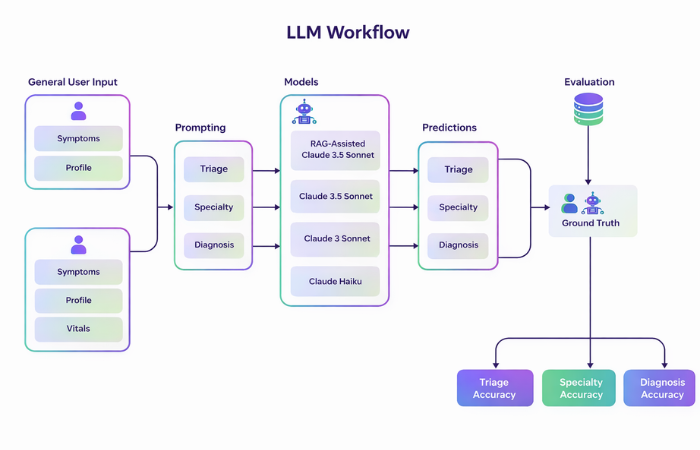
Large language models are an advanced type of artificial intelligence that is trained on massive data to understand, generate, and respond in human language while being accurate. To learn, it uses texts available online, articles, books, conversations, code, and more. It teaches LLMs to recognize patterns and predict what word should come next.
Hence, they can write
emails
answer questions
summarize content
Translate languages
Generate Ideas
If you have used large language models like ChatGPT, Claude, and Llama, you probably know how efficiently they can communicate in human-like language.
The fact that ChatGPT attracted over a million users in the first five days shows just how popular these tools truly are in the public domain.
Behind the frontend is LLM development, that includes training deep neural networks with billions of parameters, letting these models reason, analyze, and adapt as per the task.
Today, large language models are powering chatbots, search engines, coding tools, business automation, and several of the enterprise apps, making them one of the major technologies of today’s time.

Why are Large Language Models Relevant Today?
Businesses have always looked for ways to reduce their work while improving their output. Generative AI works in the same direction. For one, it can automate several tasks that previously needed human intelligence, opening doors to new innovations.
They are also ideal because they offer:
Higher efficiency reduces the need for manual intervention and speeds up the process.
Better performance with the ability to produce swift, low-latency responses.
Scalability that assists with the handling of massive data, so that it can adapt to several applications.
Flexibility that ensures your business can meet the specific requirements of use cases.
Multilingual support that encourages global communication and information access.
Better user experience through context-aware responses.
LLMs are already elevating user experience, and personalizing experiences in ways that traditional software could never do.
9 Major Large Language Models Businesses Should Know Today in 2026
Model Family | Developer | Primary Focus | Best Use Case |
|---|---|---|---|
GPT-5o / 5.1 | OpenAI | Reasoning & Multimodal | Financial Analysis & Strategy |
Gemini 1.5/2.0 | Context Window | Large-scale Research & Data Analysis | |
Claude 3 | Anthropic | Safety & Nuance | Creative Writing & Coding |
Mistral Large | Mistral AI | Efficiency | Cost-effective Multi-language Apps |
Llama 3 / 3.1 | Meta | Open-Source | On-premise Secure Deployments |
DeepSeek V3 / R1 | DeepSeek | Logic & Cost | Science & Math Research |
IBM Granite | IBM | Enterprise Data | Legal & Regulatory Compliance |
XAI Grok 2 | xAI | Real-time Data | Trend Tracking & Social Insights |
AWS Titan | Amazon | Cloud Integration | AWS-native Workflow Automation |
As generative AI reaches new heights, the LLM ecosystem is also becoming broader, more specialized, and enterprise-ready. Here is an overview of the influential models that are shaping the world of today.
OpenAI GPT – 5o and GPT 5.1
While GPT-4o was the "warm and conversational" favorite, OpenAI’s 2026 lineup focuses on reasoning. The o-series models use reinforcement learning to "think" before they speak, drastically reducing hallucinations.
Key Strengths: Unmatched reasoning capabilities and the ability to process text, audio, and vision simultaneously.
Application Examples: Advanced customer support agents, complex financial modeling, and creative content strategy.
Latest 2026 Features: High-speed "Omni" reasoning which allows for near-zero latency in voice-to-voice interactions.
Google Gemini 1.5/2.0
Gemini is built to be "natively multimodal" from the ground up, designed to function seamlessly across Google’s massive ecosystem.
Key Strengths: It features a massive context window (up to 2 million tokens), allowing it to "read" an entire library or "watch" hours of video in one go.
Best For: Deep research, large-scale video analysis, and integration with Workspace apps like Docs and Sheets.
Anthropic Claude 3 (Opus, Sonnet, Haiku)
Claude is widely regarded as the most "human" and ethically grounded model family, favored by those who prioritize safety and long-form writing.
Key Strengths: Exceptional at following complex instructions and producing nuanced, non-repetitive prose.
Special Feature: The "Extended Thinking Mode" allows the model to spend more compute time on difficult problems, leading to higher accuracy in coding and math.
Mistral Large
Hailing from Europe, Mistral provides high-performance AI/ML solutions with a focus on efficiency and open-weight accessibility.
Key Strengths: Optimized for cost-effective deployment and multilingual performance, especially in European languages.
Use Case: Ideal for businesses that want proprietary-level performance without the restrictive ecosystems of US-based tech giants.
Meta Llama 3/Llama 3.1
The Llama series revolutionized the industry by bringing "frontier" performance to the open-source community.
Key Strengths: Flexibility and transparency. Because the weights are open, companies can host Llama on their own servers for maximum security.
Impact: It has become the standard for local generative AI development, allowing startups to build custom tools without high API costs.
DeepSeek V3 / DeepSeek-R1
A major disruptor in 2025 and 2026, DeepSeek offers extreme reasoning capabilities at a fraction of the market cost.
Key Strengths: Specializes in "Chain-of-Thought" reasoning, making it incredibly powerful for mathematics, logic, and scientific research.
Why it Matters: It has forced the industry to move toward more efficient training methods, making high-end AI solutions more accessible.
IBM Granite
IBM has focused its generative AI services specifically on the enterprise, ensuring that Granite is trained on high-quality, vetted business data.
Key Strengths: High reliability and "Granite Guardian" safety features that prevent the model from generating toxic or biased content in a corporate setting.
Best For: B2B applications, legal research, and regulatory compliance.
XAI Grok 2
Developed by Elon Musk’s xAI, Grok is designed to be a "truth-seeking" AI with real-time access to global events via the X (formerly Twitter) platform.
Key Strengths: Real-time data integration and a less "filtered" conversational style.
Application: Trend analysis, sentiment tracking, and staying updated on breaking news faster than any static model could.
AWS Titan Text
Amazon’s Titan models are the "workhorses" of the AWS Bedrock environment, designed for high-scale, stable integration.
Key Strengths: Seamless connection with Amazon’s cloud infrastructure and easy fine-tuning using your own company data.
Why Choose It: If your business already runs on AWS, Titan offers the most frictionless path to deploying AI/ML development projects.
How are Businesses Using LLMs to Improve Productivity?
The various industries of the world are using LLM technology to improve their operations in a variety of ways. Here is a breakdown of LLM development use based on industries
Healthcare
LLMs are saving the healthcare industry hours of administrative work.
Clinical Summarization: Models listen to patient-doctor consultations and automatically update Electronic Health Records (EHR).
Drug Discovery: LLMs analyze existing medical literature to predict how different chemical compounds might interact, accelerating clinical trials.
Financial Institutions
In finance, precision is everything.
Fraud Detection: AI/ML solutions analyze transaction patterns in real-time to flag anomalies that traditional rule-based systems would miss.
Algorithmic Trading: Using real-time news feeds (via models like Grok 2), LLMs help traders understand market sentiment before it reflects in the price.
Retail and e-Commerce
The "Chatbot" of 2020 is dead. In 2026, retail uses generative AI development to create "Shopping Concierges."
Visual Search: A customer can upload a photo of a dress they saw in a movie, and the LLM finds it in the catalog, suggests a size based on purchase history, and offers a discount code.
Dynamic Pricing: Models analyze competitor pricing, inventory levels, and local demand to optimize margins minute-by-minute.
Logistics and Supply Chain
Route Optimization: LLMs process weather data, traffic sensors, and fuel prices to suggest the most efficient delivery routes.
Inventory Forecasting: Predicting "bullwhip effects" in the supply chain by analyzing global news and shipping delays.
Manufacturing
The use of generative AI in manufacturing industry is
Predictive Maintenance: LLMs "read" sensor logs from factory machinery to predict a breakdown before it happens.
Manual Digitization: Converting decades of scanned PDF manuals into interactive, searchable "Ask the Machine" interfaces for technicians.
Factors to Consider when Choosing the Right Large Language Model for Your Needs
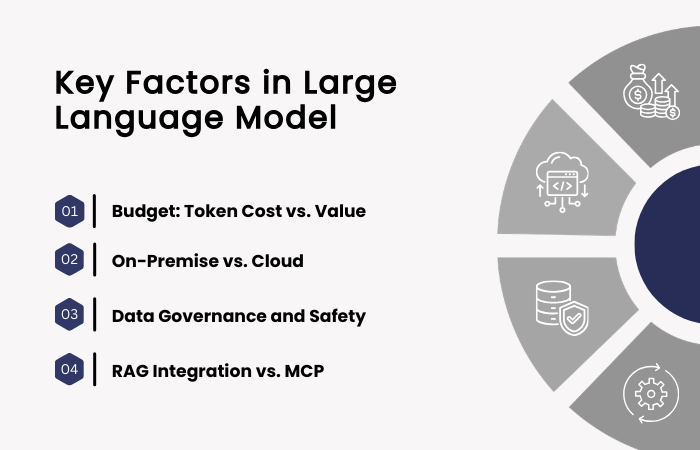
With so many options, choosing a model is a strategic decision. Most organizations are now partnering with specialized generative ai development companies to navigate these choices.
1. Budget: Token Cost vs. Value
While models like DeepSeek are incredibly cheap, GPT-5.2’s reasoning might save you more money in the long run by reducing the need for human oversight. You must balance "Inference Cost" with "Accuracy Value."
2. On-Premise vs. Cloud
If you are in a highly regulated industry (like Defense or Healthcare), you may require an open-source model (like Llama 4) hosted on your own private cloud to ensure data sovereignty.
3. Data Governance and Safety
Does the model provider use your data for training? In 2026, enterprise-tier agreements usually guarantee that your data stays yours, but it's vital to check the fine print of your AI/ML solutions.
4. RAG Integration vs. MCP
A major debate in 2026 is how the model accesses your data. Should you use traditional Retrieval-Augmented Generation (RAG), or the newer Model Context Protocol (MCP)?
RAG is great for searching vast, unstructured knowledge bases.
MCP provides a more structured, tool-based way for the model to interact with your data. To understand which foundation is right for your project, read our comparison on MCP Vs. RAG.
Final Thoughts
Everyone today knows what artificial intelligence is, but companies are still trying to determine what this innovation actually means for their business. There are still companies that are vehemently opposed to using it, and others that are already using technology to their benefit.
Irrespective of where you fall on the spectrum, the truth is, AI adoption is as necessary a shift as use of machines in industries. Without it, business risk losing their competitive edge, becoming less apt at doing their job at the pace world demands.
With generative AI technology, combined with LLM, you can have solutions that change your company for the better.
Loading FAQs
Please wait while we fetch the questions...