Prompt Engineering in Modern Machine Learning Systems: A Business-Focused Deep Dive
.png&w=3840&q=75)
Learn how prompt engineering enhances modern machine learning by improving AI accuracy, context, and performance in real-world applications.
Large language models have quietly changed how machine learning systems are designed, deployed, and scaled.
For years, progress in machine learning development has been driven by better architectures, larger datasets, and more sophisticated training pipelines. Today, a growing share of real-world intelligence is shaped at inference time, not during training. The lever that makes this possible is prompt engineering.
What began as a usability trick has evolved into a core engineering discipline. In modern AI/ML services, prompts function less like casual instructions and more like control layers that govern how models reason, respond, and integrate into business systems.
This article will explore what prompt engineering is, how it fits into production ML stacks, where it outperforms fine-tuning, and why it has become central to scalable machine learning development services.
What Is Prompt Engineering in Machine Learning?
Prompt engineering is the process of designing structured inputs that guide the behavior of pre-trained machine learning models at inference time.
In practical terms, prompt engineering enables a model to:
Perform a specific task
Follow explicit constraints
Produce structured, machine-readable outputs
Behave consistently across repeated executions
From an engineering standpoint, prompts act as runtime conditioning mechanisms. Instead of modifying model weights through retraining or fine-tuning, developers shape behavior dynamically by controlling the inputs.
This distinction matters to businesses. Prompt-based systems reduce time-to-market, lower experimentation costs, and allow teams to iterate without retraining models or collecting large, labeled datasets. That flexibility is a major reason prompt engineering now sits at the center of many AI development services.
Where Prompt Engineering Fits in the Machine Learning Stack
Traditional machine learning pipelines are training-centric:
Data → Feature Engineering → Model Training → Evaluation → Deployment
Large language model systems introduce a different execution paradigm:
User Input → Prompt Template → LLM (Frozen Weights) → Validation → Business Logic
The shift is subtle but profound. Intelligence that once lived inside trained weights is increasingly expressed at inference time through prompts.
For organizations investing in machine learning services, this means:
Faster iteration cycles
Lower dependency on labeled data
Easier experimentation across use cases
Reduced retraining and infrastructure overhead
However, it also means prompts must be treated as production assets. Poorly designed prompts introduce instability, unpredictable outputs, and operational risk.
Prompts as Control Interfaces, Not Text Blobs
In production-grade AI/ML development, prompts are not free-form text. They function as control interfaces, similar to API contracts or policy definitions.
A well-engineered prompt explicitly defines:
Who the model is acting as
What task it must perform
What constraints it must obey
What format the output must follow
This is why prompt engineering increasingly resembles software engineering rather than copywriting. The goal is not creativity, but predictability, traceability, and control.
For business-critical workflows such as document analysis, customer support automation, compliance checks, or decision support systems, this distinction is non-negotiable.
Core Prompt Engineering Patterns Used in Production Systems
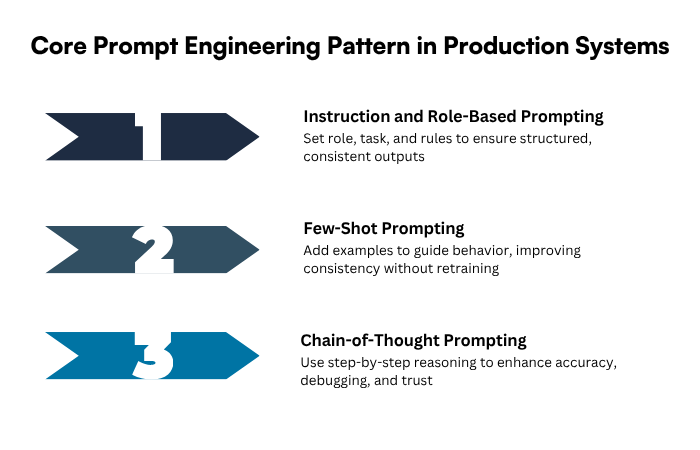
1. Instruction and Role-Based Prompting
This is the baseline pattern used across most machine learning development services.
Example:
Role: You are an AI/ML engineer
Task: Classify customer feedback into exactly one category
Rules: Output JSON only. Choose one category
Input: “The app crashes while uploading pictures”
Why this works:
The role primes domain-relevant knowledge
Explicit rules reduce output variance
Structured output simplifies validation and downstream processing
This pattern is foundational in AI development services that integrate LLMs into existing software systems.
2. Few-Shot Prompting
Few-shot prompting introduces examples directly into the prompt to guide behavior without updating model weights.
This approach is especially effective when:
Label definitions are ambiguous
Business logic is nuanced
Consistency matters more than creativity
Examples act as temporary task adapters, making few-shot prompting a powerful alternative to traditional model training in many enterprise scenarios.
3. Chain-of-Thought Prompting
Chain-of-thought prompting encourages models to generate intermediate reasoning steps before producing a final answer.
From an engineering and business perspective, this offers three advantages:
Improved accuracy on complex tasks
Better debuggability
Greater trust in model outputs
For decision-makers evaluating AI/ML services, this technique is particularly valuable in finance, operations, analytics, and policy-driven workflows.
Prompt Engineering vs Fine-Tuning: When to Use Each
Prompt engineering and fine-tuning are not competing approaches. They are complementary tools.
Prompt engineering is best when:
Speed and flexibility are priorities
Tasks evolve frequently
Labeled data is limited
Outputs must be explainable
Fine-tuning is appropriate when:
Latency requirements are strict
Output consistency must be extremely high
Prompt complexity becomes unmanageable
In many modern machine learning development projects, teams start with prompt engineering and only move to fine-tuning when prompt-based methods hit clear limits.
Prompt Templates as Reusable Engineering Assets
In production environments, prompts should be treated as first-class artifacts.
Well-managed prompt systems are:
Versioned
Parameterized
Logged
Tested and validated
This approach mirrors best practices in software development and is essential for scalable AI/ML development services. Prompts should evolve through controlled iteration, not ad hoc experimentation.
Prompt Engineering in Retrieval-Augmented Generation Systems
Prompt engineering becomes even more critical in Retrieval-Augmented Generation systems.
In RAG architectures, models generate outputs based on retrieved documents rather than internal memory alone. The prompt determines:
How retrieved context is used
What the model is allowed to infer
How strictly it must stay grounded in source material
Strong prompt design reduces hallucinations, improves compliance, and increases trust. This is why prompt engineering is a core capability in RAG application development services, especially for enterprise knowledge systems.
For a deeper understanding of how RAG systems differ from pure generative approaches, MoogleLabs’ internal guide on RAG application development provides useful context.
To clarify what is LLM in generative AI in this context, the LLM acts as a general-purpose language engine, while prompt engineering ensures the model generates responses grounded strictly in the retrieved knowledge rather than assumptions learned during pre-training.
Prompt Engineering in Agentic AI Systems
As organizations move beyond single-response models toward autonomous or semi-autonomous systems, prompts take on an expanded role.
In agentic AI systems, prompts define:
Decision policies
Tool usage rules
Stopping conditions
Logging and reporting behavior
Rather than generating text, the model follows instructions to act, decide, and coordinate. This evolution is closely tied to broader advances in agentic AI solutions, where prompt engineering becomes the backbone of system behavior.
Common Prompt Engineering Failure Modes
Even experienced teams encounter recurring issues.
Common problems include:
Overloaded prompts with too many tasks
Conflicting or implicit instructions
Missing output schemas
Vague role definitions
Unbounded response lengths
Anti-pattern:
“Summarize, analyze, criticize, improve, and rewrite this document.”
Better approach:
Break the workflow into multiple prompts with validation at each step.
For businesses relying on AI/ML services, avoiding these failure modes is critical to maintaining reliability and user trust.
How to Evaluate and Test Prompts in Production
Prompts should be evaluated with the same rigor as code or models.
Key evaluation metrics include:
Task success rate
Valid structured output percentage
Token usage and cost
Response variance across runs
A/B testing prompts is often faster and more cost-effective than retraining models. This makes prompt optimization a powerful lever in machine learning development services aimed at continuous improvement.
What This Means for Business Leaders
Prompt engineering is not a technical curiosity. It is a practical mechanism for controlling AI behavior without rebuilding systems from scratch.
For business owners and decision-makers, this translates into:
Faster AI deployments
Lower development costs
Easier experimentation
More controllable AI systems
When paired with an experienced artificial intelligence development in USA, prompt engineering becomes a strategic asset rather than a trial-and-error exercise.
Final Thoughts
Prompt engineering has become a runtime control layer for systems created through modern machine learning development services. It bridges the gap between raw model capability and real-world business requirements.
If models are infrastructure, prompts are logic. And like any logic that drives critical systems, they demand discipline, testing, and expertise.
For organizations exploring AI/ML services, understanding prompt engineering is no longer optional. It is foundational to building reliable, scalable, and business-ready AI systems.
Loading FAQs
Please wait while we fetch the questions...