The Real Gap Between AI Security and AI Safety
Most organizations assume securing AI is enough, but security and safety are not the same. This blog uncovers the gap between AI security and AI safety, explaining why systems must be protected from attacks while also ensuring reliable, unbiased, and responsible outputs for true enterprise success.
Many leaders treat protecting an artificial intelligence system as a singular task. Theu hire a team for artificial intelligence services, set up firewalls, and consider the job done. There is a fundamental disconnect in this process, which leads to expensive failures. It is the difference between a system being attacked and a system simply behaving badly on its own.
To build reliable enterprise solutions, you have to manage two distinct fronts. One is AI Security vs AI Safety, and mistaking one for the other is how most internal projects stall before reaching ROI.
Defining the Boundaries: AI Security vs AI Safety
Think of AI Security vs AI Safety as the difference between a burglar breaking into your office and your office’s automated climate control accidentally dropping the temperature to freezing.
AI Security focuses on protecting the system from external, malicious actors. This includes preventing prompt injection attacks where someone tries to trick a chatbot into leaking data or stealing the model’s proprietary weights.
AI Safety deals with internal risks. It’s about ensuring the model’s outputs align with your brand values and don't produce biased, harmful, or hallucinated information, even when no one is attacking it.
According to a 2024 report by Forbes, nearly 80% of organizations do not have a dedicated plan for risks associated with AI, yet many struggle to categorize these risks into actionable technical buckets. The EU AI Safety Act is forcing these companies to change that.
Now, when you invest in AI development services, your strategy must address both the burglar and the malfunction.
Why This Distinction Matters for Business Leaders
A recent Forbes insight points out that over 54% of organizations adopting AI lack structured risk frameworks. That gap is where confusion between AI Security vs AI Safety begins to cost money, reputation, and compliance readiness.
Business leaders often invest in firewalls, encryption, and DevOps pipelines, thinking their AI systems are safe. In reality, they are only secure, not safe.
That difference becomes visible when:
An AI chatbot gives harmful advice
A recommendation engine amplifies bias
An AI agent makes decisions outside intended boundaries
Security did its job. Safety failed.
AI Safety vs AI Security: Key Differences
Feature | AI Security | AI Safety |
|---|---|---|
Primary Goal | Protect the system from malicious actors and unauthorized access. | Ensure the system behaves reliably and aligns with human values. |
Source of Threat | External: Hackers, competitors, or malicious insiders. | Internal: Flaws in data, logic, or unforeseen model behaviors. |
Common Attacks | Adversarial attacks, model poisoning, and API breaches. | Hallucinations, biased outputs, and reward hacking. |
Focus Area | Infrastructure, data integrity, and API security. | Output reliability, model alignment, and ethics. |
Technical Solution | Encryption, Secure MLOps, and robust access controls. | RLHF (Reinforcement Learning), guardrails, and stress testing. |
Regulatory Focus | GDPR / Data Privacy Laws. | EU AI Act / OECD AI Principles. |
Analogy | A locked vault that prevents a thief from stealing the contents. | A steering wheel and brakes that keep a car from veering off the road. |
What Enterprises Get Wrong About AI Security
Most traditional IT teams approach AI through the lens of standard DevOps service protocols. They look at encryption and server uptime. While necessary, these don't cover the unique vulnerabilities of neural networks.
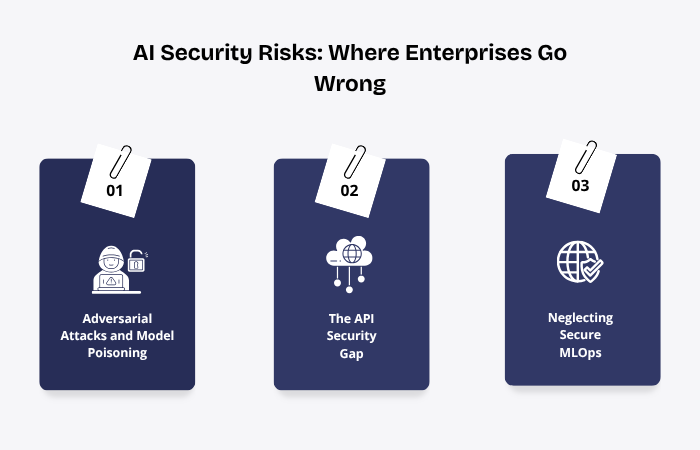
1. Adversarial Attacks and Model Poisoning
In standard software, you secure the code. In AI, the code is the data. Model poisoning occurs when a malicious actor subtly alters the training data to create a backdoor.
Similarly, adversarial attacks involve inputting specifically crafted data designed to confuse the model into making a wrong decision. This is a primary concern in AI Security vs AI Safety discussions because a secured server won't stop a model that was born with a hidden flaw.
While basic firewalls protect the server, a more granular approach like deep learning fraud detection is required to identify when a model is being fed poisoned data.
2. The API Security Gap
Many enterprises expose their models via APIs without realizing that these are new entry points for data exfiltration.
Without a dedicated DevSecOps for AI systems approach, these APIs can be reverse-engineered to steal the underlying model logic or sensitive training data.
3. Neglecting Secure MLOps
Security isn't a final step; it must be baked into the entire lifecycle. Secure MLOps practices ensure that every version of a model is tracked, scanned for vulnerabilities, and deployed through a controlled pipeline. Without this, shadow AI (unauthorized models) can create massive compliance holes.
To prevent "Shadow AI" and ensure every model is checked, a robust DevOps strategy for startups and enterprises is non-negotiable for long-term AI safety.
The Silent Risk: Where AI Safety Fails
You can have the most secure server on earth, but if your AI agent starts giving customers bad financial advice or leaking internal HR policies, you have a safety crisis.
When MoogleLabs helps organizations with AI agent development, we emphasize that safety is a continuous process. As noted in our guide on how to test AI models, checking for accuracy isn't a one-time event. Models "drift" over time, and output reliability must be monitored constantly.
Alignment Problems
The biggest challenge in AI Security vs AI Safety is alignment. A model might be technically "correct" but practically useless or even damaging. For example, a sales bot optimized solely for closing deals might start making false promises. It’s following its goal; it just isn't safe for your brand.
The Hallucination Factor
Safety also covers the tendency of Large Language Models (LLMs) to make up facts with total confidence. For businesses using Machine learning services to automate support, a single hallucination can lead to legal liability.
The Intersection: A Unified Risk Framework
The debate of AI Security vs AI Safety shouldn't be about choosing one. It’s about integration. A secure model that isn't safe will alienate your customers. A safe model that isn't secure will be exploited.
For those tracking emerging trends in AI technology, the shift is toward Red Teaming – the practice of intentionally trying to break the system from both security and safety angles before it goes live.
Feature | AI Security | AI Safety |
|---|---|---|
Intent | Preventing malicious attacks | Preventing unintended harm |
Focus | Infrastructure & Inputs | Outputs & Model Alignment |
Risk Type | Data breaches, model theft | Bias, hallucinations, bad advice |
Solution | API security, encryption | RLHF, guardrails, continuous testing |
How to Build a Resilient AI Strategy
If you are a decision-maker looking to implement artificial intelligence services, here is a roadmap to ensure your enterprise is protected.
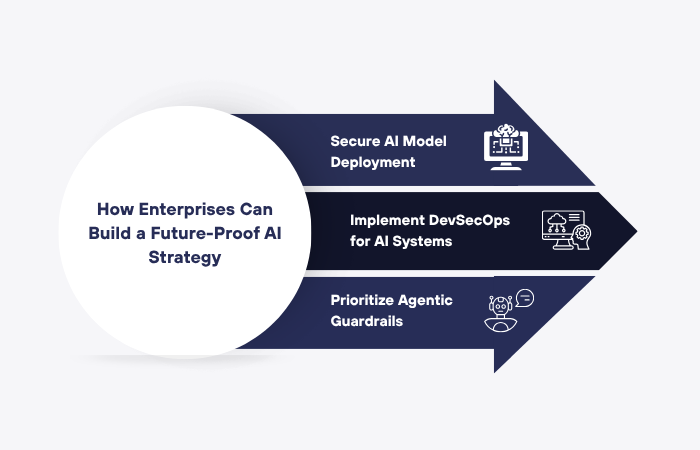
Step 1: Secure AI Model Deployment
Move beyond basic cloud hosting. Use a Secure AI model deployment strategy that includes environment isolation and real-time monitoring of model inputs and outputs. This prevents unauthorized access while ensuring the model performs as expected.
Step 2: Implement DevSecOps for AI Systems
Integrate security into your data science workflows. By adopting DevSecOps for AI systems, you ensure that security audits happen at the data collection, training, and deployment stages, rather than being an afterthought.
Step 3: Prioritize Agentic Guardrails
As businesses move toward B2A (Business-to-Agent) strategies, the autonomy of these agents increases. You need automated checks that sit between the agent and the user, acting as a filter for both AI Security vs AI Safety concerns.
Making the Connection
The technical nuances of AI Security vs AI Safety are the bedrock of modern digital trust. Companies that ignore these distinctions often face PR nightmares or data lawsuits.
Whether you need DevOps service to secure your infrastructure or specialized AI agent development to transform your operations, MoogleLabs specializes in bridging this gap. We don't just build models; we build secure, safe, and scalable enterprise assets.
Loading FAQs
Please wait while we fetch the questions...