TinyML: Bringing Machine Learning to Edge Devices
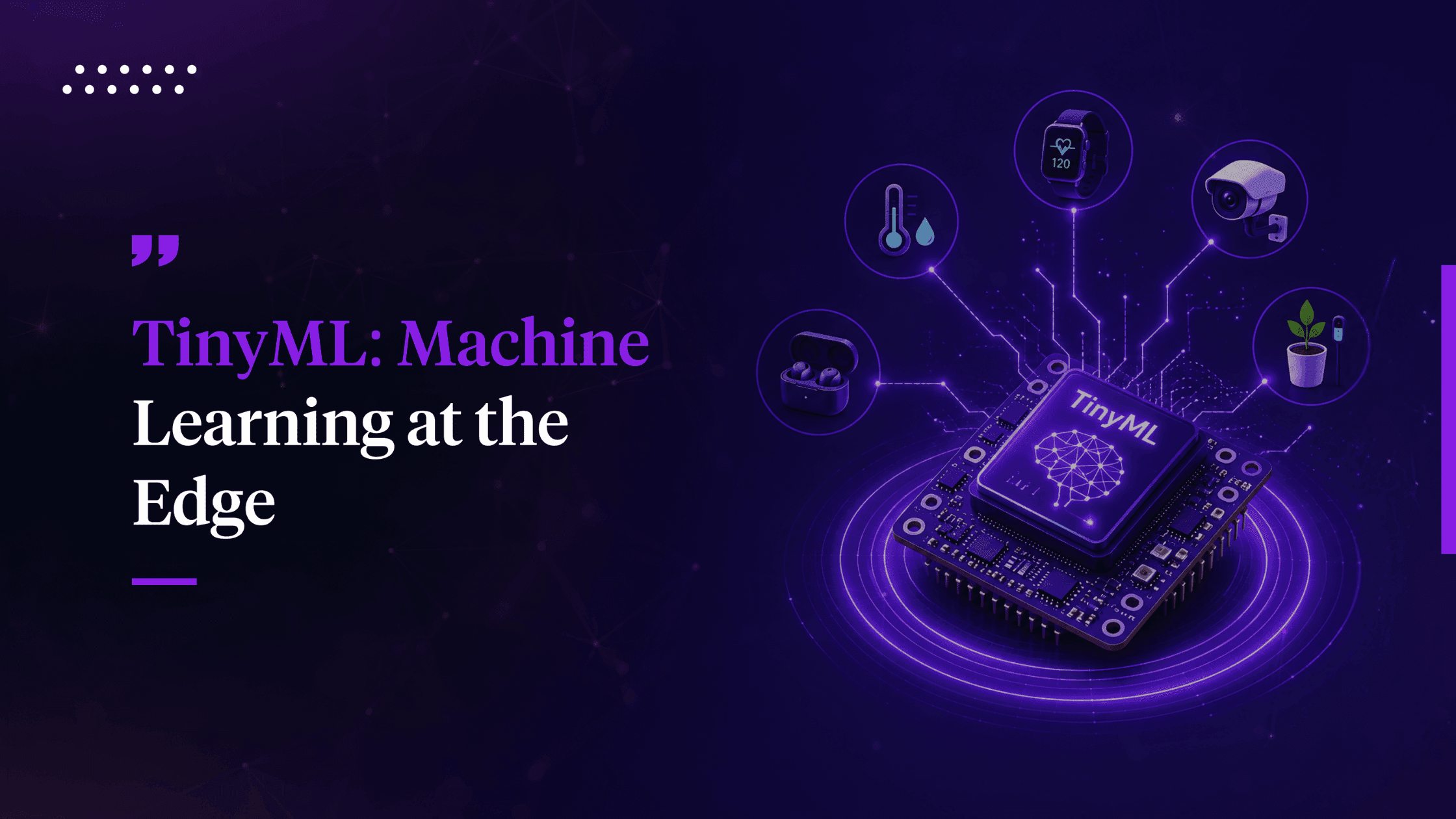
Discover how TinyML enables machine learning on edge devices, delivering real-time intelligence, low latency, enhanced privacy, and energy-efficient AI.
Deploying artificial intelligence to centralized cloud clusters introduces significant operational hurdles for enterprise IoT networks. Continuous telemetry streaming strains network bandwidth, creates unpredictable transmission latency, and drives up cloud data ingestion and storage fees.
TinyML resolves these infrastructure bottlenecks by running optimized models directly on low-power, localized microcontrollers (MCUs) at the sensor source. Shifting from cloud dependencies to autonomous edge nodes provides engineering and product teams with a predictable framework for low-latency, secure machine learning deployment.
Architectural Blueprint: Cloud ML vs. On-Device TinyML
Standard Edge AI typically relies on power-heavy gateway devices or single-board computers running full Linux distributions. TinyML, however, operates under ultra-low-power constraints, often in the milliwatt range, on bare-metal microcontrollers such as ARM Cortex-M series devices, running without standard operating system overhead.
Executing inference directly at the sensor source significantly minimizes the data attack surface, keeping raw telemetry contained inside localized, in-memory components, and reducing transit-based data exposure.
Performance Metric | Cloud-Based Machine Learning | On-Device TinyML |
|---|---|---|
Compute Infrastructure | High-performance CPU/GPU cloud infrastructure | Resource-constrained microcontrollers (MCUs) |
Latency Profile | Variable (dependent on network round-trips and queue depth) | Real-time, deterministic (sub-millisecond execution loops) |
Connectivity Requirement | Requires continuous active network uptime and data pipelines | Full offline capability; independent operational autonomy |
Power Consumption | High consumption (constant grid power and cooling required) | Ultra-low power consumption (milliwatt range; battery-operable) |
Data Lifecycle | Continuous transmission of raw data over public/private networks | Localized data processing directly at the sensor source |
The Optimization Toolchain: Compiling Models for Under 256 KB RAM
Deploying deep learning graphs to an MCU requires a specialized optimization pipeline. Hardware environments are strictly limited, often constrained to less than 256 KB of SRAM and 1 MB of Flash storage.
Post-Training Quantization (PTQ)
During training, the model weights are in 32-bit floating point. After training, these values are quantized to small 8-bit integers. This decreases the memory footprint by as much as 75% and allows for faster inference on low-power microcontrollers that can perform integer math faster than the more complex floating point computations.
Below is a typical Python implementation using TensorFlow Lite to apply full integer quantization to a trained Keras model:
import os
import numpy as np
import tensorflow as tf

# Load the trained SavedModel
converter = tf.lite.TFLiteConverter.from_saved_model("models/industrial_cnn_v1")

# Enforce full 8-bit integer quantization
converter.optimizations = [tf.lite.Optimize.DEFAULT]
converter.target_spec.supported_ops = [tf.lite.OpsSet.TFLITE_BUILTINS_INT8]
converter.inference_input_type = tf.int8
converter.inference_output_type = tf.int8

# Provide a representative dataset to calibrate quantization ranges.
# Replace the shape (1, 28, 28, 1) with your model's actual input shape,
# and use real sensor/calibration samples instead of random data.
def representative_data_gen():
    for _ in range(100):
        sample = np.random.rand(1, 28, 28, 1).astype(np.float32)
        yield [sample]

converter.representative_dataset = representative_data_gen

# Convert the model into an optimized INT8 flatbuffer binary
tflite_quantized_model = converter.convert()

os.makedirs("models", exist_ok=True)
with open("models/optimized_edge_model.tflite", "wb") as f:
    f.write(tflite_quantized_model)

# Verify: confirm the output is truly INT8
interpreter = tf.lite.Interpreter(model_path="models/optimized_edge_model.tflite")
interpreter.allocate_tensors()

input_dtype = interpreter.get_input_details()[0]["dtype"]
output_dtype = interpreter.get_output_details()[0]["dtype"]

print(f"Input dtype : {input_dtype}")   # expected: <class 'numpy.int8'>
print(f"Output dtype: {output_dtype}")  # expected: <class 'numpy.int8'>
Structured Pruning and Knowledge Distillation
Pruning: Developers isolate and strip away inactive or low-impact weight connections within the neural network graph, removing non-essential pathways to drop total parameter counts.
Knowledge Distillation: This technique uses a large, fully optimized "teacher" network to train a lightweight "student" model, forcing the student to replicate the teacher's functional output with fewer computational layers. This is a critical strategy when trying to scale down heavy architectures like transformers in machine learning.
The TinyML Ecosystem: Silicon, Sensors and Tools
Building production-grade applications requires deep alignment between hardware components and software development environments. The ecosystem aims to bridge the gap between embedded systems engineering and high-level data science procedures.
Hardware Foundations: Low-Power Silicon & Sensors
At the physical layer, modern SoCs based on ARM Cortex-M processors often integrate dedicated NPUs or DSP accelerators to handle machine learning workloads within low-power boundaries. When paired with passive sensors like IMUs, acoustic microphones, or low-resolution camera modules, these microcontrollers translate raw environmental inputs into local digital insights, building the foundation for decentralized multimodal AI applications.
Enterprise Machine Learning Development Tools
To implement these workflows smoothly, engineering teams rely on specialized software toolchains:
TensorFlow Lite for Microcontrollers: This is a framework for running machine learning models on microcontrollers and other devices with just kilobytes of memory. It has no dependencies on OS support, standard C/C++ libraries, or dynamic memory allocation and is hence very efficient for bare-metal installations.
Edge Impulse: A whole development platform that brings the whole life cycle into one experience. It gives a single, production-ready environment to import datasets, configure digital signal processing (DSP), optimize models, and compile directly to firmware.
PyTorch Edge & Arduino TinyML Toolkit: These environments enable alternate cross-compilation paths to let data scientists deploy bespoke models to edge hardware. However, they still have access to native low-level C programming loops for fine-grained memory control.
Enterprise Deployments: Transforming Passive Sensors into Smart Nodes
Integrating edge processing into an organization’s infrastructure goes beyond basic data collection, turning standard endpoints into intelligent decision-making assets. Partnering with a dedicated AI/ML development provider helps companies deploy these systems to achieve clear business value across various industrial applications.
Predictive Maintenance (Industry 4.0)
In today's production plants, lost production time due to unexpected machine downtime can cost thousands of dollars per hour. Using conventional monitoring methods, raw vibration, temperature, and acoustic data are sent to a central server for processing, leading to significant network overhead.
The system can be designed to analyze the high frequency sensor data locally using lightweight on-device anomaly detection models directly on ARM Cortex-M microcontrollers connected to the machine. It then analyzes the characteristics of the vibration signals in real-time, rapidly identifying the microstructural deviations or bearing faults, and sends out a single alarm (the minimum bandwidth required) if it is able to detect a possible failure.
Smart Wearables & Healthcare Monitoring
Healthcare applications demand excellent data protection, reliable connectivity, and fast response times. Wearable medical devices utilize localized digital signal processing (DSP) loops to assess physiological telemetry directly at the wrist of the wearer.
Specialized tiny machine learning services run fully on the device and can signal critical problems, such as irregular heart rhythms or abrupt falls, within milliseconds. This local execution ensures that sensitive health data remains on the user’s hardware, therefore complying with tight health-care privacy rules such as HIPAA or GDPR.
Computer Vision & Intelligent Infrastructure
Many systems in a smart city are equipped with battery-powered camera nodes to monitor occupancy or traffic flow. The constant flow of HD video streams to a central cloud server endangers citizen privacy and requires huge network capacity.
The sensor runs specialized TinyML computer vision loops that analyze pictures directly in internal SRAM, count occupants or monitor motion locally, and promptly discard raw video frames. The gadget merely communicates a few bytes of text, which is the final tally, guaranteeing total user privacy and saving an enormous amount of network capacity.
Production Challenges & DevOps Best Practices
Transitioning machine learning development workflows from cloud environments to decentralized micro-hardware introduces specific challenges that demand structured engineering solutions.
Implementation Challenges
Hardware Fragmentation and Driver Abstraction: The micro-hardware world is greatly fragmented in contrast to cloud virtual computers. A model that is designed for one target core may need to be manually tuned to perform well on a different vendor’s silicon architecture.
Precision vs. Memory Footprint Trade-off: Extreme quantization and pruning can significantly shrink the size of a model, but too much optimization may remove relevant parameters and significantly impact the accuracy of the inference.
Decentralized Physical Security Risks: Intelligent assets placed in public or unmonitored contexts generate physical attack surfaces. Adversaries may try to extract the physical model, reverse engineer firmware files, or alter sensor inputs.
DevOps Best Practices
Set Static Memory Optimization Baselines: Avoid dynamic allocation (malloc) on target microcontrollers to minimize the risk of heap fragmentation. Ensure optimized binary fits within the static Flash and SRAM constraints before deployment.
Incorporate Quantization-Aware Training (QAT): If the accuracy loss is significant after post-training quantization, then QAT will be the best choice. It emulates the same 8-bit integer accuracy issues that occur with a forward-pass training on the cloud so that the model can adjust accordingly and still perform well.
Automate the Model-as-Firmware CI/CD Pipeline: Model binaries created for TinyML should be considered as immutable firmware artifacts. Create automated testing pipelines that run code on field devices with real hardware in the loop (HITL) testbeds, before pushing it out over-the-air (OTA) to field devices.
Implement Local Anomaly Isolation Fallbacks: Develop local edge apps with strong deterministic fallback logic. If an edge model receives out-of-distribution sensor data, the device must securely fall back to normal threshold-based rule loops and flag the anomaly for future dataset refining.
The Growth Horizon: Green IT and Sustainable Edge AI
As enterprise infrastructure scales, the electrical and cooling demands of massive cloud data centers have become a critical corporate concern. TinyML offers a sustainable path forward for large-scale automation. By executing machine learning services within milliwatt power envelopes, decentralized edge nodes significantly reduce the thermal and electrical loads on centralized infrastructure, supporting corporate Green IT and sustainability initiatives.
The convergence of tiny machine learning development, high-speed 5G networks, and autonomous edge frameworks will change how companies interact with physical environments. While large-scale language systems rely heavily on structured context and prompt engineering in modern machine learning within centralized cloud setups, hardware nodes prioritize bare-metal operational boundaries. Future systems will feature hyper-localized mesh networks in which smart sensors collaborate and share inference results locally, reducing reliance on the cloud and enabling highly resilient, autonomous operations.
Maximizing the Value of Edge Intelligence
Moving from cloud infrastructure to decentralized edge architecture demands significant experience in embedded firmware development, data science optimization, and scalable DevOps orchestration.
Partnering with an experienced software engineering business like MoogleLabs can speed up this process. Providing specialized machine learning services, advanced ML solutions, and end-to-end technical consulting, MoogleLabs helps enterprises design, optimize, and deploy intelligent applications tailored to specific hardware constraints.
Whether your goal is to add predictive maintenance to industrial equipment, implement secure biometric processing in consumer wearables, or reduce rising cloud data ingestion costs, our engineering teams have the practical experience to bring your models out of the cloud and onto the edge.
Contact the data science and embedded software teams at MoogleLabs to audit your current IoT infrastructure and discover how localized edge intelligence can improve your operational efficiency.
Loading FAQs
Please wait while we fetch the questions...