How Small Businesses Use Agentic AI to Level the Operational Playing Field
Agentic AI gives small businesses a powerful advantage by handling repetitive workflows and operational tasks autonomously. Explore real-world use cases, implementation strategies, and how SMBs can scale efficiently without expanding their workforce.
The operational gap between small firms and massive corporations has historically been defined by budget and headcount. Large enterprises deployed vast technical departments, while smaller teams managed limited hours and manual workflows. However, with the introduction of AI, small teams have been closing this operational gap in months rather than years.
According to data from the US Chamber of Commerce, 58% of small businesses utilize AI tools, a figure that has doubled since 2023. This growth occurs because low-code agent platforms remove the technical barriers that previously made advanced machine learning inaccessible.
Through sophisticated engineering frameworks, Agentic AI in SMBs is reshaping daily operations, allowing a small team to achieve the productivity output of a large enterprise.
The Removal of the Technical Barrier
Historically, deploying artificial intelligence required complex infrastructure, dedicated data science teams, and substantial capital. The rise of low-code agent platforms has changed this dynamic by removing technical blockages. Small firms can now implement autonomous workflows using agentic AI without maintaining internal software development departments.
This shift is driven by the rise of multi-agent architectures that replace single-prompt interactions. The practical business impact of this transition is clearly reflected in recent technical metrics. Data from 2026 trends reports indicate that organizations utilizing advanced automated coding tools achieved 30% faster shipping times, accelerating product development cycles.
For a startup or small firm, this means software creation, system integration, and workflow automation are accessible through direct configuration rather than custom manual programming. Read our technical guide on agentic AI workflows for a deeper breakdown of how these automated architectures function behind the scenes.
Agility vs. Inertia: The SMB Competitive Edge
To understand why small teams can deploy these systems effectively, look at how big corporations handle technology deployment. Enterprises frequently find themselves stuck in prolonged approval cycles, navigating compliance audits, committee meetings, and security reviews before deploying a single automation workflow.
Small businesses don't have that baggage; they have speed. While a corporate department is busy drafting endless requirement sheets for a customer support setup, a startup founder or growth marketer can configure and deploy an entire multi-agent system over a single weekend.
Operational Metric | The Enterprise Reality | The Agentic SMB Advantage |
|---|---|---|
Deployment Speed | Months of security reviews and corporate approvals. | Days. Rapid testing via accessible low-code platforms. |
Cost to Build | Heavy custom development costs and infrastructure maintenance. | Fractional SaaS costs leveraging existing modular agent frameworks. |
Pivoting Ability | Changing a workflow requires retraining across departments and policy updates. | Immediate refinement. Updating agent system prompts takes minutes. |
By utilizing AI agent development, small operations bypass the bureaucracy that slows down larger competitors, turning organizational scale from an advantage into a bottleneck.
The Reality of Low-Code Frameworks: Opportunity vs. Integration Debt
The narrative surrounding modern artificial intelligence solutions often highlights complete technical democratization. Visual development interfaces allow operators to construct automation logic by linking foundational large language models (LLMs) directly to communication APIs and internal databases.
For an SMB, this ease of initial configuration represents a drop in experimental costs. Building an automation proof-of-concept no longer requires massive up-front development cycles just to see if an idea works. Project leaders can prototype functional logic loops quickly, allowing small businesses to achieve much more within their existing budgets.
Deploying Agentic AI in SMBs through these frameworks offers immediate operational advantages, but visual simplicity should not be confused with zero operational friction. While assembling the primary logic path is straightforward, handling API version updates, model updates, and data synchronization issues requires ongoing maintenance.
When a third-party software vendor changes its database schema, a low-code agent loop can break silently, causing data drops or halted workflows. Small businesses must plan for this integration debt by assigning clear internal ownership for system monitoring, ensuring that automated efficiency does not turn into technical debt.
5 Realistic Agent Use Cases for Small Businesses
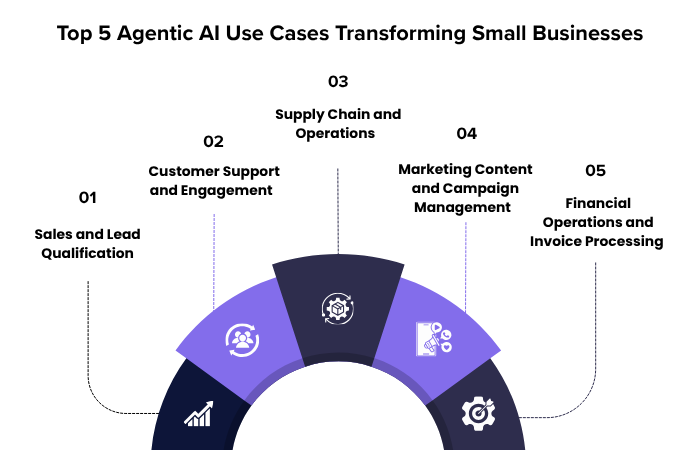
To maximize financial returns, small firms must move past general conversational tools and focus on dedicated AI agents solutions. Businesses achieve the clearest financial returns by deploying specialized agentic AI systems to handle specific, high-volume operational tasks.
1. Sales and Lead Qualification
Manual lead scoring and email follow-ups demand several sales hours. AI agents can continuously monitor inbound lead queues. They can quickly check out a prospect company details, double-check information against public records, and even kick off targeted local outreach on their own. By taking care of that initial qualification phase independently, the agent filters out the dead ends and passes verified, high-intent leads straight to your sales representatives.
2. Customer Support and Engagement
Standard chatbots fail because they can't handle anything outside their script. A well-configured support agent can pull a customer's order history, identify what went wrong, and process a replacement or refund, without escalating to a human. The boundary matters here. Complex complaints, upset long-term clients, or anything involving judgment calls should still go to a person. The agent handles volume; your team handles relationships.
3. Supply Chain and Operations
Running out of stock costs more than the lost sale; it costs you the customer. An operational agent can watch stock levels in real time, spot when a product is trending toward a shortfall based on historical sales, and trigger a purchase order before you hit zero. For small businesses managing dozens of SKUs without a dedicated ops person, this alone can justify the setup cost.
4. Marketing Content and Campaign Management
Small teams running paid ads across Google, Meta, and LinkedIn know the problem: by the time you notice a campaign is underperforming, you've already wasted budget. A marketing agent can monitor performance daily, flag underperforming ad sets, and shift spend toward what's working, without waiting for your weekly review meeting. It won't replace a strategist. But it will stop you from bleeding budget on autopilot.
5. Financial Operations and Invoice Processing
Managing accounts payable and receivable manually introduces constant compliance risks. Financial agents can automatically parse incoming invoices using multimodal Large Language Models (Vision-Language Models), which read and understand unstructured invoice data tables without requiring rigid, layout-specific coordinate templates. Once the data is parsed, the agent matches line items against internal purchase orders, flags pricing discrepancies, and queues verified transactions for final approval.
See our deep-dive analysis of agentic AI use cases to explore how they fit specific vertical markets.
Real-World Scenario: The 3-Person Global Campaign
To see the operational leverage of artificial intelligence solutions, consider a small, three-person software consulting firm experiencing a surge in website traffic. Without an agentic setup, qualifying these leads requires hours of manual research, leaving little time for actual client delivery.
Setting up Agentic AI in SMBs transforms this dynamic. By implementing a targeted agent workflow, the three-person team manages the influx smoothly:
Phase 1: Enrichment
The inbound agent automatically scrapes public corporate profiles for every new submission, identifying the company's size, industry, and current tech stack.
Phase 2: Intent Scoring
The agent reviews the text within the inquiry form against historical client data to determine intent. It flags high-value pain points and matches them against your specific service offerings to separate casual browsers from ready-to-buy clients.
Phase 3: Routing
High-intent enterprise leads are automatically booked onto the founder's calendar via API integration, accompanied by a generated research brief. Low-intent or out-of-scope inquiries receive an automated, polite email directing them to public resources.
The internal team focuses entirely on attending qualified meetings and closing deals, while the agentic AI system handles the initial filtering.
The 30-Day SMB Agentic AI Sprint Plan
Implementing automated business systems can feel overwhelming without a structured framework. Small businesses can successfully integrate AI development services by following a systematic, month-long deployment schedule focused on specific operational bottlenecks.
Week 1: Audit and Workflow Mapping
Identify the most repetitive, time-consuming manual workflows within your current business structure. Document the specific steps, applications, and decisions involved in these processes. Focus on tasks where data entry, simple classification, or standard responses occupy more than five hours per week for your staff.
Week 2: Platform Selection and Architecture Design
Select the appropriate tools that match your technical setup. Determine whether your workflows require standard pre-built agent modules or custom integration via low-code platforms. Map out the precise boundaries for the agent, defining exactly what data it can access and when it must hand the task over to a human team member.
Week 3: Pilot Implementation and Data Integration
Connect the selected agent platforms to your secure internal business applications, such as customer relationship management software, communication tools, or internal inventory databases. Begin running the system on a restricted test dataset or a small subset of incoming customer queries to monitor performance, verify security protocols, and fix early configuration errors.
Week 4: Team Training and Production Launch
Train your internal staff on how to monitor, review, and collaborate with the newly deployed agentic systems. Launch the agentic workflow into full production across your targeted business unit. Continuously track key performance metrics, such as time saved per worker, task resolution speed, and overall output accuracy, to calculate your direct return on investment.
Managing Failure Points: Designing Operational Guardrails
Deploying agentic AI in SMBs means giving up direct click-by-click control over software operations. Without rigorous structural boundaries, non-deterministic language models can hallucinate information, misinterpret context, or execute faulty API requests. For an SMB, an unmonitored system error can result in broken client relationships or direct financial loss.
To protect operations, organizations must build custom agentic systems with three specific layers of safety infrastructure:
Deterministic Validation Nodes: Program strict hardcoded constraints that the agent cannot override. For instance, an automated customer support agent should be programmatically blocked from initiating refunds or changing client account tiers without passing the data packet to a human manager.
Semantic Drift Identification: Implement verification steps where an agent checks its own generated output against an internal, verified knowledge base before sending data externally. If the confidence score drops below 95%, the system must halt execution and flag the record for review.
Human-in-the-Loop Thresholds: Design systems to automatically escalate complex or sensitive data tasks. High-value sales negotiations, contract generation, and bulk inventory purchases should require physical confirmation from a team member, combining AI speed with human judgment.
The Strategic Path Forward
Advanced automation isn’t just an enterprise luxury anymore. Agentic AI in SMBs has completely changed the game, turning complex tech into a tool that ordinary teams can actually use every single day.
When you pass off repetitive, data-heavy digital chores to these systems, you get to clear out the daily administrative clutter. That means your people can finally focus on what matters: creative strategies, real client relationships, and actual growth.
But making this work means picking the right tasks to automate and keeping the backend secure. You don't have to guess your way through it, either. Working with a dedicated AI development partner takes the stress out of the rollout.
If you want to see how this fits into your workflow, reach out to the engineering team at MoogleLabs. Look at our AI agent development services and build the exact AI agent solutions your business needs to scale.
Loading FAQs
Please wait while we fetch the questions...