AgenticOps: Managing, Securing, and Scaling Autonomous AI Agents as Enterprise Infrastructure
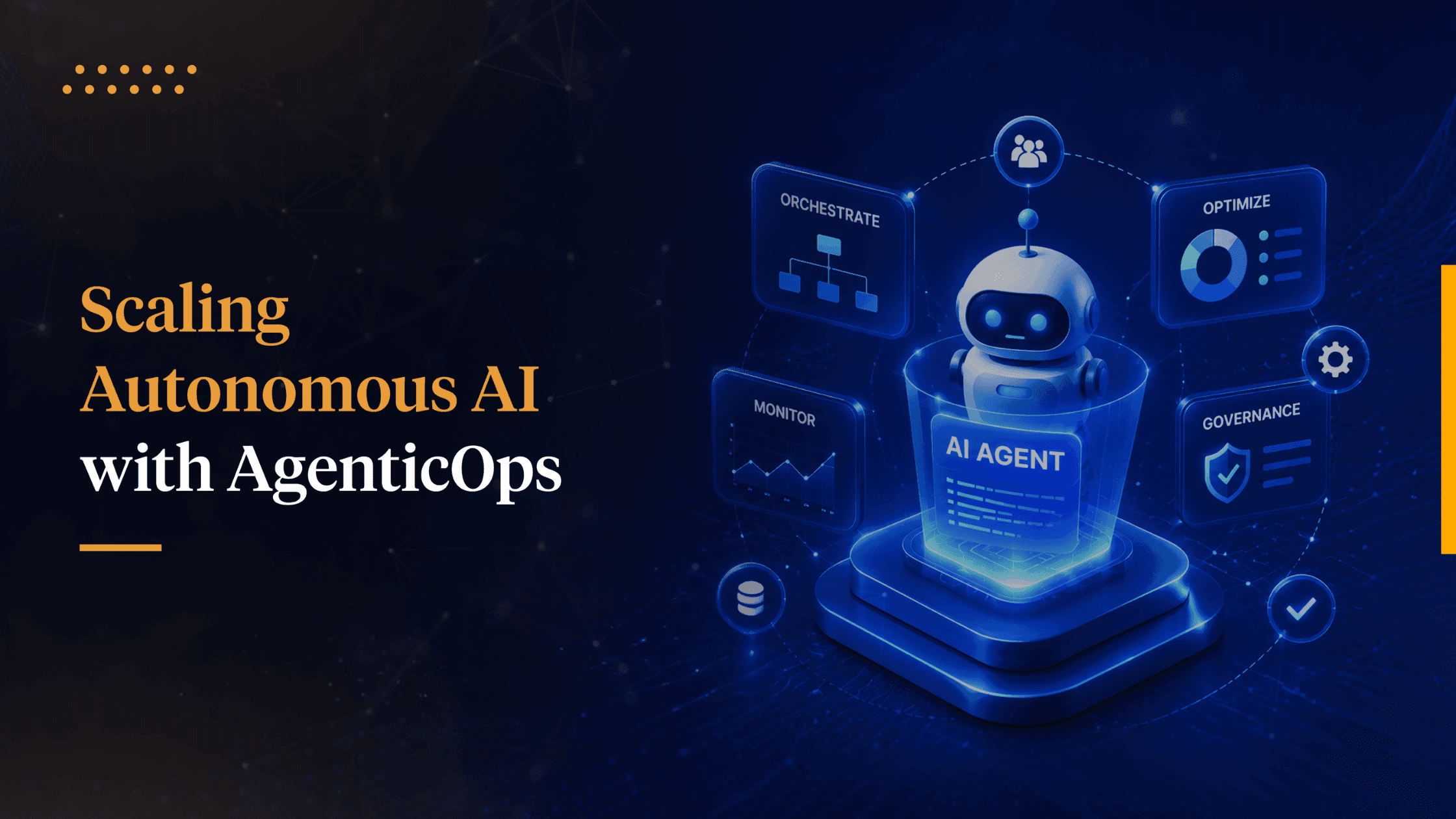
Autonomous AI agents require more than DevOps or MLOps to operate securely at scale. Discover how AgenticOps enables governance, orchestration, Zero-Trust security, observability, and cost optimization to transform AI agents into reliable enterprise infrastructure.
The way enterprises deploy AI is fundamentally changing. Passive models that wait for prompts and generate static responses are making way for autonomous AI agents—digital entities capable of reasoning, executing API calls, and making live operational choices across company networks.
Once an agent starts updating database records, running workflows, or tweaking cloud settings, it is no longer just a model. It becomes an active digital worker operating with privileged system access. Managing these non-deterministic behaviors demands AgenticOps, a discipline that goes well beyond traditional scripting and standard automation.
AgenticOps provides the dedicated control plane, security protocols, and operational visibility required to provision, govern, and optimize autonomous agents at scale. It offers a structured way to transform unpredictable AI behaviors into secure, enterprise-grade capabilities.
What is AgenticOps?
AgenticOps is the systematic management of autonomous AI agents treated as enterprise infrastructure assets and non-human identities. It moves beyond standard model deployment to focus on the live execution, memory state, permission bounds, tool integration, and action traces of agentic systems. To understand why this distinct framework is necessary, consider how the scope of IT management has evolved:
DevOps governs deterministic code, managing how human-written scripts and application binaries move reliably into production environments.
MLOps governs probabilistic models, ensuring that data pipelines, feature stores, and model weights remain statistically accurate over time.
AgenticOps governs active, goal-oriented decision loops. It manages what non-deterministic digital workers actually do once granted live access to corporate networks, APIs, and databases.
Modern enterprises cannot simply extend standard DevOps services or basic deployment scripts to govern autonomous entities. While traditional DevOps solutions ensure that an application runs reliably, and specialized MLOps services ensure that a model returns statistically accurate outputs, AgenticOps governs the live actions and security boundary of the agent itself.
The 5 Pillars of Enterprise AgenticOps
Managing AI agents as infrastructure requires a unified lifecycle model. To safely scale agents from pilot projects into core production environments, enterprise architecture must rest on five operational pillars:
1. Provisioning & Multi-Agent Orchestration
Provisioning an autonomous agent is not just a matter of setting up a virtual machine or launching a container. This involves establishing the agent's context window, linking long-term vector storage, integrating API tool registries, and selecting base reasoning models.
Monolithic agents are seldom used to manage complex workflows in production environments. Instead, corporations use specialized multi-agent architectures where individual agents collaborate: one analyzes incoming data, another verifies security compliance, and a third executes system orders.
Effective AI agent orchestration ensures these digital workers interact fluidly without colliding or leading to race conditions. Engineering teams can build orchestration backbones that dynamically provision compute, deploy vector memory, and route sub-tasks to the most cost-effective reasoning engines available by leveraging custom agentic AI services.
2. Zero-Trust Identity & Security Management
An AI agent that can read records in a database, update configuration files or trigger an external API call needs to be considered a privileged non-human identity. Hardcoding admin keys or giving a self-governing agent broad system access is a huge security hole. AgenticOps follows stringent Zero-Trust standards for digital workers:
Brokered Ephemeral Credentials: Agents are provided with ephemeral, purpose-built tokens that are produced as needed. When a given sub-task is done, the token is expired right away.
Tool-Level Access Control: Agents are given access only to the precise function signatures needed for their current objective, thus preventing unauthorized system exploration.
Deterministic Input/Output Guardrails: Sanitization layers cleanse sensitive PII, internal account keys, and credential tokens before prompt payloads are submitted to external reasoning models.
3. Deep Observability & Execution Traceability
Typical application logging is CPU measurements, memory use, and network traffic. But these measures tell us very little about the reasons behind a particular action taken by an AI agent.
Specialized observability for autonomous decision-making via AgenticOps. It records the full execution trail by capturing the raw input, the agent's internal reasoning processes, tool invocations, and the resulting system observation. Such detailed traceability helps engineering teams audit past decisions, troubleshoot malfunctioning processes, and identify specific sources of failure when an agent does not behave as planned.
4. Policy Governance & Human-in-the-Loop (HITL) Controls
Autonomous systems need operational guardrails. AgenticOps defines programmatic boundaries that specify what an agent can perform autonomously and what it needs human intervention for. Low-impact, reversible operations, such as writing a draft report, querying a read-only database, or filing a support request, can be done completely autonomously.
On the other hand, high-impact or irreversible actions such as changing financial ledgers, deleting database records, or modifying core network configurations automatically go through explicit Human-in-the-Loop approval gates. This compromise allows execution at machine speed when it is safe to do so, but maintains human control over mission important decisions.
5. Cost & Resource Optimization
Autonomous AI bots can consume huge amounts of token bandwidth and CPU power. An unmonitored agent that’s stuck in a retrying logic loop may rapidly rack up thousands of dollars in model API expenses in a matter of hours. AgenticOps enforces strict cost control at the infrastructure level:
Token Budget Caps: Imposing strict ceilings on the maximum token use permitted for each job or execution session.
Dynamic Model Routing: Automatically routes simple, high-volume jobs to lightweight, cost-efficient models and reserves bigger reasoning models for complicated issue resolution.
Loop-Detection Circuits: Detect and kill circular reasoning routes in the execution trail that are superfluous and waste resources.
Critical Challenges in Scaling Autonomous Digital Workers
While the benefits of enterprise AI agents are clear, deploying autonomous workers without a structured AgenticOps framework exposes organizations to distinct operational risks across security, reliability, and cost management.
1. Runaway Loops and Token Burn
When an agent encounters an unexpected error or ambiguous tool response, its natural response is often to retry, rephrase, or seek an alternative path. Without circuit breakers, the agent can cycle endlessly in a hallucination loop, consuming compute and API budgets without reaching resolution.
2. Cascading Failures in Multi-Agent Networks
In multi-agent systems, agents rely on the output of downstream peer agents. If a primary research agent introduces a subtle error into its summary, downstream execution agents will act on that flawed premise, compounding the error across the entire operational chain.
3. Prompt Injection and Security Exploits
Unlike traditional applications that process rigid, structured data inputs, AI agents evaluate unstructured text instructions. Attackers can exploit this via prompt injection by embedding hidden instructions inside data payloads, such as incoming emails or uploaded PDFs, to trick an agent into bypassing safety protocols, accessing unauthorized tools, or leaking data.
4. Audit and Compliance Gaps
Enterprise compliance frameworks require clear proof of who authorized a transaction, changed a system configuration, or processed sensitive personal data. If an autonomous agent alters records independently without an audit trail, the enterprise faces significant regulatory exposure under frameworks such as GDPR, HIPAA, or SOC 2.
Building production-grade safeguards against these failure modes requires deep technical knowledge spanning cloud architecture, identity systems, and machine learning infrastructure. Organizations frequently engage with experienced development partners to align robust MLOps enterprise strategies, design security architectures, and implement guardrail layers before launching autonomous digital workers into production.
Why AgenticOps is Essential for the Modern Enterprise
As organizations accelerate their digital transformation initiatives, the density of AI agents operating inside enterprise networks will soon rival and likely exceed the number of human employees.
Without a dedicated operational framework, managing hundreds of active, non-deterministic agents creates overwhelming technical debt, severe security vulnerabilities, and uncontrolled operational costs. AgenticOps delivers three fundamental business advantages:
Unlocking True Scalability: IT teams can now scale their digital workforce from 5 experimental agents to thousands of enterprise-grade workers safely without adding administrative overhead or technical complexity through automation of governance, identity provisioning, error handling.
Mitigating Enterprise Risk: Enforce zero-trust credential brokering, sandboxed execution and audit logging to prevent rogue agent behavior, quick injection attacks and compliance violations in multi-cloud systems.
Optimizing Operational Efficiency: Through combined structured DevOps development and tailored MLOps solutions, you maximize the agents' speed and minimize their calculate and token bandwidth usage, thereby saving on both capital expenditure and operational budgets.
Building Your AgenticOps Roadmap with MoogleLabs
To move to an autonomous operational model, you need a partner who knows the whole technology lifecycle, from core cloud engineering to sophisticated agent architectures. MoogleLabs is a trusted partner for enterprise AI and digital transformation solutions, providing an end-to-end experience to build, install, and administer production-grade agentic environments:
Custom AI Agent Development: We build domain-specific digital workers, with domain-specific tool registries, secure memory architectures, and robust reasoning frameworks.
Agentic AI & Orchestration Services: Building strong multi-agent orchestration layers that accurately coordinate intricate, cross-functional business activities.
Enterprise DevOps & MLOps Consulting: Modernize your cloud infrastructure, CI/CD pipelines, and model management frameworks to accommodate non-human identities and dynamic agent execution.
MoogleLabs merges proven DevOps services, advanced MLOps services, and forward-looking agentic architectures to help enterprise engineering teams turn autonomous AI from an experimental technology into a safe, predictable, and scalable strategic advantage.
Preparing Your Enterprise for Autonomous Digital Workers
As autonomous AI agents evolve from specialized pilot programs into full-fledged enterprise infrastructure users, traditional management frameworks are no longer sufficient. AgenticOps provides the necessary bridge, offering a unified control plane that balances machine-speed execution with enterprise-grade governance, Zero-Trust identity management, and deep operational visibility.
Organizations that establish these operational foundations today will be uniquely positioned to scale their digital workforce safely and efficiently. Taking the next step toward a production grade AgenticOps strategy requires evaluating your existing infrastructure, identity protocols, and orchestration layers.
Partnering with AI/ML development company can help your organization design, deploy, and govern secure agentic environments tailored to your core business goals. Explore how MoogleLabs can empower your team to build a resilient operational foundation for the future of autonomous digital systems.
Loading FAQs
Please wait while we fetch the questions...