Multimodal AI: The Next Evolution of Generative AI
.png&w=3840&q=75)
Multimodal AI is the next evolution of generative AI, enabling systems to process text, visuals, audio, and structured data simultaneously. Learn how organizations are leveraging it to improve automation, decision-making, and operational efficiency.
Every business leader faces the same hidden bottleneck - teams spend hours translating real-world business context into text prompts before traditional AI systems can assist. Distributed schematics, field video feeds, scanned documents, customer calls, and dashboard screenshots all have to be reduced into written instructions. In that process, important context often gets left behind.
Multimodal AI removes this manual translation layer. By combining text, visuals, audio, and structured data within a single intelligent system, modern AI models can process complex enterprise inputs in parallel. This allows autonomous agents and generative AI applications to solve layered, real-world problems in their original form rather than forcing every input into a text box.
Technical Architecture: From Unimodal Isolation to Shared Semantic Spaces
Understanding the value of modern multimodal AI requires examining how enterprise artificial intelligence has evolved across recent deployment cycles.
The Structural Limits of Unimodal Systems
Traditional deep learning tools operated within strict, independent lanes. A natural language processing model handled text strings; an image recognition algorithm scanned pixel arrays; an acoustic network parsed sound frequencies.
Each was built on separate training data, run on independent codebases, and restricted to its specific lane. While these unimodal tools achieved high accuracy within their defined tasks, they remained fundamentally disconnected from one another.
A linguistic model could write step-by-step repair documentation but could not see if a field worker was following those steps correctly. A computer vision system could flag a physical defect on a component, but it lacked the language reasoning to cross-reference that defect with a customer service history log or an equipment warranty contract.
The Shift to Deep Network Fusion
Early engineering attempts to bridge these gaps relied on cascading separate models sequentially. A system would take an audio recording, route it through a speech-to-text program, feed the resulting text into a language model, and then pass the resulting text to another image generation tool.
However, this serial design suffered compounding errors, high latency, and an inability to understand the true context across the different formats. Modern multimodal AI models avoid this sequential approach by fusing deep architectures. During training, text, vision, and audio data points are mapped into a single, shared semantic embedding space.
This design allows the neural network to build cross-modal understanding. When a model views a blueprint while reading a feedback email, it does not process them as two separate tasks. Instead, it integrates both inputs simultaneously, mimicking human perception to provide deep contextual awareness.
Market Dynamics and the Financial Reality
The push toward multimodal models is driven by measurable economic demand rather than developer speculation. According to exhaustive industry analytics from Precedence Research, the global multimodal AI market was valued at approximately $2.51 billion in 2025. It is projected to reach $42.38 billion by 2034, expanding at a compound annual growth rate (CAGR) of 36.92%.
This rapid capital expansion reflects active deployments across major industries. Businesses are realizing that relying on text-only tools means missing out on the efficiency gains made possible by multi-format computing. To understand how these systems scale within an enterprise IT ecosystem, explore our comprehensive framework about generative AI.
Core Pillars of Multimodal Generative AI Solutions
Enterprise-grade multimodal AI platforms rely on specific cross-modal pathways to manage complex data workflows:
Text-to-Image and Vision Synthesis
This pathway translates descriptive text prompts, design requirements, or compliance constraints directly into structured visual outputs. Using advanced architectures like convolutional networks and diffusion techniques, the system maps words into a visual space. This allows organizations to instantly generate detailed technical designs, user interface mockups, or clear floor layouts simply by describing the necessary parameters.
Image-to-Text Analytics and Visual Comprehension
Conversely, this particular function allows the software to view complex visual imagery and generate clear, contextual text summaries or structured reports. It acts as a digital eye for the platform, extracting data from scanned invoices, processing aerial logistics images, reading charts, or monitoring live production video feeds to flag anomalies and provide immediate business intelligence.
Audio-to-Image and Waveform Processing
This technical pathway blends audio wave processing with image synthesis or text generation models. By converting sound waves into visual spectrograms and applying generative adversarial networks (GANs), the software can analyze machine noises, customer service dialogue, or ambient audio to build descriptive logs, spot hidden performance issues, or map audio data into visual formats.
Orchestrating Autonomous Enterprise Agents
The biggest trend in the generative AI ecosystem is the move from passive chatbots to proactive, autonomous agents. A modern enterprise setup should not only answer text-based inquiries but also perform multi-step processes, manage complex activities, and function autonomously over extended cycles. Multimodal AI is the key enabler of these sophisticated systems. A text-only processing agent cannot operate within a modern corporate environment.
Deploying a comprehensive generative AI solution via advanced models requires deep familiarity with cross-format infrastructure. The true development of AI agents requires models with visual and auditory perception. Incorporating vision-language models allows modern agents to see software interfaces, interpret charts, read data dashboards, and respond to verbal instructions in real time. This setup forms the basis of "embodied AI," in which digital agents can navigate legacy enterprise platforms just like human operators.
When organizations invest in strategic generative AI development, they establish an architectural foundation that allows software agents to execute complex, multi-format workflows without manual intervention.
Multi-Format Enterprise Workflows Covered by Advanced Agents:
Customer Interaction Processing: Listening to customer calls, analyzing tone and speech markers, and generating structured feedback reports for support teams.
Automated Document Extraction: Reviewing complex visual documents like scanned invoices, logistics bills, or legal contracts, and matching that visual data directly with internal databases.
Product Description Generation: Taking raw prototype photographs, analyzing the visual features, and writing complete product descriptions for e-commerce platforms.
To see how these setups help growing businesses run complex operations without ballooning overhead, read our tactical breakdown of agentic AI in small businesses.
Overcoming Computational and Architectural Bottlenecks
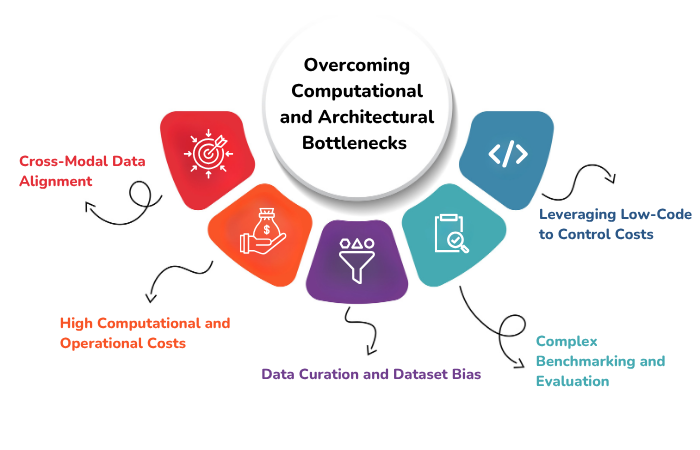
While the business benefits are clear, software engineers and enterprise IT leaders must navigate several technical challenges when deploying multimodal models:
Cross-Modal Data Alignment
Ensuring that a model correctly matches visual features with text descriptions remains a complex engineering challenge. If data streams are misaligned, the model can misinterpret visual context or fail to link a written instruction with its corresponding image asset, leading to parsing errors.
High Computational and Operational Costs
Processing text, high-resolution video, and audio streams in parallel requires significant compute power. These platforms are much more expensive to train and run at scale than traditional text-only systems, which can limit access for smaller teams or organizations with tight IT budgets.
Data Curation and Dataset Bias
Building effective multimodal models requires massive datasets with accurately matched text, video, and audio pairs. These datasets are difficult to collect and clean. Furthermore, any biases embedded in visual or auditory training data can compound existing text biases, making strict monitoring of datasets essential.
Complex Benchmarking and Evaluation
Measuring the performance of a multimodal platform is difficult. Unlike simple text models, where answers can be checked against a reference key, evaluating cross-modal outputs requires subjective judgments about how well the model has combined its inputs. Teams must build custom, robust benchmarking tools to track system quality over time.
Leveraging Low-Code to Control Costs
To balance these computational costs and development complexities, many forward-thinking enterprises are using low-code development frameworks to deploy their applications. Check out our guide on generative AI services with Low-Code/No-Code development to learn how to build and scale these tools efficiently without overcomplicating your infrastructure.
How Multimodal AI is Redefining the Future of Work
The widespread adoption of multimodal models is fundamentally altering daily corporate workflows:
Input Stream Simplification
Employees no longer need to translate real-world problems into text strings before an AI can assist. A field engineer troubleshooting an equipment failure can record a quick video of the machine, upload it directly to the corporate support tool, and receive step-by-step diagnostic advice instantly. This keeps inputs as natural as the work itself.
Cross-Functional Platform Synchronization
Multimodal tools bridge communication gaps between different business units. Product teams working with engineering designs, finance professionals tracking spreadsheets, and creative personnel building video mockups can all query a unified corporate knowledge base without having to reformat their files. This shared visibility reduces internal alignment delays and speeds up project delivery timelines.
New Roles and Skillsets
As organizations build automated workflows around these cross-modal platforms, entirely new professional roles are emerging. Roles such as multimodal prompt strategists, cross-format output reviewers, and multi-format data curators are becoming increasingly vital to ensure that system outputs align with business goals.
Inclusive Workplace Accessibility
Multimodal models make workplaces more inclusive by supporting different communication styles, language backgrounds, and accessibility needs. Employees can interact with corporate software using whichever format is most natural for them: voice, images, text, or a mix of all three. This technology closes the gap between how humans naturally work and the tools that support them.
Operationalizing a Multimodal AI Strategy with MoogleLabs
Moving away from text-limited legacy systems, navigating high-dimensional datasets, optimizing cross-modal alignment, and controlling compute costs require an experienced engineering approach. At MoogleLabs, we specialize in transforming these complex technical shifts into concrete operational advantages.
Whether your business requires a specialized generative AI framework, a custom generative AI solution, or dedicated generative AI development, our teams build the architecture to keep your workflows resilient. We provide specialized engineering expertise across:
Custom Framework Architectures: Building unified semantic embedding layers that map your proprietary video, voice, and text documentation safely without cloud cost overruns.
Targeted AI Agent Solutions: Building autonomous, context-aware systems using Model Context Protocol (MCP) architectures that securely operate within legacy software environments and corporate dashboards.
Advanced AI Agent Development: Developing robust, multi-sensor validation agents for software reliability testing, telemetry monitoring in production and real time quality control.
As the technology matures, organizations who design their technological infrastructure around these broad multimodal patterns will achieve a distinct operational advantage. The past in single modality just gave us a glimpse of what was possible. At MoogleLabs, we bring the whole image to life with end-to-end engineering.
Loading FAQs
Please wait while we fetch the questions...