RWA Tokenization vs Custom Blockchain Protocols: What Smart Enterprises Are Choosing for Blockchain Solutions in 2026
In 2026, RWA tokenization is an enterprise priority. Most businesses now prefer established tokenization platforms over custom blockchain builds for faster deployment, built-in compliance, stronger security, and better investor confidence—driving quicker ROI and scalable growth.
Real-world asset (RWA) tokenization has moved from experiment to enterprise priority. In 2026, business owners are no longer asking “Should we tokenize assets?” The question is now:
“Should we build our own blockchain protocol, or use an RWA tokenization platform?”
For most enterprises, the answer is clear.
If your goal is speed, compliance, investor trust, and long-term scalability, building on an established RWA tokenization platform is far more practical than developing a custom protocol from scratch.
This article breaks down why that is the case and how the right blockchain solutions partner can help you move from idea to execution.
What Is an RWA Tokenization Platform?
Definition:
An RWA tokenization platform is a pre-built blockchain infrastructure that allows businesses to convert real-world assets into digital tokens that represent ownership, rights, or revenue streams.
These assets may include:
Real estate
Private equity
Debt instruments
Commodities
Carbon credits
Art and collectibles
Infrastructure assets
Instead of writing a new blockchain solutions protocol, enterprises use platforms that already include:
Smart contract frameworks
Compliance modules (KYC/AML)
Custody integrations
Investor dashboards
Asset lifecycle management tools
This reduces development time and risk significantly.
For a deep dive on how blockchain technology supports RWA tokenization, see How Blockchain Solutions Are Shaping RWA Tokenization.
Tokenization – Changing the World
Understanding market size and growth helps you justify investments and align with business goals:
RWA tokenized assets reached ~$24 billion on-chain in 2025, up roughly 380% in three years, showing strong adoption by financial issuers and investors.
Analysts see potential for the total tokenized securities market to expand toward a $400 billion valuation in 2026, with room to grow toward the trillion-plus range in the coming decade.
These figures reinforce that tokenization is now more than experimentation. It’s becoming a legitimate infrastructure layer for institutional markets and enterprise capital.
Why Is RWA Tokenization Gaining Momentum in 2026?
Tokenized real-world assets are expected to represent trillions of dollars in market value over the coming years. Institutional adoption is increasing, with banks, asset managers, and fintech industry launching tokenized funds and debt instruments.
What changed?
Regulatory clarity in several jurisdictions
Institutional-grade custody and compliance systems
Improved blockchain solutions infrastructure
Demand for fractional ownership and liquidity
Business leaders now view tokenization as a capital efficiency strategy rather than an experimental project.
Custom Protocol vs RWA Tokenization Platform: What’s the Real Difference?
Let’s break this down clearly.
Option 1: Building a Custom Blockchain Protocol
This means:
Designing consensus mechanisms
Developing smart contract architecture
Creating validator infrastructure
Managing security from the ground up
Handling compliance logic internally
Maintaining and upgrading the protocol long term
Risks and Costs:
12–24 months development cycle
High security exposure
Complex regulatory interpretation
Expensive audits
Ongoing protocol governance
Even with strong Blockchain Development Services, custom protocol projects demand large engineering teams and deep capital reserves.
Option 2: Building on an RWA Tokenization Platform
This approach includes:
Using audited smart contract templates
Leveraging built-in compliance layers
Integrating custody and payments through APIs
Deploying tokens faster
Focusing on business model instead of infrastructure
Benefits:
Faster time to market
Reduced engineering risk
Easier investor onboarding
Lower development cost
Built-in upgrade paths
For most business owners, the second path aligns better with ROI expectations.
7 Reasons Enterprises Prefer RWA Tokenization Platforms in 2026
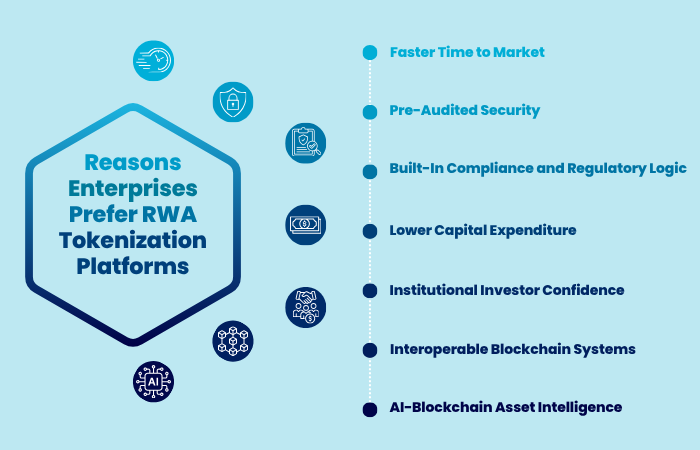
1. Faster Time to Market
Launching a tokenized asset offering in months instead of years can mean:
Capturing early investor demand
Testing market fit sooner
Iterating based on feedback
Custom protocol development often stalls before monetization begins.
At MoogleLabs, our blockchain services focus on deployment efficiency, helping clients validate business models early rather than overbuilding infrastructure.
2. Security Through Pre-Audited Infrastructure
Security breaches in blockchain solutions can destroy brand trust overnight.
Established RWA platforms typically include:
Audited smart contracts
Multi-signature wallet systems
Compliance tracking
Permissioned access controls
With additional blockchain audit services, businesses gain another layer of protection before launch.
3. Built-In Compliance and Regulatory Logic
Tokenizing securities or asset-backed tokens requires compliance with:
Securities regulations
AML/KYC laws
Jurisdictional restrictions
Investor accreditation rules
RWA platforms often include rule engines that:
Restrict token transfers
Verify investor eligibility
Maintain audit logs
Custom protocol teams must build this from scratch, increasing risk and legal costs.
MoogleLabs’ Blockchain Consulting Services help enterprises map regulatory requirements to technical architecture early in the project lifecycle.
4. Lower Capital Expenditure
Developing a protocol involves:
Core blockchain solutions engineers
DevOps teams
Security researchers
Ongoing network maintenance
Using an RWA tokenization platform shifts focus from infrastructure to asset strategy.
For decision-makers, this means:
Lower upfront investment
Clearer budgeting
Reduced long-term maintenance burden
5. Institutional Investor Confidence
Investors prefer:
Audited platforms
Transparent reporting
Recognized technology stacks
Clear compliance frameworks
Launching on an established RWA platform signals credibility.
A custom protocol may appear innovative but often raises questions around stability and governance.
6. Interoperability with Existing Blockchain Ecosystems
Modern RWA platforms often integrate with:
Ethereum-compatible networks
Layer-2 scaling solutions
Institutional custody providers
DeFi liquidity pools
Custom protocols frequently struggle with interoperability, which limits liquidity and adoption.
7. AI + Blockchain Integration for Asset Intelligence
In 2026, tokenization is not just about digitizing ownership. It’s about generating insights.
By combining AI systems with tokenized assets, enterprises can:
Predict asset performance
Monitor risk exposure
Detect anomalies
Automate compliance checks
This is where AI and blockchain solutions converge.
At MoogleLabs, our AI testing services validate machine learning models used in asset valuation and risk scoring, ensuring reliability before production deployment.
Step-by-Step: How to Launch on an RWA Tokenization Platform
Here is a simplified execution framework for decision-makers.
Step 1: Asset Evaluation
What asset type are you tokenizing?
What regulatory classification applies?
What jurisdictions are involved?
Step 2: Platform Selection
Evaluate:
Compliance features
Smart contract audit history
Interoperability
Custody integrations
Scalability
Step 3: Smart Contract Configuration
Define token structure
Set transfer rules
Define revenue distribution logic
Step 4: Compliance Integration
KYC/AML workflows
Investor accreditation
Geographic restrictions
Step 5: Security Review
External smart contract audit
Penetration testing
Governance review
This is where professional Blockchain Development Services and audit teams add real value.
Step 6: Launch and Monitor
Investor onboarding
Asset performance tracking
AI-driven risk analysis
When Does a Custom Protocol Make Sense?
There are rare cases where custom development is justified:
Building a new Layer-1 blockchain solutions
Creating a niche consensus model
Running a national-scale blockchain infrastructure
Deep protocol-level research initiatives
For most asset issuers, real estate developers, fintech founders, and investment firms, this is an unnecessary overhead.
Results You Can Measure: MoogleLabs Case Study Snapshot
In our Decentralized Advertising Platform case study, blockchain technologies created measurable business outcomes for a Web3 ad rewards product. Key results include:
78% increase in user participation driven by tokenized incentives.
100% transaction transparency via immutable blockchain logs.
52% higher advertiser ROI with verified engagement.
Daily active users scaling from hundreds to 25,000+ in 3 months.
See the full case study here: Decentralized Advertising Platform.
These numbers show what can happen when you leverage robust blockchain systems alongside smart economic incentives.
Business Case: What Decision-Makers Care About
Business leaders typically evaluate three metrics:
1. Speed
How fast can we generate returns?
2. Risk
What are the legal and technical exposures?
3. Scalability
Can this grow across markets?
RWA tokenization platforms score higher across all three dimensions.
The past work on blockchain solutions clearly shows the trend that organizations succeed faster when focusing on application logic rather than base protocol engineering.
Final Thought for Decision-Makers
If you are a business owner exploring tokenization in 2026, your edge will come from strategic execution, not protocol engineering.
Choosing the right infrastructure partner makes the difference between:
Spending two years building plumbing
Launching revenue-generating digital assets within months
At MoogleLabs, we combine blockchain solutions, enterprise-grade Blockchain Development Services, and AI validation frameworks to help organizations deploy secure, compliant tokenization ecosystems.
If tokenization is part of your 2026 growth roadmap, now is the time to evaluate your infrastructure strategy.
Loading FAQs
Please wait while we fetch the questions...