Architecting Resilient Web Autonomy: AI Browser Agent Development in 2026
Discover how AI browser agents are transforming enterprise web automation with hybrid architectures, self-healing workflows, and zero-trust security. Learn the strategies for building resilient, scalable, and production-ready autonomous systems in 2026.
Enterprise web automation faces a major stability issue. Engineering leads managing parallel automation projects run into clear structural bottlenecks. These include unpredictable token consumption, high latency, brittle session state management, and constant website layout changes.
Moving away from fragile, selector-dependent scripts requires better architecture. By using specialized generative AI development services, modern enterprises deploy production-grade digital operators. Driven by an AI browser agent, these operators interact with web-based ERP systems, financial directories, and partner portals.
The Hybrid "Agent-Actor" Architecture
Deploying an autonomous agent that requests a full-page screenshot and raw data analysis for every single action creates massive engineering challenges. It slows down systems and balloons costs. When implementing advanced corporate workflows, scaling these capabilities requires a solid understanding of how foundational agentic AI software manages task execution and environment states.
To solve this, developers implement a structural design pattern called the Hybrid Agent-Actor Architecture. This model begins with a high-level corporate objective. It immediately checks if the target navigation path is already stored in the system memory. This structural division separates tasks into two clear operational modes:
Deterministic Playback (The Actor)
Repetitive, structured navigation paths do not require real-time semantic processing. Examples include logging into corporate single sign-on (SSO) systems, navigating to known dashboard URLs, or downloading standard reports.
The Actor executes these steps using compiled scripts running at native machine speed. This bypasses the language model during standard navigation. As a result, it reduces session latency and minimizes unnecessary token expenses.
Semantic Reasoning (The Agent)
The model engine takes control only when the target web environment shifts away from the established baseline. If an external vendor portal modifies its multi-step layout, introduces a new popup window, or reorganizes its structure, the system triggers the reasoning loop.
The AI browser agent analyzes the updated layout, recalculates its planning graph, and fixes the automation path on the fly.
Technical Evaluation of the Modern AI Browser Agent Stack
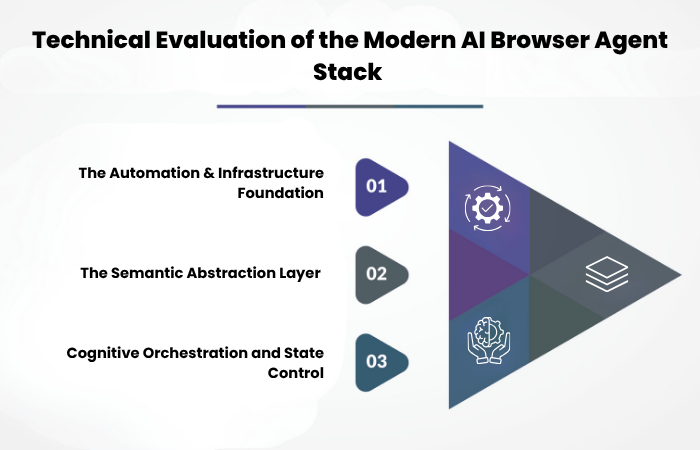
Building a reliable system requires assembling a modular technology stack. Rather than relying on monolithic frameworks, developers organize components into clear functional layers.
Layer 1: The Automation & Infrastructure Foundation
The lowest layer manages the physical browser environment, network transport protocols, and hardware isolation constraints.
Playwright vs. Puppeteer: For large enterprise agent fleets, Playwright is the preferred foundation. It offers reliable context isolation. This ensures that session storage state variables, cookies, and local data parameters never bleed between parallel execution threads. Puppeteer remains useful when an application requires deep access to the Chrome DevTools Protocol (CDP) for low-level performance profiling or custom execution tracing.
Headless Cloud Infrastructure: Local execution pipelines fail to scale efficiently when managing dozens of simultaneous workflows. Production systems deploy agents inside remote browser environments like Browserbase or Steel. These platforms provide instant sandboxed compute nodes. They automate proxy rotation to prevent rate-limiting blocks, record full session replays for post-execution auditing, and handle complex anti-bot systems at the network layer.
Layer 2: The Semantic Abstraction Layer
This tier turns chaotic HTML structure into clean, structured datasets that a multi-modal model can process efficiently.
Stagehand & Browser Use: These specialized libraries act as a functional bridge between backend models and browser windows. Instead of overwhelming a model input window with megabytes of raw front-end source code, these tools translate the visible interface into compact visual coordinate grids and semantic node lists. This optimization strips out non-functional metadata and layout noise.
AgentQL: When data extraction must remain consistent despite changes to frontend code, AgentQL provides a structured approach. It replaces fragile CSS locators and complex XPath expressions with semantic queries. These target page elements based on their underlying business context rather than their temporary position in the code.
Layer 3: Cognitive Orchestration and State Control
The top layer manages long-term planning, error recovery rules, and multi-step execution graphs.
State Persistence via LangGraph: Complex business processes rarely follow linear paths. If an AI browser agent encounters an infrastructure error or an unhandled verification gate midway through an invoicing process, a standard script crashes. This causes a total loss of progress. LangGraph solves this by modeling workflows as state-managed cyclical graphs. If a step fails, the framework freezes all session variables, preserves the exact state memory, alerts human administrators via a centralized dashboard, and resumes the automation path smoothly once the blocker is cleared.
Engineering Roadblocks and Production Guardrails
Moving an operational proxy out of staging requires implementing rigorous security protocols and strict architectural limits. To maintain systemic safety, an Enterprise Guardrail System must manage three distinct layers simultaneously:
Prompt Injection and Zero-Trust Session Security
Because browser agents must read unvetted text from public web portals, they are vulnerable to indirect prompt injection attacks. A malicious website can embed hidden text instructions telling the agent to ignore previous instructions and export sensitive corporate data to an external URL.
To neutralize this risk, enterprise architectures enforce a Zero-Trust data policy. The model must never have direct visibility into raw authentication tokens. Credentials sit in isolated hardware security modules. The infrastructure layer injects them directly into the browser's network headers. This keeps sensitive data completely outside the model's context window.
Managing Action Volatility and Interface Retries
Modern web interfaces do not always react cleanly to instantaneous programmatic commands. Pages built on heavy asynchronous JavaScript frameworks often fail to register clicks if an element hasn't finished loading its event handlers.
Production automation requires human-like interaction profiling. AHA data show that mimicking human timing profiles reduces automated form rejection rates by more than 45%. Execution engines must generate natural mouse movement arcs, execute smooth scrolling intervals to trigger lazy-loaded elements, and apply realistic keyboard focus states to prevent target platforms from rejecting automated input sessions.
The High-Stakes Circuit Breaker
Unbounded agent autonomy poses significant operational risks. If a model encounters a loop error on an internal accounting portal, it could submit duplicate requests endlessly. Engineering teams prevent this by building hard structural pauses directly into the graph orchestration layer.
The Threshold Rule: Any action that crosses a defined financial threshold, modifies a production database record, or initiates external client communication triggers an automated freeze. The agent saves its context variables and waits for a verified human click on an operational dashboard before completing the transaction.
Enterprise Implementation Blueprint: The Phased Deployment
Deploying autonomous agent architecture across a large organization requires a structured, multi-stage rollout to preserve stability and mitigate systemic risk.
Phase | Name | Core Activity | Human Involvement |
|---|---|---|---|
Phase 1 | Identification & Mapping | Audit internal workflows; document boundaries and data sources. | 100% Manual Mapping |
Phase 2 | Read-Only Sandbox | Agent proposes steps in shadow mode without executing physical clicks. | Human reviews and approves every single step |
Phase 3 | Supervised Autonomy | Agent fills forms and navigates independently; stops at major gates. | Human confirmation required for final actions (e.g., payments) |
Phase 4 | Full Scale Autonomy | System runs unattended in the background, tracking live telemetry. | Exception handling only |
When running Phase 4, monitoring pipelines must track three key metrics:
Average Token Spend per Session: Catches unexpected prompt inflation loops early.
Visual Error Ratios: Tracks how often front-end layout updates force the system to drop out of deterministic playback and utilize semantic self-healing mechanisms.
Task Velocity Trends: Pinpoints performance bottlenecks caused by slow third-party web portals or infrastructure latency.
Advanced Automation Scenarios and Field Insights
Implementing a universal agent framework without accounting for domain-specific front-end behaviors introduces operational friction. Mapping these intricate environments often requires studying real-world agentic AI use cases to see how production systems balance browser navigation with deep enterprise application workflows.
Multi-Tenant SaaS Synchronization
Migrating or balancing data across multi-tenant SaaS tools lacking native integration layers is a common enterprise bottleneck. An AI browser agent automates this by abstracting the browser window into an orchestration layout.
The primary engineering obstacle is handling asynchronous rendering schedules. Examples include fast WebSocket updates paired with slow, chunked database queries. The orchestration layer must manage these mismatched speeds by implementing predictive wait loops. This verifies that all data fields are fully populated before triggering a form submission.
Managing State Overlap in Parallel Threads
Scaling agent infrastructure to process hundreds of parallel web tasks can easily overwhelm local server resources. This causes CPU spikes and memory exhaustion inside basic container setups. Production architectures mitigate this by separating the browser execution environment from the core model reasoning loops.
Executing browser instances inside distributed cloud infrastructure networks allows developers to run massive parallel queues. These remote grids provide clean execution boundaries. They isolate cookies, canvas fingerprints, and tracking configurations. This prevents a front-end crash on a single site from disrupting adjacent enterprise workflows.
Defending Against Captcha Challenges and Advanced Rate Limiting
Public web directories and financial tracking engines consistently deploy defensive layers like Cloudflare Turnstile, reCAPTCHA, and Akamai perimeter blocks. These disrupt traditional scraping methods. An intelligent browser agent addresses these barriers by mimicking the rhythms of authentic human interaction.
Instead of moving mouse paths directly to exact coordinate pixels in a single frame, the execution engine maps a natural curve with random millimeter variations and varying scroll pauses. Integrating smart residential proxy networks further enables the agent to route traffic through rotating geolocations. This mimics normal business-user distributions to ensure consistent, long-term access.
The Strategic Advantage with MoogleLabs
Moving beyond experimental scripts to deploy resilient, production-ready systems demands deep expertise across specialized software engineering and AI domains. MoogleLabs provides specialized generative AI development services designed to convert complex machine learning concepts into highly predictable business assets.
Our engineering teams do not rely on basic out-of-the-box API wrappers. We construct tailored, enterprise-grade solutions built on hybrid architectures. By combining secure token isolation protocols, zero-trust infrastructure boundaries, and self-healing orchestration networks, we ensure your automated assets remain resilient against front-end structural changes.
Partnering with an experienced engineering team allows your organization to minimize maintenance overhead, safeguard sensitive corporate data, and unlock new levels of operational capacity. Contact MoogleLabs today to evaluate your automation landscape and discover how custom agent architectures can transform your day-to-day corporate workflows.
Loading FAQs
Please wait while we fetch the questions...