Mixture of Experts (MoE) Explained: How It Makes AI Models More Scalable
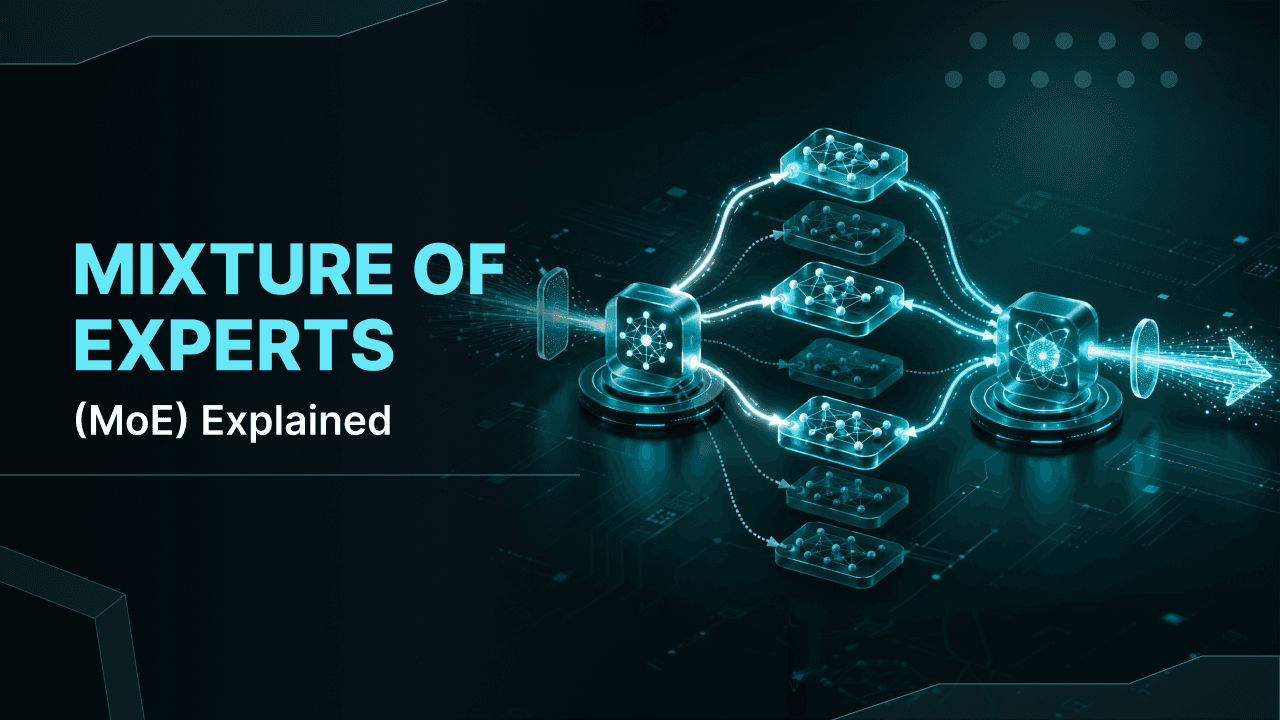
Mixture of Experts (MoE) enables enterprise AI to scale efficiently by activating only the parameters needed for each task. Explore how sparse architectures can improve compute efficiency, support complex workloads, and optimize AI infrastructure costs.
Enterprise leadership faces a clear bottleneck with modern artificial intelligence: cost and latency. Traditional dense models require immense computing power because every single parameter fires for every single request. Mixture of Experts changes this equation entirely.
By activating only specialized sub-networks needed for a given task, this architecture allows organizations to run larger, more capable models at a fraction of the operating cost. Here is how sparse design drives real-world scalability.
What Is Mixture of Experts? Demystifying Sparse Architecture
Standard deep learning models act like monolithic machines. When you ask a traditional large language model a simple question, the system turns on 100% of its internal pathways. Whether the task requires basic formatting or complex financial reasoning, every parameter consumes energy and computing time.
Mixture of Experts (MoE) breaks this inefficient cycle. Instead of relying on one massive, uniform system, an MoE architecture divides the workload among multiple specialized sub-networks called "experts".
Sitting above, these experts are an intelligent routing system known as a gating network. When a request comes in, the gating network evaluates the prompt and directs it only to the specific experts equipped to handle that domain.
Dense Models: Every parameter runs on every query, driving up server costs and response times.
Sparse MoE Models: Only 10% to 25% of the total network turns per query, preserving performance while minimizing resource usage.
This selective execution, known as conditional computation, lets companies deploy high-capacity artificial intelligence without taking on massive hardware overhead. Engineering teams at MoogleLabs utilize this intelligent AI inference architecture to help companies scale their digital tools efficiently.
The Enterprise Case for MoE: Slashing Compute Costs While Scaling Operations
Scaling digital operations usually means watching cloud bills rise in direct proportion to user adoption. Monolithic architectures force companies to choose between paying steep infrastructure fees or settling for smaller, less capable models. Sparse MoE architectures remove that compromise.
By running only the necessary parameters per request, sparse routing lowers active compute requirements per token. This efficiency translates directly into better unit economics for custom digital products.
Architecture Metric | Dense Monolithic System | Sparse Mixture of Experts | Business Impact |
|---|---|---|---|
Parameter Usage | 100% active per token | 10%–25% active per token | Cuts unnecessary computing load |
Inference Latency | High during peak demand | Fast, steady response times | Improves end-user satisfaction |
Hardware Footprint | Requires heavy GPU resources | Optimizes server VRAM usage | Lowers monthly cloud expenditure |
Domain Expertise | Generalist across all tasks | Specialized sub-networks | Delivers higher accuracy per domain |
Key market data highlights why infrastructure efficiency is now a core executive priority:
Gartner forecasts that global spending on artificial intelligence will hit $2.59 trillion in 2026, with core infrastructure expansion accounting for over $401 billion.
Benchmark analysis shows that sparse MoE models cut token processing costs by up to 40% compared to traditional dense architectures.
Gartner projects that 40% of enterprise software applications will feature task-specific autonomous agents by the end of 2026, up from under 5% in previous years.
These shifts show that market growth depends on operational efficiency. Investing in strategic GenAI development services helps organizations expand system capabilities while keeping monthly operating expenses predictable.
Real-World Applications Across Core Enterprise Workflows
From a product development standpoint, MoE simplifies system architecture. Instead of building, hosting, and maintaining separate specialized software models for different business units, teams can deploy a single MoE foundation model that dynamically manages multi-domain tasks.
At MoogleLabs, specialists design high-performing deep learning solutions that allow corporate systems to handle complex, multi-departmental workloads smoothly.
Advanced NLP Services for Complex Communications
In corporate NLP services, MoE systems handle diverse text processing tasks without domain confusion. The central router sends contract reviews to legal-focused experts, code analysis to technical sub-networks, and customer queries to service-oriented experts. This separation keeps specialized vocabulary accurate across all channels.
High-Speed Computer Vision Services
When integrated into computer vision services, sparse routing enables fast visual processing. Dedicated sub-networks analyze static image data while others evaluate video streams. This division of labor speeds up image analysis for retail, logistics, and quality assurance workflows.
Deep Learning in Fraud Detection
Financial processing requires instant threat identification. Implementing deep learning in fraud detection using MoE routes standard, low-risk user transactions through fast, low-cost experts. If suspicious activity occurs, the system immediately passes the transaction to high-capacity validation pathways for deeper checks without creating delays for legitimate users.
Orchestration with Small Language Models
Rather than relying on one massive central framework, MoE acts as an organized network of specialized small language models working together under a central gateway. Companies get the execution speed of localized models alongside the broader reasoning skills of larger systems.
Modern Enterprise Integrations: RAG Development and MCP vs RAG
Modern enterprise applications need direct access to private corporate data and external tools. Sparse MoE systems serve as the core engine powering these integrated digital operations.
Reliable Knowledge via RAG Development
Retrieval-Augmented Generation gives language architectures access to private corporate data. By fetching document context from secure databases, RAG development grounds model outputs in verified company records, ensuring accurate responses during executive decision-making.
Execution Frameworks: MCP vs RAG
While RAG supplies contextual information, the Model Context Protocol (MCP) enables operational execution. Comparing MCP vs RAG highlights how these two technologies support enterprise workflows:
RAG (Knowledge Retrieval): Acts as an open-book reference layer, pulling relevant facts from unstructured files, internal wikis, and business archives before generating answers.
MCP (System Action): Serves as a standardized connection layer, allowing the underlying model to interact directly with enterprise software APIs, CRMs, and databases to perform actions.
Integrated Operations: In modern software setups, RAG runs alongside MCP tools. The system uses RAG to retrieve institutional knowledge and MCP to complete tasks securely.
When integrated into modern digital environments by MoogleLabs, sparse MoE models absorb knowledge via RAG pipelines and execute real-world business tasks using MCP protocols under strict security controls.
Strategic Business Impact and Future Enterprise Trends
Enterprise leadership has moved past simple experimentation. Modern technology investments are judged on bottom-line value, throughput speeds, and system reliability.
MoE technology supports these operational metrics directly. By cutting token processing expenses and maximizing hardware capacity, companies keep software margins healthy while expanding user bases.
Key trends shaping corporate strategy include:
Sovereign Infrastructure: Organizations are building dedicated, private compute environments to maintain complete data privacy. MoE architectures help these localized platforms deliver high performance within fixed hardware limits.
Agentic Workflows: Systems are moving from basic text generation toward multi-step task execution. MoE routing ensures complex agent processes run quickly while keeping energy consumption low.
Resource Optimization: As data center power consumption draws more scrutiny, sparse parameter execution offers a practical path toward lower energy usage per operational task.
By partnering with MoogleLabs to deploy generative AI services, organizations can establish efficient technical architecture that turns computational performance into a lasting market advantage.
Conclusion
Scaling enterprise artificial intelligence no longer requires brute-force compute budgets. Mixture of Experts offers a proven path to high-performance operational growth by decoupling model capacity from processing overhead. Organizations that modernize their software foundations with sparse routing reduce latency, lower cloud expenses, and build resilient, automated systems. Adopting this architectural shift ensures long-term competitive advantage. MoogleLabs provides the engineering expertise needed to transition these advanced models into production realities.
Loading FAQs
Please wait while we fetch the questions...