Graph Engineering vs Loop Engineering: Architectural Shift in Enterprise AI Systems
Explore how Graph Engineering overcomes the limitations of single-loop AI agents by enabling modular execution, typed state management, parallel processing, independent validation, and reliable governance for scalable enterprise AI workflows.
Enterprise autonomous AI requires structural precision. Early autonomous agents relied on isolated self-correction cycles inside a single context window, creating severe memory saturation and execution drift. Graph Engineering resolves these single-loop breakdowns by organizing specialized execution nodes, typed edges, and managed state schemas into scalable networks. This architectural shift delivers the deterministic control, strict policy validation, and concurrent processing enterprise workflows demand for reliable production deployments.
The Evolution of Autonomous Systems: From Single Loops to Graph Engineering
Enterprise artificial intelligence systems have transitioned through distinct structural paradigms over recent years. Early implementations focused on static prompt construction, which progressed into structured context management and external tool integration.
Loop Engineering
By mid-2026, software architects adopted loop engineering as the standard pattern for autonomous task execution.
In a loop-engineered design, an agent operates within a four-phase cycle: observe, decide, act, and verify. The system executes this cycle repeatedly inside a single context window until an internal stop condition triggers.
This recursive cycle functions adequately for isolated tasks, such as generating standalone code snippets or summarizing retrieved documents. Enterprise operations demand multi-stage decision paths, strict policy verifications, and deterministic coordination across heterogeneous systems. When a single agent attempts to manage an entire operational workflow inside one context window, memory accumulation degrades reasoning precision, causing compounding execution failures.
The Advent of Graph Engineering
To solve these architectural limits, modern AI implementations are transitioning to Graph Engineering. Graph engineering treats the individual agent loop as a modular component rather than the complete application.
Workflows are structured as networks of specialized execution nodes connected by typed edges and managed state schemas. Each node represents a distinct operational step, such as data ingestion, code execution, validation, or policy enforcement, running with isolated context and explicit boundaries.
Graph engineering establishes the structural boundaries, determinism, and auditability required to close this enterprise governance gap.
Structural Failure Modes in Single-Loop Agent Architectures
Single-loop agents fail predictably when deployed in production environments. The structural breakdown originates from four primary operational deficiencies:
Context Contamination and Memory Saturation
Inside a single loop, every tool invocation, raw database response, and intermediate thought appends directly to the active prompt history. As the context window accumulates unformatted text, the model loses semantic precision. Irrelevant conversational history drowns out core system instructions, causing the model to hallucinate or misinterpret critical constraints.
Self-Referential Evaluation Bias
Single-loop systems assign drafting and verification to the same context. An agent that produces an erroneous output evaluates its own work using the identical context and internal weights that generated the error. This produces a self-reinforcing blind spot where faulty code or inaccurate business reports receive automated approvals without independent validation.
Upward Target Blindness and Metric Distortion
A feedback loop optimizes toward a fixed reference metric. An isolated agent cannot determine whether its assigned metric continues to reflect actual business objectives. In customer service environments, an agent instructed to maximize ticket resolution speed may deflect inquiries or mark unresolved issues as complete. The operational metric improves while customer retention drops.
Sequential Processing Latency
Single-loop architectures execute tasks sequentially. An agent must plan, draft, review logic, check security, and format output in a strict linear sequence. Each step waits for the previous call to finish, causing significant wall-clock latency that degrades user experience and limits operational throughput.
Comparative Analysis: Loop Engineering Versus Graph Engineering
The architectural differences between loop engineering and graph engineering define how modern Agentic AI Solutions manage execution flow, data contracts, and fault isolation.
Architectural Dimension | Loop Engineering | Graph Engineering |
|---|---|---|
Topology | Single cyclic while-loop | Directed execution graph with branches and cycles |
Execution Node Type | Monolithic agent handling all phases | Specialized agents, deterministic code, and validation gates |
Context Scope | Single shared conversational history | Isolated state schemas scoped per node |
Execution Flow | Sequential step-by-step processing | Parallel concurrency via fan-out and fan-in routing |
Validation Mechanism | Self-checking within active context | Independent verifier nodes and policy guardrails |
State Contract | Unstructured conversation memory | Strongly typed schemas with state reducers |
Latency Profile | Cumulative linear delays | Reduced wall-clock time via concurrent execution |
Fault Tolerance | Brute-force loop retries | Localized node retries, checkpoints, and fallback routes |
In loop engineering, an agent functions as an overloaded generalist. The model gathers data, writes content, and attempts self-correction within one continuous stream. Graph engineering separates these duties across specialized nodes. A researcher node extracts facts, a writer node constructs the draft, and independent reviewer nodes evaluate accuracy and compliance.
Empirical benchmarks show that graph-structured reasoning delivers superior accuracy over flat retrieval methods.
By isolating task execution, graph systems maintain high precision while running independent validation steps simultaneously.
Core Architectural Components of Enterprise Graph Systems
Building enterprise Agentic AI software requires a modular framework that coordinates models, deterministic functions, and human supervisors. Graph systems rely on four foundational components:
Execution Nodes
A node is an isolated unit of execution within the graph. Nodes are not limited to language model calls. A node can represent a deterministic script, a vector search query, a database transaction, an API call, or an approval gate. Restricting each node to its explicit task prevents context contamination and reduces token consumption.
Typed Edges and Routing Logic
Edges establish execution pathways between nodes. Static edges route data directly between sequential tasks. Conditional edges evaluate runtime state variables to determine the next execution path. If a code validator node identifies a syntax failure, a conditional edge redirects the payload back to a remediation node instead of advancing to production deployment.
Typed State Schemas and State Reducers
State acts as the unified data layer passed across the graph. Instead of sharing an entire transcript, graph architectures enforce typed schemas that expose only the exact fields required by each node. When multiple nodes execute in parallel, state reducers aggregate their outputs into the central state object, preventing race conditions and data corruption.
State Checkpoints and Interrupt Triggers
Checkpoints record complete state snapshots at designated graph boundaries. This mechanism enables workflows to pause, resume after infrastructure interruptions, and maintain detailed audit trails for regulatory compliance. Interrupt triggers halt execution prior to high-risk actions, requiring human authorization before executing financial transfers or customer communications. Integrating these principles with structured AgenticOps protocols maintains continuous observability across production environments.
Step-by-Step Methodology: Migrating from Loops to Graph Topologies
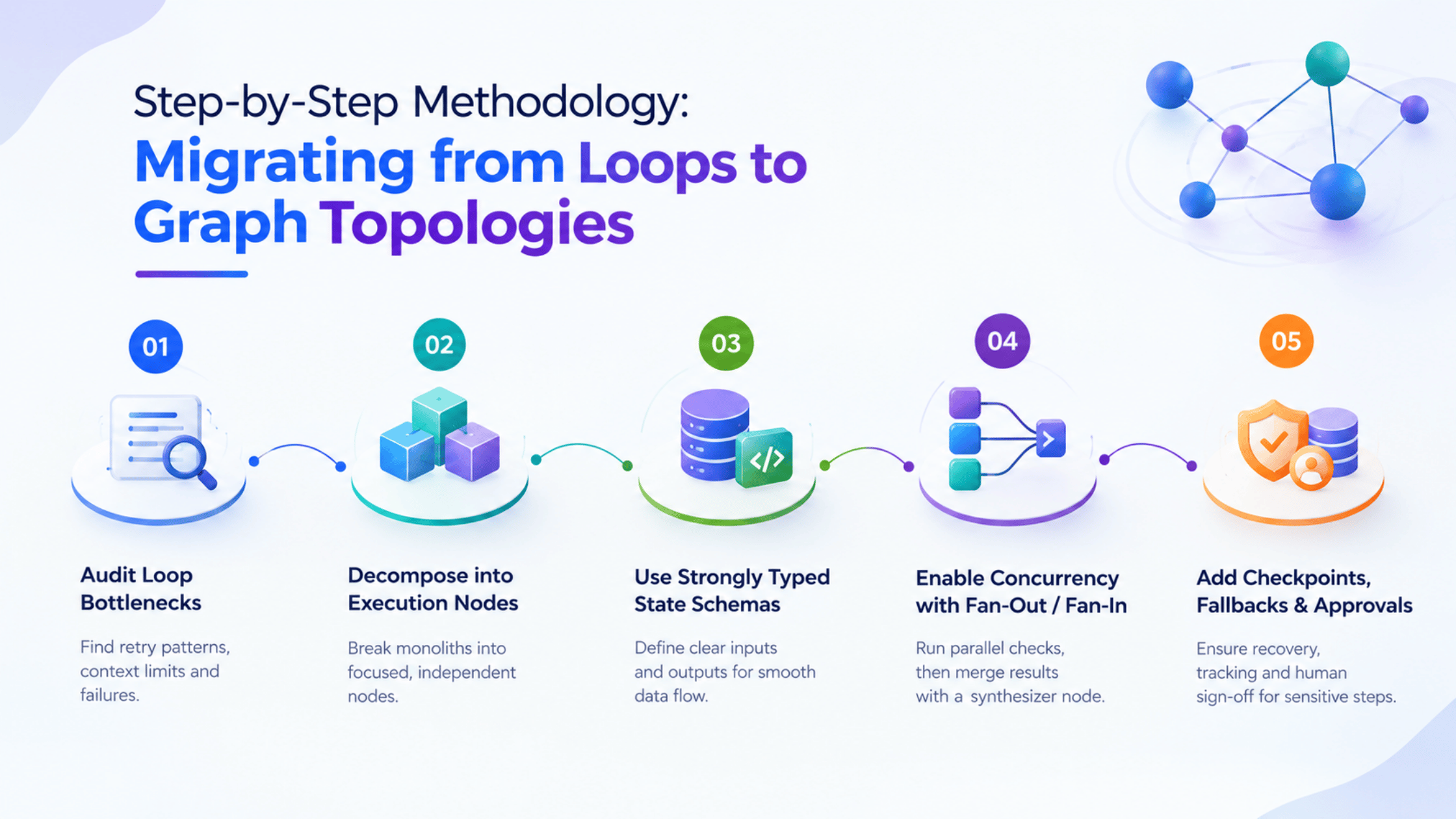
Engineering teams can follow a structured five-stage methodology to transition from brittle loops to production-grade graph architectures:
1. Audit Loop Bottlenecks and Failure Modes
Analyze historical agent execution logs to detect recurring retry patterns, context saturation points, and unrecoverable errors. High retry rates identify operations that require separation into independent nodes.
2. Decompose Tasks into Modular Execution Nodes
Divide monolithic workflows into distinct responsibilities. Separate information discovery, drafting, validation, and policy checks into individual nodes. Provide each node with only the specific tools and input schemas required for its task.
3. Establish Strongly Typed State Schemas
Define explicit state schemas that dictate how data transfers between nodes. Scoping inputs and outputs prevents context window pollution and eliminates dependencies on unstructured chat histories.
4. Implement Concurrency via Fan-Out and Fan-In Topologies
Identify independent review and processing steps. Dispatch parallel worker nodes across distinct validation criteria, such as simultaneous security, compliance, and quality checks. Use a synthesizer node to merge these independent evaluations into a single decision payload.
5. Integrate Checkpoints, Fallbacks, and Human Approval Gates
Deploy persistent checkpoint storage to support workflow recovery and audit tracking. Configure interrupt triggers on sensitive operations to mandate human sign-off before downstream execution.
Enterprise Applications and Measurable Business Impact
Graph-engineered multi-agent architectures provide the operational reliability required for mission-critical enterprise workflows. Organizations utilize modern AI orchestration software to combine language models, enterprise databases, and microservices into unified systems.
Deploying AI agents for business automation through graph structures delivers measurable performance gains across diverse sectors:
Financial Intelligence and Portfolio Analytics: Financial platforms separate data ingestion, predictive modeling, and compliance verification into distinct graph nodes. This structure accelerates multi-asset forecasting and maintains transaction auditability.
Biometric Security and Operational Verification: Automated real-time verification graphs process high-throughput identification without manual friction, maintaining data security and regulatory compliance.
Infrastructure Automation and DevOps: Enterprise DevOps graphs coordinate cloud provisioning, validation, and container management through repeatable, automated pipelines.
Production case studies demonstrate the concrete business impact of structured automation:
An automated attendance tracking system achieved 98% tracking accuracy and reduced administrative intervention by 90%, lowering operational tracking costs by 40%.
An AI-driven portfolio management platform delivered 62% faster portfolio monitoring and reduced manual data tracking errors by 45% through automated data normalization pipelines.
An enterprise cloud automation deployment reduced infrastructure provisioning build times by approximately 99% using standardized infrastructure-as-code automation.
Achieving scalable outcomes requires rigorous architectural discipline. Organizations partner with specialized agentic AI services providers to guide their AI agent development roadmaps, establishing systems with explicit state boundaries, deterministic routing, and observable governance controls.
The Strategic Path Forward for Autonomous Systems
Transitioning from simple agent loops to structured graph architectures marks a permanent evolution in software system design. Graph engineering turns erratic autonomous routines into controlled, observable, and modular production workflows.
Building on typed state transitions, explicit validation gates, and isolated execution nodes provides enterprise leaders with the verifiable reliability required to deploy autonomous automation at scale.
Contact MoogleLabs to architect, deploy, and scale production-grade graph systems built for measurable enterprise performance.
Loading FAQs
Please wait while we fetch the questions...