AI for Real Estate: Valuation, Lead Scoring, and Document Processing
AI for real estate is transforming valuation, lead scoring, document processing, and transaction workflows. Explore how predictive models, intelligent automation, AI agents, and secure cloud architectures help property enterprises improve efficiency, accuracy, compliance, and scalability.
Property markets lose millions each year to administrative friction, delayed market indicators, and manual paperwork. Appraisers spend days compiling local sales. Brokerage teams waste hours calling cold web leads who merely downloaded a neighborhood guide. Legal departments comb through fifty-page commercial lease agreements line by line.
Twenty years ago, property technology meant basic desktop databases and listing forms. Today, enterprise platforms run on predictive algorithms and continuous text processing pipelines. Applied AI for Real Estate removes these manual routines, replacing them with automated valuation engines, instant buyer scoring, and accelerated document extraction.
Building property software that works requires disciplined systems engineering. Teams that treat machine learning models as simple plug-in scripts end up with broken data ingestion, erratic pricing assessments, and inflated cloud expenses. Moving past simple pilots demands dedicated real estate software development services that connect mathematical models directly into core transaction software.
The Systemic Bottlenecks in Enterprise Real Estate Data
Property organizations sit on deep silos of disjointed property records. Local property listings rest inside regional databases with incompatible data schemas. County deeds and tax assessment registries update on delayed municipal schedules. Signed lease documents and escrow packages remain filed away in flattened image files.
When engineering teams attempt to train predictive algorithms over disconnected databases, the entire platform suffers. A pricing algorithm cannot calculate local liquidity when title transfers lag weeks behind closed transactions. It cannot score prospective buyers when browsing telemetry sits separated from customer relationship software.
Closing this architectural divide requires modern real estate software development. Technical teams must build clean data processing layers that sanitize, structure, and synchronize data before downstream algorithms consume it.
Automated Valuation Models: Moving Past Static Comparable Sales
Traditional appraisals rely on historical sales from months earlier. In volatile lending environments, backward-looking comparisons fail to reflect true asset values. Modern Automated Valuation Models evaluate multiple data streams at the same time:
Geospatial and Hyperlocal Factors: Ingesting spatial proximity to mass transit lines, school district zones, municipal zoning changes, and revised flood maps.
Capital Market Indicators: Tracking daily mortgage rate changes, municipal inventory absorption rates, regional construction costs, and localized building permit volumes.
Computer Vision for Property Condition: Analyzing listing imagery with visual neural networks to detect interior renovations, roof wear, or deferred structural maintenance, converting visual conditions into objective valuation adjustments.
Engineering teams executing custom artificial intelligence services build feature pipelines that update property valuations as soon as new market indicators register. These valuation engines produce dynamic statistical confidence intervals. Integrating modern AI for real estate into these models lets portfolio managers, institutional buyers, and mortgage underwriting teams inspect the exact risk distribution for every single property asset before allocating capital.
Predictive Lead Scoring: Focusing Broker Bandwidth Where Deals Close
Real estate sales desks waste substantial time dialing cold leads. A casual visitor downloading a floor plan brochure does not possess the same buying intent as someone booking weekend property walk-throughs. Machine learning models score buyer readiness by analyzing behavioral telemetry across website sessions and customer portals:
Prospect Metric | Traditional CRM Logic | Machine Learning Qualification |
|---|---|---|
Listing Engagement | Tracks raw page views | Evaluates price stability, geographic focus, and session frequency |
Financial Qualification | Reads self-reported forms | Validates pre-approval documentation and cash reserves |
On-Site Interaction | Logs duration of visits | Measures engagement with property tax records and mortgage calculators |
Opportunity Routing | Round-robin assignment | Routes high-probability leads to top brokers based on past deal history |
Integrating specialized AI development services lets brokerages prioritize sales outreach based on measurable user intent rather than intuition. This automated qualification keeps sales desks focused entirely on transactions ready to close.
Intelligent Document Processing: Streamlining Closings
Deploying AI for real estate document processing addresses one of the industry's heaviest administrative burdens: closing transaction volume. Commercial deals generate hundreds of pages of complex legal records, including purchase agreements, master tenant leases, title commitments, and disclosure statements that require thorough legal analysis.
Manual document audits create administrative backlogs that delay property closings and increase overhead costs. Intelligent document workflows extract transaction metrics directly from scanned legal files:
Commercial Lease Abstraction: Extracting base rent adjustments, common area maintenance expenses, renewal deadlines, and co-tenancy clauses across extensive retail or industrial portfolios.
Title and Escrow Examination: Checking parcel identification numbers, boundary maps, and recorded liens against public records to surface cloud-on-title risks prior to closing.
Closing Statement Auditing: Comparing closing disclosures against original lender loan estimates to flag unauthorized fees and ensure statutory compliance.
To maintain operational integrity, document pipelines require deterministic validation checks. When optical character recognition algorithms encounter poor scan quality or conflicting contract language, the system routes the file to human specialists for manual review instead of generating ungrounded estimates.
Connecting Predictive Models with Autonomous Agent Workflows
Predictive intelligence delivers the greatest impact when tied directly to operational systems. Modern property firms are moving beyond passive reporting dashboards toward autonomous software agents that execute processes across business applications.
Understanding how AI agents are changing business automation provides a clear pattern for property operations. Rather than forcing administrators to manage each closing step manually, autonomous software agents coordinate tasks across platforms:
Transaction Coordination Agents: Once a purchase contract is executed, software agents parse closing dates into operational milestones. The agent schedules physical inspections, orders environmental reports, verifies earnest money transfers through banking APIs, and updates buyer checklists.
Maintenance Dispatch Agents: In multi-family residential portfolios, tenant maintenance tickets route through visual diagnostic algorithms. The agent assesses uploaded photos of appliance leaks, verifies equipment warranty terms, issues work orders to preferred contractors, and confirms tenant access windows without property manager intervention.
Tenant Screening Workflows: Software agents collect rental applications, run identity and employment checks via background verification interfaces, evaluate debt ratios, assemble standardized lease agreements, and coordinate digital signatures.
Embedding agentic architectures in transaction pipelines cuts administrative delays and keeps deals on schedule. Platforms adopting AI for real estate at this level turn static databases into responsive transactional software.
Navigating Algorithmic Governance, Bias, and Compliance Mandates
Building machine learning models for property markets carries legal responsibilities. Housing algorithms fall under regulatory oversight, including the Fair Housing Act and the Equal Credit Opportunity Act. Automated systems must operate fairly and be fully auditable.
Enterprise development pods implement structural safeguards across development lifecycles:
Feature Audits and Bias Mitigation
Models trained on historical transaction records can adopt legacy systemic biases. Engineering teams run feature audits to guarantee algorithms do not use demographic details, protected identity variables, or geographic proxies like historic redlining borders to calculate valuations or route leads.
Explainability and Adverse Action Reporting
When an automated system denies an applicant or rejects credit terms, regulations require clear documentation. Development teams configure explainability frameworks that produce mathematical breakdowns of the criteria that determined the decision.
Data Security and VPC Isolation
Property software processes sensitive financial details, including banking records, tax documents, credit histories, and identity data. Machine learning architectures deploy inside isolated Virtual Private Cloud perimeters, applying encryption and zero-retention rules to prevent tenant records from leaking to public networks.
Modernizing Legacy Platforms vs. Greenfield Engineering
Adopting modern AI for real estate platforms often collides with technical debt, which remains a persistent barrier for established real estate operators. Brokerages and asset management companies cannot simply shut down their core transaction systems, legacy SQL databases, or central MLS connections to launch a greenfield cloud stack.
The practical path forward involves modular modernization. Specialized engineers place lightweight APIs and service layers around legacy databases:
Data Normalization Connectors: Ingestion tools pull raw transactional records from legacy databases and transform them into organized cloud data repositories.
Containerized Model Endpoints: Valuation models, lead scoring engines, and document extraction routines deploy as microservices inside cloud containers, exposing standard API endpoints that legacy interfaces query without rewriting underlying systems.
Decoupled User Workspaces: Front-end developers build fast web interfaces for agents and transaction coordinators, feeding off the centralized API layer.
Deploying dedicated engineering pods directly into client codebases accelerates system updates. Applying forward deployed engineering practices allows systems architects to configure network boundaries, update outdated APIs, and harden data pipelines directly within the corporate cloud environment.
Building Scalable Property Platforms with MoogleLabs
Building enterprise property platforms requires seasoned technical execution. MoogleLabs provides specialized software engineering, combining practical domain experience with modern data infrastructure. Our technical teams build custom property discovery engines, valuation systems, and transaction backends built to handle high transactional throughput.
Our development approach delivers measurable operational results:
The ISLC™ Governance Framework: We apply our proprietary Intelligent Software Lifecycle Control framework across development pipelines. This methodology bounds automated tasks, governs model prompts, and verifies system outputs to keep property workflows accurate.
Cloud-Native Architecture: Our team brings proven delivery experience, including cloud-native real estate platform development on Microsoft Azure, delivering transaction management portals, property discovery search interfaces, and automated service coordination.
Enterprise Security Standards: We deploy custom platforms configured for strict data isolation, integrating with cloud infrastructure across AWS and Microsoft Azure to support industry compliance mandates.
System Integration: We connect predictive models into your established business software, including Salesforce, central MLS streams, and enterprise resource planning systems, without forcing disruptive software replacements.
Strategic Implementation Roadmap for Enterprise Operations
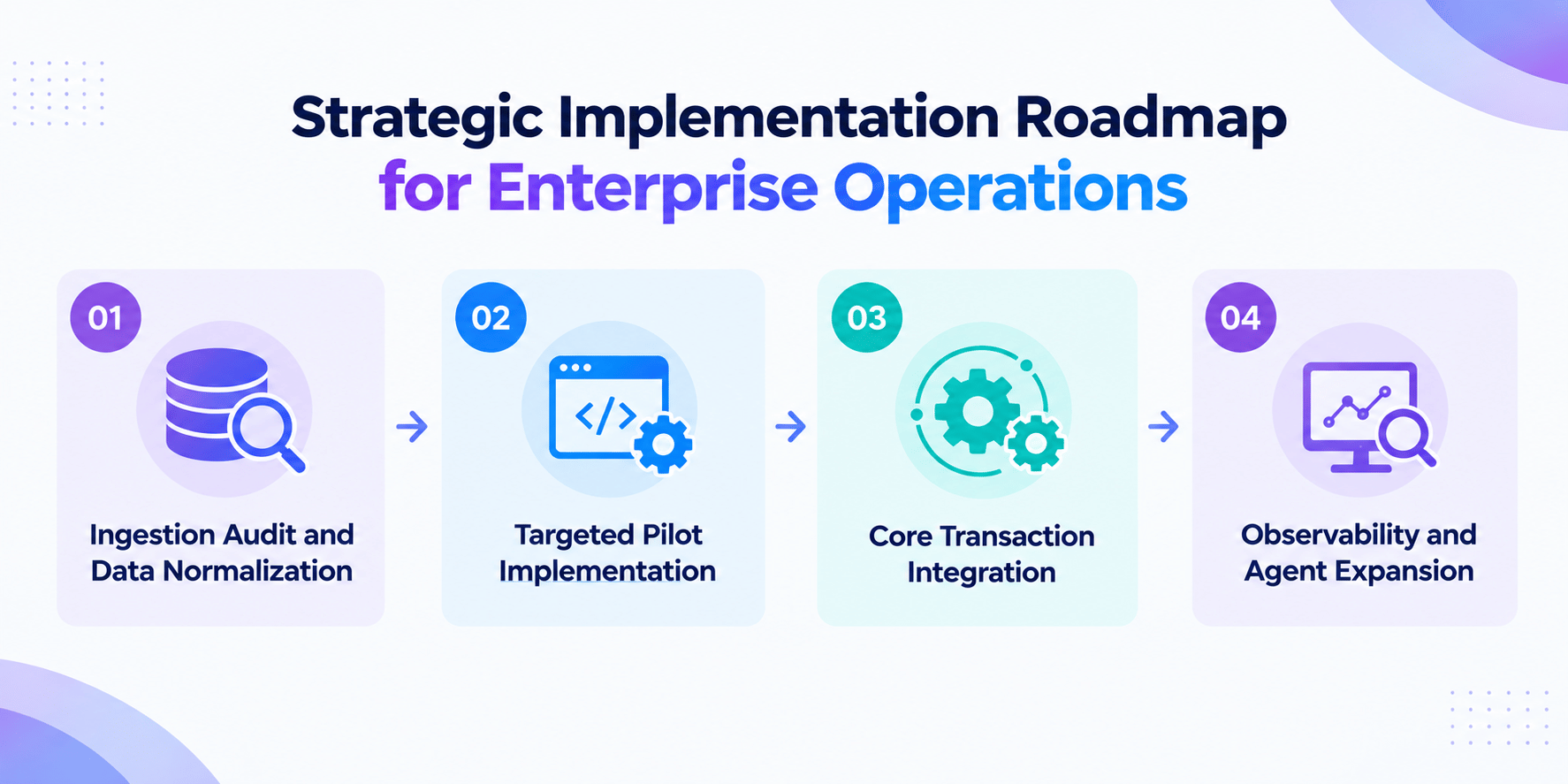
Migrating an enterprise real estate organization from manual processes to automated workflows demands clear execution phases. Attempting to deploy automated valuations, lead scoring, and document extraction at the same time creates operational gridlock:
Phase 1: Ingestion Audit and Data Normalization: Identify data silos across internal databases, MLS feeds, and document drives. Clean, normalize, and centralize property records into an enterprise cloud repository with strict schema checks.
Phase 2: Targeted Pilot Implementation: Select a specific bottleneck, such as automated commercial lease extraction or predictive buyer scoring, and deploy a containerized machine learning pipeline within a test sandbox. Benchmark latency, error rates, and operational time savings against manual baselines.
Phase 3: Core Transaction Integration: Move tested pipelines into production environments. Expose endpoints directly to broker CRMs, transaction coordination tools, and client web portals with deterministic fallback rules.
Phase 4: Observability and Agent Expansion: Instrument continuous monitoring to track data drift, market volatility shifts, and user adoption. Introduce multi-agent workflows to automate multi-step operational coordination across escrow, inspections, and property maintenance.
Organizations that establish clean data pipelines, deploy deterministic system controls, and build on secure cloud foundations capture durable operational advantages as transaction speeds accelerate. Rolling out production-grade AI for real estate ensures property firms remain competitive as markets evolve.
If your enterprise plans to build a custom property platform, evaluate specialized real estate software development services, or upgrade internal systems with enterprise artificial intelligence services, connect with MoogleLabs' engineering team to review your technical requirements and scope your implementation roadmap.
Loading FAQs
Please wait while we fetch the questions...