Forward Deployed Engineering: Bridging the Enterprise AI Gap from Strategy to Production
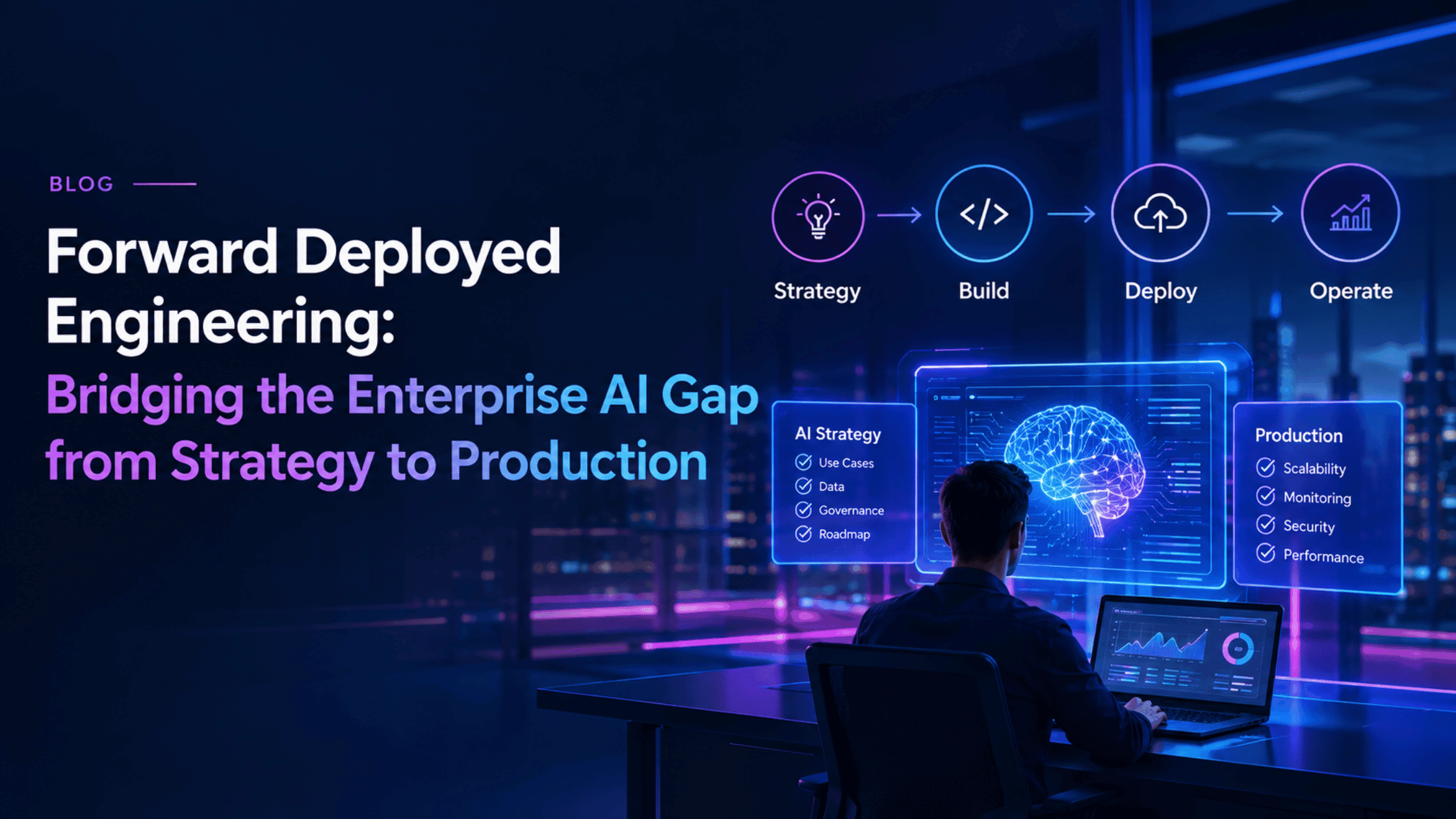
Forward Deployed Engineering embeds experienced engineers directly into enterprise infrastructure to bridge the gap between AI strategy and production. The approach addresses legacy integration, data fragmentation, security, agentic AI controls, scalability, and production reliability.
Enterprise teams spent years funding generative AI experimentation. Budgets went to proprietary model licenses, vector databases, and proofs of concept. Most initiatives still stall before reaching everyday operations. Systems work cleanly inside sandboxes. They break immediately against outdated internal APIs, messy database schemas, and strict network perimeters.
Traditional IT outsourcing hands over static code modules against rigid tickets. Management consultants leave slide decks that skip ground-level technical debt. Forward deployed engineering changes this setup.
By placing experienced systems engineers directly inside customer infrastructure, this model aligns custom artificial intelligence solutions with real corporate workflows.
The Enterprise Production Crisis: Why AI Projects Stall
Enterprise artificial intelligence initiatives fail for reasons fundamentally different from traditional SaaS deployments. Conventional software behaves deterministically: given input X, the platform executes logic Y and returns output Z. Generative systems, autonomous agents, and probabilistic models operate with non-deterministic variations, dynamic context windows, and variable inference latencies.
When organizations attempt to operationalize complex models using conventional offshore staffing or disconnected engineering pods, three systemic points of failure reliably emerge:
Context Drift and Data Fragmentation: Enterprise data does not live inside tidy vector databases. It sits scattered across legacy SQL instances, unstructured PDF document stores, cloud buckets, and ticketing tools. Models stripped of real-world operational context return hallucinations or irrelevant outputs.
Brittle Integration and Legacy Infrastructure: Algorithms must read from and write to mission-critical infrastructure. When an automated service interacts with legacy systems that lack modern REST or gRPC interfaces, traditional remote engineers push the burden back to internal platform teams, stalling deployments for months.
Runaway Compute and Operational Costs: Enterprise adoption breaks down when inference expenses spiral out of control. Running every transactional query through massive frontier models without caching, dynamic routing, or prompt-boundary defenses quickly burns annual IT allocations.
Building resilient systems demands moving beyond generic outsourcing. Resolving these operational liabilities requires specialized engineers who work on-site and in-repo to harden architectures within client firewalls.
What Is a Forward Deployed Engineer in Applied AI?
Popularized by data-intensive pioneers like Palantir and rapidly adopted across major cloud ecosystems, forward deployed engineering places technical teams directly at the customer's operational boundary.
A Forward Deployed Engineer (FDE) is not a business analyst, a pre-sales solutions architect, or a traditional staff-augmentation resource. An FDE is a senior systems software engineer, data architect, and technical consultant operating as a unified delivery unit.
Forward Deployed Engineering vs. Alternative Delivery Models
Operational Attribute | Management Consulting | Traditional IT Outsourcing | Forward Deployed Engineering |
|---|---|---|---|
Primary Deliverable | Strategy decks & roadmaps | Code modules against tickets | Hardened, production-ready software |
Working Location | Executive boardrooms | Remote offshore development centers | Embedded in client repos and cloud VPCs |
Accountability Metric | Billable advisory hours | Completed sprint story points | Production uptime, latency, and business ROI |
Architecture Focus | High-level system concepts | Isolated software features | Last-mile integration & system telemetry |
Problem Ownership | Identifies strategic gaps | Escalates edge-case blockers | Writes the glue code to solve bottlenecks |
Traditional software engineers work in controlled environments, building platform features against clean product roadmaps. When external enterprise data is malformed, or an internal database times out, standard development pipelines reject the input. In contrast, forward deployed engineers expect enterprise conditions to be messy. Their explicit mandate is to drag sophisticated models into the mud of corporate reality, writing custom middleware, schema adapters, and test harnesses until the system runs dependably.
Deploying high-performing models requires disciplined data prep and runtime boundary monitoring. Teams must apply advanced AI Context Engineering to structure semantic search layers and clean document chunking strategies. Simultaneously, embedded squads institute proactive AI cost optimization measures, ensuring multi-turn prompts and inference token volumes remain commercially sustainable over sustained production runs.
Deploying Scalable Generative AI Solutions & Agentic AI Services
Enterprise software is undergoing an architectural evolution: shifting from informational chatbots that provide passive answers to autonomous, multi-agent frameworks that take actions across business systems.
Deploying practical agentic AI services requires far more than basic API calls to external foundational models. Autonomous agents must interpret ambiguous goals, decompose directives into logical steps, query enterprise systems, validate outputs, and self-correct runtime errors.
When building agentic AI-powered software, the critical engineering challenge is managing non-deterministic behavior. Left unconstrained, an autonomous agent tasked with processing procurement invoices can trigger cascading execution loops, corrupting databases or exhausting API token quotas.
Forward deployed engineers mitigate these operational hazards by building controlled operating perimeters:
Transactional Guardrails: The team establishes deterministic boundaries. While an agent may use generative reasoning to extract information from an ambiguous invoice, the financial transaction, balance deduction, and approval routing must run through deterministic code blocks.
Workload-Aware Model Routing: Not every enterprise operation demands an expensive reasoning model. Embedded engineers build dynamic routing architectures that direct routine classification tasks to lightweight open-source models, reserving frontier engines for multi-step reasoning. To understand how routing algorithms split complex query loads across specialized sub-networks, see our technical breakdown of Mixture of Experts.
Tool-Use Integration and Sandboxing: Modern enterprise agents execute operations by leveraging custom functions and internal APIs. Forward deployed engineers write secure sandboxes, containerized runtimes, and mock environments to validate tool usage before granting autonomous agents production write access.
By treating the integration layer as a software engineering discipline, forward deployed engineers transform theoretical generative AI solutions into dependable operational systems.
Enterprise Governance, Compliance, and Security Controls
Deploying applied AI within heavily regulated sectors such as financial services, healthcare, and insurance introduces complex legal, operational, and compliance requirements. Enterprisewide rollouts stall when security teams discover that customer records or proprietary data could be exposed to public model endpoints.
Forward deployed engineers build enterprise security directly into the deployment pipeline:
VPC Isolation and Zero-Data Retention: Forward deployed engineering pods deploy open-source or dedicated enterprise models inside the client's Virtual Private Cloud (AWS, Microsoft Azure, or GCP). Workloads are configured under strict zero-data-retention (ZDR) agreements, preventing runtime payloads from ever leaving the company perimeter.
Role-Based Context Masking: If a frontline support representative lacks the security clearance to view a patient’s full medical history or an employee's compensation tier, an agent assisting that representative must inherit identical constraints. FDEs implement pre-retrieval data sanitization and dynamic role-based access control (RBAC) across vector collections.
Deterministic Fallbacks and Circuit Breakers: Probabilistic models occasionally produce low-confidence predictions or experience context failures. Forward deployed teams implement circuit breakers that automatically drop execution into deterministic fallback code or route requests to human reviewers whenever validation thresholds fail.
Intellectual Property Protection: A major vulnerability of off-the-shelf software vendors is vendor lock-in. When using external generative AI development services, enterprises must maintain full ownership of all customized middleware, fine-tuned weights, embeddings, and pipeline code. Embedded engineering guarantees that intellectual property remains client property from the first commit.
How Forward Deployed Engineering Works in Practice
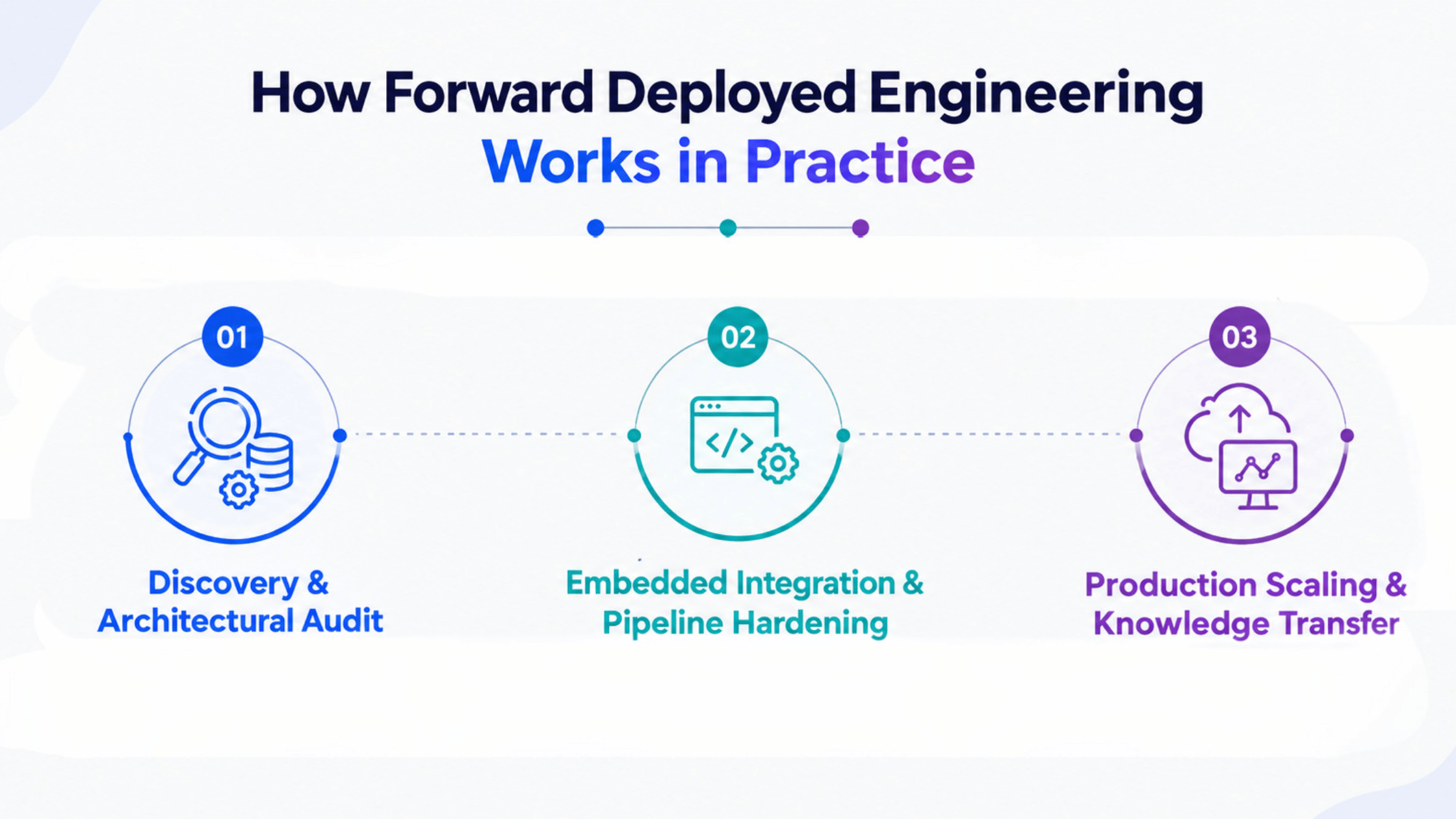
The forward deployed delivery model follows an agile, hands-on lifecycle focused on time-to-value and rapid production hardening. Rather than spending months producing abstract system blueprints, FDEs deploy early prototypes inside production environments to identify architectural bottlenecks immediately.
Phase 1: Discovery & Architectural Audit
The engagement begins inside the client's technical ecosystem. The forward deployed team audits data pipelines, checks database schemas, inspects existing REST/SOAP APIs, and verifies identity systems. Rather than asking "What are the business requirements?", the team asks "Where are the system integration bottlenecks that prevent data from reaching production endpoints?"
Phase 2: Embedded Integration & Pipeline Hardening
The engineers write custom adapters that bridge modern neural networks with legacy corporate platforms. During this stage, the team configures vector retrieval pipelines, builds deterministic safety layers, and integrates semantic caching to control operational expenses. Code is merged directly into client version-control systems under existing security and CI/CD protocols.
Phase 3: Production Scaling & Knowledge Transfer
Once the system handles production workloads reliably, the forward deployed team instruments continuous telemetry to track latency variations, schema drift, and token burn rates. Crucially, the engagement ends with operational enablement. The embedded engineers run cross-training workshops, deliver production runbooks, and transfer codebase governance to internal platform squads, ensuring the organization maintains complete autonomy over the system.
Strategic Integration: Accelerating Enterprise AI Deployment with MoogleLabs
Moving from isolated proofs-of-concept to production-grade deployments requires bridging the gap between algorithmic design and enterprise infrastructure. While traditional software outsourcing focuses on code completion against static tickets, modern intelligence initiatives require embedded engineers who can diagnose legacy technical debt, harden data perimeters, and resolve runtime friction directly within client environments.
MoogleLabs delivers this last-mile bridge through cross-functional engineering pods that integrate directly into enterprise cloud platforms across AWS and Microsoft Azure. Rather than treating deployment as an afterthought, our teams deploy bespoke artificial intelligence solutions, production-hardened generative AI solutions, and autonomous agentic AI services built to interact reliably with complex, multi-tenant workflows. The foundation of our delivery model rests on disciplined execution:
Proprietary Lifecycle Governance: We deploy systems using our Intelligent Software Lifecycle Control (ISLC™) framework. ISLC™ acts as an active governance layer wrapping client codebases, enforcing automated test generation, vector database indexing, and factual RAG grounding to prevent context pollution and hallucination.
Enterprise Security and Compliance: Our engineers design architectures that meet strict compliance standards, including HIPAA and GDPR, for regulated verticals like healthcare, financial services, and supply chain logistics. Every asset, from vectorized stores to fine-tuned weights, remains isolated inside your private cloud perimeter under zero-retention configurations.
Autonomous Agent Sandboxing: To support agentic AI-powered software, our teams build deterministic execution boundaries, transaction verification gates, and API sandboxes. This ensures autonomous agents interact safely with live databases, ERPs, and CRMs without entering recursive execution loops or modifying critical business records without authorization.
Computational Cost Control: Production deployments balance performance against compute sustainability. Our forward deployed engineers configure semantic caching and modular workload routing, directing routine tasks through lightweight architectures while reserving frontier models for multi-step reasoning.
Concluding Thoughts
Enterprise artificial intelligence yields real competitive value only when systems operate reliably at the boundary of core corporate operations. Rushing algorithms into production without runtime guardrails, data observability, and architectural governance risks costly pipeline failures, security blind spots, and project resets.
By uniting embedded systems engineering with continuous lifecycle controls, forward deployed teams resolve the integration challenges that stall digital transformation. When models operate inside well-governed infrastructure, enterprises achieve faster time-to-market, predictable inference budgets, and software assets built to scale.
If your organization is evaluating enterprise generative AI development services or preparing to operationalize autonomous agent systems, connect with the MoogleLabs technical team to scope your architectural requirements and begin your production deployment.
Loading FAQs
Please wait while we fetch the questions...