AI-Powered Data Integration: How Businesses Are Connecting Data Sources With AI
.png&w=3840&q=75)
AI-powered data integration helps businesses connect APIs, databases, and enterprise applications through intelligent, real-time data pipelines. Discover how machine learning improves data quality, automates schema alignment, strengthens governance, and enables reliable AI-driven operations.
Data architectures spent two decades trapped behind disconnected silos. In production environments running autonomous software agents, lightweight language models, and sub-second inference calls, the old integration playbook breaks down completely.
Workplace copilots, predictive engines, and multi-agent systems interact with active records every second. Static batch pipelines fail under that pressure. Enterprise data cannot sit inside overnight staging tables while operations move forward.
Systems need live feedback loops that clean, validate, and move payloads immediately. This shift makes AI-powered data integration a mandatory engineering standard for modern platforms.
What Is AI-Powered Data Integration?
Traditional data consolidation relies on rigid schemas, brittle transformation rules, and manual maintenance scripts. When an upstream partner updates an endpoint parameter, the pipeline halts. Data engineers spend days tracking down broken queries and backfilling missing records.
In contrast, AI-powered data integration puts statistical models directly inside ingestion pipelines. The system tracks schema variations, flags semantic shifts, and repairs mapping rules without manual developer intervention.
Instead of waiting for an engineer to rewrite extraction scripts, machine learning models infer column relationships by inspecting data payloads directly.
Dynamic Schema Alignment: Standard ML models link different endpoints by matching raw attributes, field names, and sample values.
Automated Drift Protection: Changes to third-party software payload keys are reflected in ingestion engine table definitions.
Anomaly Isolation: Autonomous agents identify sudden null spikes or corrupted numbers and quarantine bad records prior to ingestion by models.
Companies modernizing their architectures often contract experienced AI development services to replace brittle extraction scripts with adaptive data flows.
How AI Connects Distributed Enterprise Data Sources
Production records rarely live in one clean location. Data sits scattered across on-premises mainframes, cloud object buckets, software-as-a-service providers, and private relational databases.
These components must be wired together, and that requires experienced application integration services that can handle messy, distributed protocols.
Intelligent API Gateways:
Network brokers inspect incoming JSON payloads and format them into clean schemas on the fly.
Event handlers route asynchronous webhooks into persistent database queues without dropped packets.
Modern Transformation Frameworks:
High-speed ELT pipelines load unformatted records straight into managed cloud warehouses.
Dynamic transformation scripts run validation checks directly inside private virtual networks.
Change Data Capture Mechanisms:
Sub-second event streams keep operational databases matched with downstream analytics engines.
Low-latency message brokers deliver transactional updates to machine learning services without slowing primary transaction tables.
Running these pipelines at scale requires real engineering discipline. Mature enterprises invest in dedicated AI/ML development to keep automated pipelines humming under heavy transaction volumes.
Can AI Connect APIs, Databases, and Enterprise Applications?
The short answer is yes. We need to replace brittle point-to-point scripts with open communication standards so that these platforms can talk cleanly.
Connecting enterprise resource planning tools, customer databases, issue trackers, and internal databases is required for teams in complex enterprise application integration.
Standardized Context Protocols: Modern interfaces give language models a standardized way to access internal databases and tools, eliminating the need to build custom connectors for each new tool. See how protocol standards measure up to retrieval architectures in our architectural breakdown of MCP vs. RAG.
Zero-Copy Virtualization: Logical query views expose remote databases to inference engines without the overhead of creating expensive duplicate storage pools.
Microservice Routing: Specialty network layers wrap legacy systems in modern interface protocols, maintaining legacy mainframes accessible to modern software stacks.
Modern engineering teams use AI-powered data integration to turn fragmented records into clean, dependable streams.
How RAG and Vector Databases Leverage Integrated Data
A language model is only as smart as the records placed in its prompt window. When context pipelines pull stale or corrupted records, models hallucinate and produce untrustworthy answers.
Semantic Document Processing: Modern pipelines read semi-structured text, split sections by meaning, and generate embeddings through dedicated transformer models.
Metadata Indexing in Vector Stores: Vector databases store embeddings alongside critical metadata like creation timestamps, source departments, and document versions.
Grounded Retrieval Mechanics: Production pipelines fetch context by semantic similarity, giving models verified enterprise records before text generation starts. Review our detailed blueprint on RAG app development to inspect full implementation patterns.
Workplace Agent Operations: Governed data flows let employee tools resolve requests without human supervision. Explore how enterprises deploy AI copilots across daily business operations.
Dependable AI-powered data integration makes sure generative models run on facts rather than fabricated guesses.
Core Challenges: Data Quality, Security, and Governance
Placing machine learning models over corporate infrastructure introduces operational risks if the underlying pipes lack strict governance. Scaling production platforms requires three technical controls:
Automated Quality Assertions
Duplicate or conflicting entries pollute model reasoning.
Programmable verification gates quarantine bad records before chunking, embedding, and storage.
Zero-Trust Security Perimeters
Access rights on source databases must follow documents straight into model prompt windows.
Role-based permissions keep sensitive financial logs out of reach of unauthorized staff. Learn how to harden runtime boundaries in our analysis of AI cybersecurity integration.
Lineage Telemetry And Tracking
System dashboards monitor data distributions, null rates, and semantic drift across active streams.
Immutable event logs allow software teams to track bad answers to the exact source row.
To go live safely, companies use enterprise-ready artificial intelligence solutions to find pipeline bugs before bad data gets to production.
Architectural Implementation: Building Modern Integration Pipelines
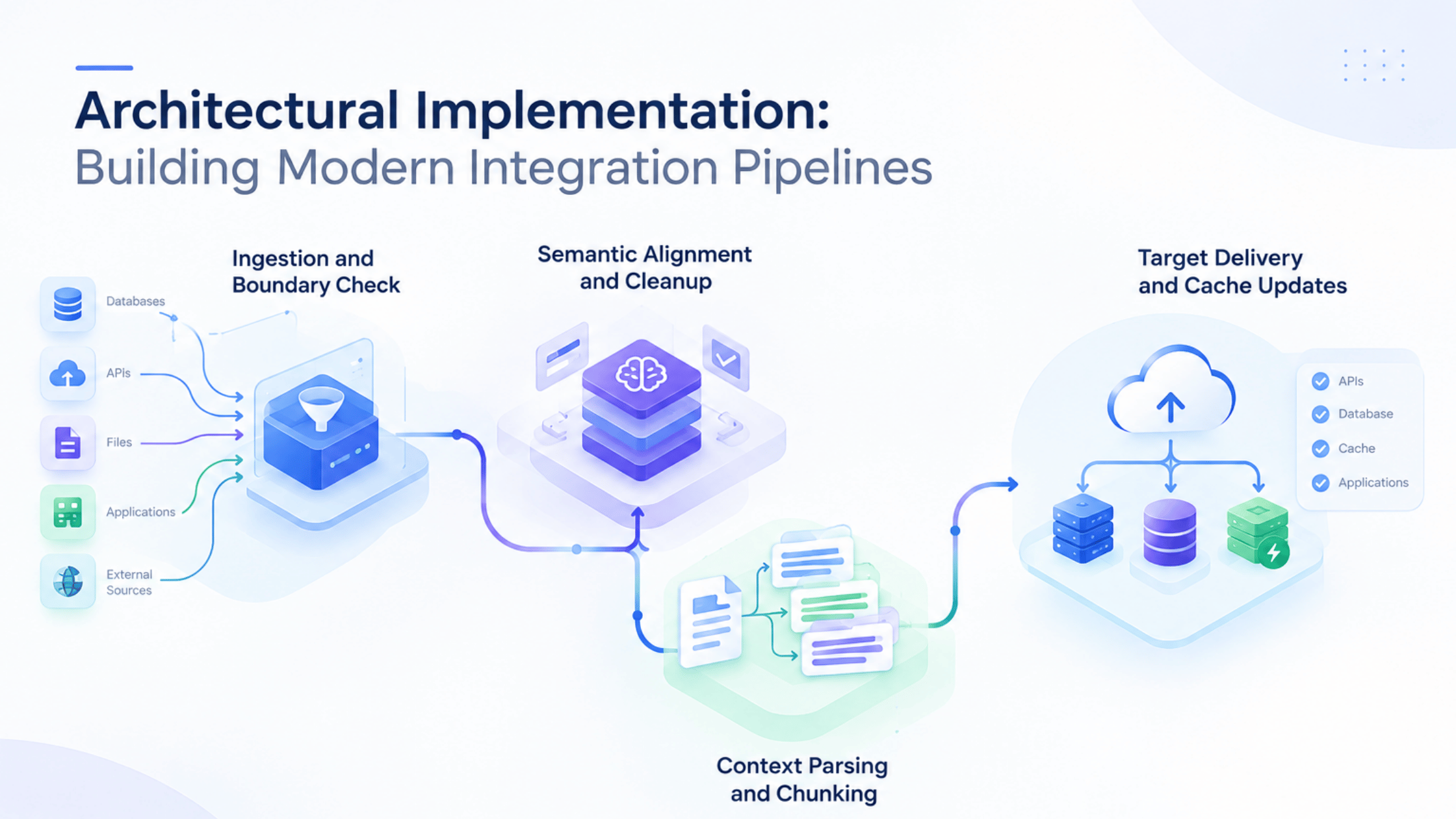
Building strong enterprise pipelines requires breaking down core platform responsibilities into well-defined, observable domains. Combining ingestion, cleaning, and model calls in one script creates maintenance debt that breaks under load. An effective architecture uses four successive zones:
Ingestion and Boundary Check: Records are received through streaming brokers, message queues, or API webhooks. We run automated schema validators on every payload to check its format, drop corrupt packets into dead-letter queues, and archive raw copies in object storage.
Semantic Alignment and Cleanup: Raw entries are passed through classification models that align different attributes to canonical company definitions. Transforming disparate customer status flags of three acquired companies into consistent account categories.
Context Parsing and Chunking: Division of unstructured documents at semantic boundaries, not arbitrary line counts. The parsing logic preserves the association of tables, headers, and bulleted clauses so that models are presented with complete thoughts.
Target Delivery and Cache Updates: The pipeline writes normalized rows into analytical databases while vector engines index text chunks. High-throughput streams update semantic memory caches, letting active copilots see fresh records within seconds of a commit.
Fast failure isolation by decoupling ingestion from downstream model enrichment. Engineers can reprocess raw historical data without taking down customer-facing systems. “AI-powered data integration gives engineering teams the operational control they need to run mission-critical systems.
Selecting the Right Integration Patterns: Batch, Streaming, or Event-Driven
No single data transport pattern solves every enterprise use case. Modern architectures combine several data transport strategies based on system latency, compute expenses, and operational needs.
Scheduled Micro-Batches
Micro-batches are good for records that are not urgent, like archived support emails or daily accounting logs. Running batch transformations every fifteen or thirty minutes drops server bills and keeps cloud compute costs predictable.
Event Streaming
Payment fraud detection, dynamic dispatching, and warehouse tracking workloads need instant pipeline response times. Streaming engines read row modifications directly from transaction logs, pushing updates to models without touching intermediate storage disks.
On-Demand Database Querying
Many autonomous tools require immediate verification that can’t wait for scheduled ingestion routines. This model has the software querying the structured database interfaces as needed for new transaction information.
Experienced guidance is needed to assess these engineering trade-offs. Bad pattern choices lead to expensive cloud bills, stale models, or swamped internal databases. Enterprise leaders can choose the right ingestion methods for their technical workloads with specialized application integration services.
Real-World Applications Across Core Industries
Applying machine learning to data pipelines solves messy operational bottlenecks across major enterprise industries:
Financial Transaction Monitoring
Global banks process millions of payments across different currencies, banking formats, and regulatory registries. Automated data mapping standardizes payment payloads, catches transaction anomalies, and flags compliance risks without analysts manually reconciling tables.
Supply Chain And Route Logistics
Logistics operators handle shipping manifests, customs declarations, container sensors, and local traffic alerts. Unified pipelines transform messy vendor formats into a single operational view, alerting dispatchers to shipment delays hours before trucks hit the gate.
Healthcare Records Management
Healthcare networks manage clinical trial updates, medical claims, and electronic health records stored across separate hospital databases. Machine learning pipelines clean clinical details and mask patient identities, allowing researchers to study treatment outcomes without violating privacy rules.
Modernizing these enterprise pipelines requires experienced engineering execution. Many technical leaders rely on professional AI development services to launch self-healing data flows across their legacy software stacks.
The Future of Enterprise Data Orchestration
Decades of enterprise software experience show that algorithms never solve underlying infrastructure failures. The commercial success of generative systems and multi-agent workflows depends entirely on how cleanly live business records reach model inference windows.
Adopting resilient AI-powered data integration protects operational budgets, eliminates integration blind spots, and guarantees data integrity. Organizations that pair advanced enterprise application integration with continuous AI/ML development successfully scale production-grade AI solutions across core business operations.
To audit your data architecture, eliminate pipeline latency, and deploy robust AI-powered data integration, connect with the systems engineering team at MoogleLabs.
Loading FAQs
Please wait while we fetch the questions...