Agentic RAG vs RAG: Designing Next-Generation AI Applications
Can Low-Code/No-Code become the future of enterprise application development? Explore how LCNC platforms can reduce development bottlenecks, accelerate innovation, and help businesses build applications faster with fewer coding requirements.
Enterprise AI is evolving rapidly from simple search tools to active, autonomous decision-makers. While standard information lookup transformed data access across companies, today's operational workflows require systems that reason, plan, and take action.
Comparing standard RAG vs agentic RAG highlights how modern workflows are moving beyond static context retrieval. Organizations adopting this model can significantly increase operational speed, reduce manual overhead, and achieve sustainable competitive advantages.
The Evolution: From Passive Knowledge Search to Active Execution
The rapid adoption of enterprise generative AI development introduced business organizations to the foundational advantages of large language models. However, early deployments revealed clear limits regarding static training windows, hallucinations, and an inability to access real-time internal enterprise data.
Retrieval-augmented generation emerged as the primary standard to bridge this gap. By connecting language models directly to external vector databases, traditional RAG frameworks allowed applications to fetch relevant document fragments and generate contextually grounded text.
Despite improving accuracy, standard RAG operates on a rigid, single-pass pipeline. The user enters a prompt, the system converts the text into vector embeddings, retrieves mathematically similar chunks from a database, and feeds those static inputs into the model for output generation.
While effective for basic document search and policy lookup, this approach breaks down when handling complex, multi-variable enterprise workflows. If the initial retrieval fetches incomplete, ambiguous, or irrelevant context, the static pipeline cannot self-correct, leading to incomplete or inaccurate answers.
Agentic RAG fundamentally re-engineers this process by transforming passive retrieval into an active, iterative reasoning cycle. Instead of executing a single lookup step, Agentic RAG deploys intelligent AI agents solutions capable of planning, query decomposition, context evaluation, and tool usage.
When faced with a complex operational query, the system breaks the objective into smaller tasks, validates the retrieved evidence against strict confidence thresholds, executes secondary lookups if information is missing, and invokes external application programming interfaces (APIs) to complete tasks. This evolution shifts natural language processing services from informative text generators into active operational engines.
How does Agentic RAG Work?
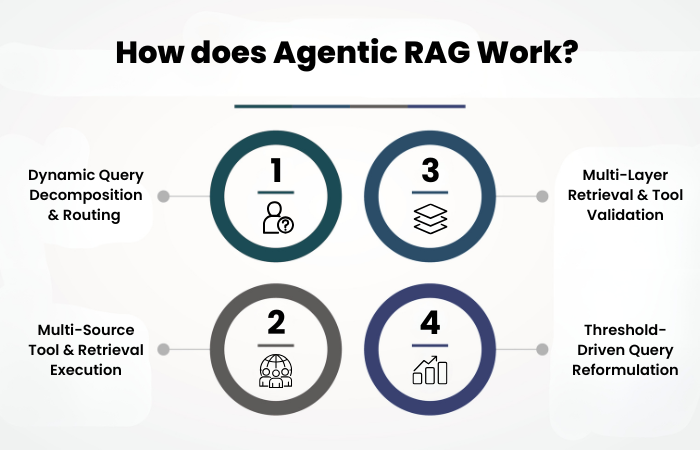
Agentic RAG transforms static information retrieval into a dynamic execution cycle governed by an orchestration layer (such as LangGraph or AutoGen). Instead of relying on a single vector search, the agent manages task execution using four core engineering mechanisms:
1. Dynamic Query Decomposition & Routing
When a complex, multi-part prompt is received, an orchestrator LLM decomposes the intent into granular sub-queries. A router module then directs each sub-query to its optimal data source - routing structured data requests to SQL databases via Text-to-SQL, unstructured domain knowledge to vector stores, and real-time operational status to REST APIs.
2. Multi-Source Tool & Retrieval Execution
Unlike standard RAG, which only reads from a vector database, Agentic RAG equips the model with tool-calling capabilities. The system can execute parallel or sequential read/write operations fetching semantic chunks, querying relational database tables, or issuing HTTP requests to ERP and CRM systems within a single operational turn.
3. Multi-Layer Retrieval & Tool Validation
To ensure accuracy without attributing human-like "self-awareness" to the model, Agentic RAG relies on programmatic and model-based validation techniques:
Schema & Status Validation: Ensuring tool and API responses return valid payloads (e.g., HTTP 200 OK, JSON schema compliance).
Retrieval Relevance Thresholds: Calculating vector similarity and keyword density scores to ensure retrieved document chunks meet a baseline relevance metric.
Verifier Models (Evidence Checking): Running secondary judge models or output guardrails to evaluate whether the retrieved context explicitly grounds the generated response, filtering out hallucinations before delivery.
4. Threshold-Driven Query Reformulation
If initial retrieval results fall below defined confidence thresholds or fail evidence validation checks, the orchestrator triggers a fallback loop. The system reformulates the search parameters, adjusting dense/sparse hybrid search weights, expanding keywords, or querying alternative indexes until required evidence criteria are satisfied.
This upgrade moves standard workplace tools from simple AI copilots into dynamic digital workers capable of completing tasks end-to-end. Enterprise teams often partner with specialized technical providers like MoogleLabs to deploy high-performing GenAI development services, turning static content repositories into active engines.
RAG vs Agentic RAG: Key Differences Explained
Comparing RAG vs Agentic RAG makes the difference in operational performance clear. Standard RAG focuses purely on finding documents, while Agentic RAG focuses on solving problems and completing business workflows.
Architectural Feature | Standard RAG Setup | Agentic RAG System | Real Business Impact |
|---|---|---|---|
Process Flow | Single-pass line (Retrieve → Generate) | Stateful loop (Decompose → Route → Retrieve → Validate → Act) | Handles multi-layered, complex enterprise jobs. |
Data Access | Read-only vector search. | Read/write access across vector stores, SQL databases, and business APIs. | Links answer retrieval directly to workflow execution. |
Handling Ambiguity | Relies strictly on the initial user query. | Sub-query decomposition and prompt/query expansion. | Resolves ambiguous prompts to deliver higher-quality, relevant outputs. |
Error Handling | Delivers incomplete context straight to the user. | Applies verifier models, confidence thresholds, and schema validation. | Reduces hallucinations and inaccurate data in core operations. |
Tech Stack Needs | Basic vector store and standard prompt templates. | Agent frameworks, state tracking, action triggers, and active monitoring. | Provides robust software ready for enterprise operations. |
Enterprise Adoption and Real-World Examples
Companies worldwide are adopting Agentic AI services to automate multi-step operations. Market data highlights this rapid shift:
Gartner forecasts that 40% of enterprise applications will feature task-specific AI agents by 2026, up from under 5% in 2025.
Research from McKinsey indicates that 23% of companies are already scaling Agentic AI tools.
S&P Global Market Intelligence reports that 58% of organizations are actively looking to implement the Agentic AI capabilities in their business operations.
High-Impact Industry Use Cases
Leading brands demonstrate how Agentic RAG improves business outcomes:
Financial Operations and Wealth Management
SEC Retrieval + Analytical Execution
Wealth advisors query complex market data across dense SEC filings and analyst notes using vector retrieval. The orchestrator agent passes retrieved financial metrics into python calculation tools to execute portfolio projections, running output through verifier models to ensure strict compliance with regulatory disclosures before presenting recommendations.
Grounding-Led Customer Banking (e.g., Klarna)
When resolving billing or refund requests, AI assistants first query localized return and policy documents using semantic search. Once the required policy conditions are verified against transaction records via schema validation, the agent invokes payment gateway APIs to execute returns automatically.
Engineering and Technical Support
Log-Driven Code Verification (e.g., Uber Genie)
Technical support agents parse system error logs and issue vector search queries against internal codebase repositories and API documentation. If initial document fragments fail to cover the specific stack trace, the agent reformulates search queries and uses Abstract Syntax Tree (AST) validation tools to verify code syntax before surfacing fix recommendations to engineers.
Supply Chain and Automated Procurement
Hybrid ERP Lookup + Contract RAG
Supply chain systems query ERP relational databases to monitor live stock levels. When inventory drops below reorder points, the agent performs vector retrieval over supplier contracts and SLA documents to compare negotiated volume discounts. After validating that contract terms match current vendor pricing schemas, the agent executes API calls to generate purchase orders.
Building Production-Grade Agent Applications: Infrastructure, Security, and Governance
Moving from simple testing projects to production-ready AI agents solutions requires careful engineering, proper monitoring, and strong control systems. Organizations scaling Agentic RAG prioritize three core operational pillars:
AI Inference Infrastructure and Performance
Agentic workflows run multiple language model steps and tool calls for a single user task. Managing this workload requires scalable AI inference infrastructure that keeps processing speeds fast while controlling cloud spending. Enterprise teams use model tuning, smart caching, and prompt optimization to keep running costs predictable.
AgenticOps and AI Observability
Because AI agents make real-time choices, engineering teams need specialized management tools. Establishing AgenticOps standards gives teams deep AI observability across every step of execution. Monitoring software tracks step-by-step reasoning, API execution accuracy, token usage, and latency to fix bugs and prevent unnecessary processing loops.
AI Agent Security and Access Controls
Giving autonomous agents access to internal software tools makes security a top priority. Strong AI agent security practices protect systems against prompt attacks, data leakage, and unapproved changes. Key protective steps include:
Role-Based Access Control (RBAC): Enforcing strict permission limits across all connected databases and APIs.
Secure Tokenization: Using safe token systems to handle actions without revealing private login credentials.
Human-in-the-Loop (HITL) Safeguards: Requiring human sign-off for critical business steps, such as large payments or database updates.
Deterministic Schema Guardrails: Validating all tool inputs/outputs against strict JSON schemas prior to API execution.
Deploying secure, enterprise-grade AI applications requires solid technical skills in modern machine learning, NLP services, and system integrations.
Engineering teams at MoogleLabs incorporate these governance, security, and observability standards into every stage of development, allowing organizations to scale autonomous workflows with complete confidence.
Future Trends: Multi-Agent Systems, Memory, and Hybrid Architectures
As generative AI technology matures, enterprise implementations are evolving beyond isolated single-agent setups toward interconnected software ecosystems. Key trends defining next-generation AI applications include:
Multi-Agent RAG Orchestration
Rather than using a single model to manage an entire process, complex tasks are distributed across networks of specialized agents. For example, one agent queries internal documentation, a second runs SQL analytical queries, a third verifies security policies, and an orchestrator agent synthesizes the results into a final action.
Structured Short-Term & Long-Term Memory
Applications incorporating structured short-term working memory and long-term episodic vector memory. This allows agents to retain domain context, track multi-session interaction histories, and refine their problem-solving strategies over time.
Standardized AI Agent Orchestration Protocols
Industry standards are emerging to govern how autonomous agents communicate, exchange operational state data, and hand off tasks across disparate cloud environments.
Hybrid RAG Routing
To manage token expenditure and processing speed, enterprises are adopting hybrid designs. High-frequency, straightforward user queries are processed through standard low-cost RAG pipelines, while complex operational goals are dynamically routed to agentic reasoning loops only when tool execution or multi-step logic is required.
To stay ahead of these rapid advancements, technology teams work alongside engineering specialists like MoogleLabs to design flexible architectures that adapt as market capabilities evolve.
Conclusion
Moving from simple retrieval to dynamic agent systems is a major step forward in enterprise software. By automating complex workflows and reducing errors, companies gain a clear operational edge. Maintaining strong governance and security guardrails ensures sustainable long-term performance. Partnering with engineering specialists like MoogleLabs empowers businesses to build, deploy, and scale secure agentic applications that drive continuous growth.
Loading FAQs
Please wait while we fetch the questions...