AI Governance for Multi-Agent Systems: Identity, Permissions, Audit Trails, and Accountability
Learn how to govern multi-agent systems in production with secure agent identities, access controls, audit trails, human oversight, and risk management. Explore practical AI governance strategies to keep autonomous workflows secure, compliant, and accountable.
Your agents can now call APIs, move data, and trigger payments without anyone clicking a button. That’s the upside, and the exposure. AI Governance for Multi-Agent Systems gives every agent an identity, a permission boundary, a logged trail, and a human owner. This guide walks business leaders through each piece, from access design to audit logs to accountability, so autonomous workflows stay productive and safe in production.
What Is AI Governance for Multi-Agent Systems?
AI Governance for Multi-Agent Systems is the set of policies and technical controls that define who each agent is, what it can access, what it must log, and who answers for its actions. It focuses on agents running in production, not on AI ethics in general.
How does a multi-agent AI system work?
A multi-agent system splits one business process across specialized agents: one gathers data, one validates it, one acts, one reviews. Frameworks like AutoGen, CrewAI, and LangGraph manage the hand-offs. Multi-agent orchestration decides who talks to whom and which tools each agent can call. Our post on agentic AI workflows shows how these chains are built.
Why is governance different for multi-agent systems?
A chatbot needs prompt filters and output checks. A team of agents needs control over actions too, since one agent’s output becomes another’s input and small errors grow along the chain. Gartner predicts over 40% of agentic AI projects will be cancelled by the end of 2027, citing cost, unclear value, or inadequate risk controls.
What risks arise when AI agents interact with each other?
Cascading errors: one agent’s wrong claim becomes another agent’s fact, then lands in a live database.
Runaway loops: two agents keep prompting each other and API costs climb overnight.
Context poisoning: tampered data passes between agents and slips past filters set only at the entry point.
How Should Enterprises Manage AI Agent Identity and Access?
Give every agent its own machine identity. Grant the least access its task needs, and replace shared API keys with short-lived tokens.
Does every AI agent need a unique identity?
Yes. With shared credentials, every action looks like it came from the same place, so audits go nowhere. Use a dedicated service principal, an OAuth 2.0 client-credentials grant, or a SPIFFE/SPIRE ID per agent. A compromised billing agent then can’t pose as the database admin.
How do you apply least-privilege access to AI agents?
Start at zero and add only what the task proves it needs:
Explicit tool allowlists per agent
Read-only database views for retrieval agents
Scoped tokens that expire when the task ends
The right AI agent development tools make these controls easier to build in from day one.
How should agents authenticate when accessing APIs, databases, and enterprise applications?
Retire long-lived API keys. Keep secrets in a manager such as HashiCorp Vault, use mutual TLS between services, and issue short-lived tokens per session. The stakes are real: IBM’s 2025 Cost of a Data Breach report found 13% of organizations had breaches of AI models or applications, and 97% of those lacked AI access controls. Identity is the first layer of AI Governance for Multi-Agent Systems.
How Can Businesses Control AI Agent Permissions?
Controling AI agent permissions is needed to make sure that your business stays safe and auditable.
What permissions should an AI agent have?
Match permissions to risk. Searching a knowledge base is low risk; issuing a refund is not. Set hard limits: spending caps per request, row limits per query, and approved recipient lists for outbound messages.
How can role-based and attribute-based access control be applied to agents?
Use both. RBAC gives each agent a role, such as Inventory Reader or Order Processor. ABAC checks context at runtime, including time, request volume, data classification, and origin. Roles set the baseline; attributes tighten it when conditions shift.
When should an AI agent require human approval before taking action?
Whenever an action is hard to undo, moves money, or reaches outside the company. The agent pauses, posts a plain-language summary, and waits for a named person.
Tier | Example actions | Approval |
|---|---|---|
Read-only | Search, retrieval, public API queries | None |
Conditional | Ticket updates, low-value orders | Automated rules; humans review exceptions |
High-impact | Payments, schema changes, client emails | Human sign-off before execution |
How Do You Create Audit Trails for Multi-Agent AI Systems?
Building a centralized logging framework into the core architecture assists with creating an audit trail for multi-agent AI systems.
What information should AI agent audit logs capture?
Log enough to replay any decision:
Correlation ID and agent identity
Prompt, system instructions, and retrieved context
Tool calls with parameters and responses
Timestamps, approvals, and the final output
How can teams trace decisions and tool calls across multiple agents?
Pass one correlation ID through every hop, emit structured JSON logs with OpenTelemetry, and send them to a single store. You can then rebuild the full chain and spot the step where things went wrong. This traceability is the backbone of AI Governance for Multi-Agent Systems and of AgenticOps governance.
How should organizations investigate failed or unauthorized agent actions?
Pull the correlation graph, rebuild the timeline, and check three suspects in order: permission misconfiguration, prompt injection, then plain bugs. Keep logs in write-once storage. Some teams anchor log hashes through smart contract integration for added tamper evidence.
How Can Enterprises Build Accountability in Multi-Agent Systems?
Clear ownership, cryptographic identities, runtime guardrails, and deterministic audit trails are the core of an infrastructure that supports accountability in multi-agent systems.
Who is responsible when an AI agent makes a mistake?
The organization that deployed it. An agent can’t carry responsibility, so a named person must. Check vendor contracts rather than assuming they cover your decisions, and bring in counsel for liability questions. This isn’t legal advice.
How should teams assign responsibility across developers, operators, and business owners?
Developers: code quality, prompt security, sandboxing, tests
Operators: runtime monitoring, access configuration, incident response
Business owners: policy, permission limits, spending thresholds, outcome metrics
Record this in a RACI chart before launch. Clear ownership is what makes AI Governance for Multi-Agent Systems enforceable.
How can human oversight and approval checkpoints reduce risk?
Checkpoints put a person at the moments that matter without slowing routine work. Track how often reviewers override the agent. Frequent overrides point to a weak agent or loose rule. No overriding may mean rubber-stamping.
What Security Risks Should AI Agent Governance Address?
Addressing security risks at the intersection of autonomy and live enterprise action
How can organizations prevent prompt injection and unauthorized tool use?
Indirect prompt injection hides instructions inside content an agent reads, like an email or web page, and tricks it into misusing its tools. Defend in layers: input validation, sandboxed code execution, output sanitization, and approval gates on risky tools. OWASP lists prompt injection among the top risks for LLM applications. Use of enterprise AI security framework helps defend against such malicious actors.
How should agents handle sensitive data and secrets?
Keep credentials out of prompts and vector stores. Redact personal data with proxy middleware before it reaches a model. Grant access to the fields an agent needs, not whole tables. Sound data engineering and AI integration keeps classifications clean, which makes redaction rules dependable.
How can teams detect unexpected agent behavior and privilege escalation?
Watch telemetry for request spikes, repeated permission denials, and new agent-to-agent paths. Alert on them, and build a kill switch that suspends an agent and revokes its tokens.
How to Build an AI Governance Framework for Multi-Agent Systems
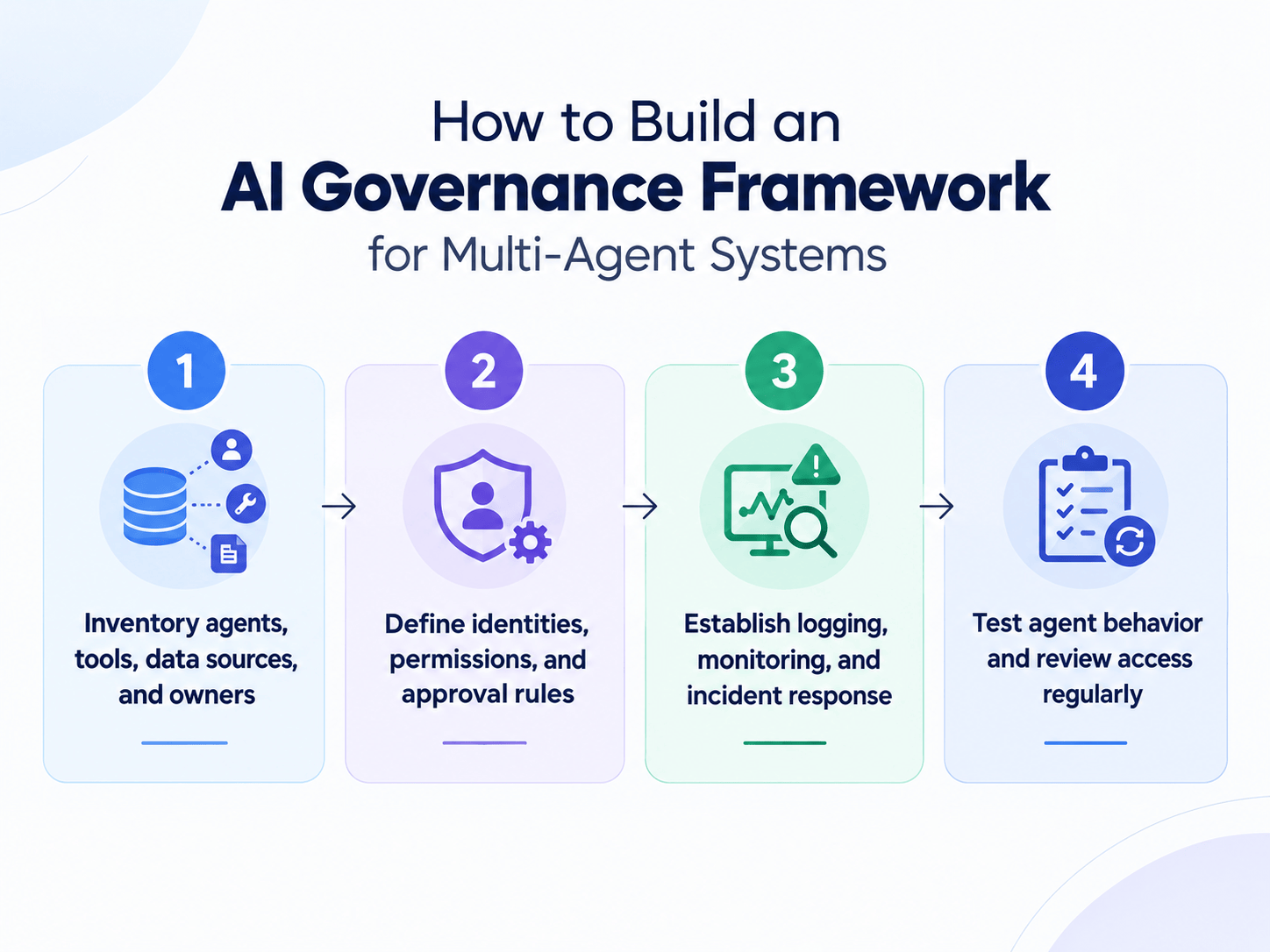
Here’s a four-step AI agent governance framework you can start this quarter.
Step 1: Inventory agents, tools, data sources, and owners: List every agent, its model, the tools and data it touches, and its human owner. An experienced AI agents development company can speed up this discovery.
Step 2: Define identities, permissions, and approval rules: Issue unique identities, assign RBAC roles, add ABAC conditions, and set a tier for each action. Write approval thresholds in dollars and data types, not vague phrases.
Step 3: Establish logging, monitoring, and incident response: Turn on correlation IDs and central logging, add anomaly alerts, and write a runbook with the kill switch and a named on-call owner.
Step 4: Test agent behavior and review access regularly: Red-team for prompt injection, permission leakage, and agent-to-agent spoofing. Review access every quarter and drop tools nobody uses. The NIST AI Risk Management Framework and ISO/IEC 42001 can give this work structure.
What Should Enterprises Check Before Deploying Multi-Agent AI?
Before you deploy the multi-agent AI systems, check security controls, data isolation, tool permissions, and governance frameworks to avoid failures.
Multi-agent governance checklist for enterprise teams
Every agent has its own identity; no shared keys
Tool allowlists and token expiry are enforced
Approval gates cover payments, deletions, and external messages
Correlation IDs travel across agents; logs resist tampering
Injection filters and sandboxes are tested
Kill switch tested; every agent has a named owner
Questions to ask an AI development partner
Strong agentic AI services providers answer these with architecture, not slogans:
How do you enforce least privilege between collaborating agents?
How do you record decision provenance and agent-to-agent messages?
What stops an agent stuck in a loop?
Can your enterprise AI search and knowledge assistant respect role-based document access?
How to measure governance effectiveness after deployment
Track a short scorecard: blocked unauthorized attempts, approval turnaround, override rate, log completeness, and time to contain incidents. Review it monthly with business owners.
Putting AI Governance for Multi-Agent Systems Into Practice
AI Governance for Multi-Agent Systems works best when it’s built in before launch, not bolted on after the first incident. Give each agent an identity, limit its permissions, log every step, and name an owner.
If you’re planning AI agent development or want AI agents Solutions that stand up to audit, the MoogleLabs team can review your setup and design the controls.
Explore our agentic AI services, AI/ML development, and blockchain engineering, then talk to us about a governance review.
Loading FAQs
Please wait while we fetch the questions...