AI Agent Orchestration Platforms for Modern Enterprises
Understand how AI agent orchestration platforms help enterprises build scalable, governed, and intelligent AI ecosystems by coordinating agents, tools, and business workflows.
Enterprises are past the stage of asking whether AI can help. The real question now is how to make AI behave like a dependable part of the operating model. That is where AI agent orchestration platforms matter. They do not just generate answers - they coordinate tools, data, workflows, approvals, and specialist agents, so work can move from prompt to action with control.
In this blog, we examine the role of AI agent orchestration platforms in modern enterprises, the leading platforms in the market, and the trends shaping their adoption.
What are AI Agent Orchestration Platforms?
An AI agent orchestration platform is the foundational coordination layer that enables multiple specialized digital agents to work together as a unified system. Rather than relying on traditional automation systems like Robotic Process Automation (RPA) which follow rigid, hardcoded scripts and halt immediately when a process deviates - orchestrated systems operate on high-level goals. The orchestration layer uses the reasoning power of generative AI services to understand a target objective, break it down into logical subtasks, delegate those tasks to specialized agents, and synthesize the final outputs.
Translating this dynamic operational model into a secure enterprise solution depends on a highly coordinated, three-part technical environment.
The Intelligence Layer
This consists of the underlying foundation models and Large Language Models (LLMs) that provide the reasoning, natural language understanding, and decision-making capabilities.
The Orchestration Layer
This is the executive control system. It manages the flow of execution, maintains memory across long customer journeys, routes data between agents, and manages human-in-the-loop validation gates.
The Integration Layer
This is the connectivity tissue, consisting of APIs, database connectors, and emerging standards like the Model Context Protocol (MCP). This layer allows the orchestration system to read and write data directly across enterprise systems such as CRMs, ERPs, and document repositories.
AI agent development builds the worker. Orchestration builds the operating model around the worker. That distinction is important because enterprise problems rarely sit inside one clean workflow. They cross departments, systems, permissions, and compliance boundaries.
The Core Distinction - AI Agents vs. Orchestration Platforms
The two are related but not the same.
An AI agent:
Handles a focused task
Uses models and tools
May remember context
Usually acts within a narrower scope
An orchestration platform:
Routes work across multiple agents
Sequences tasks across systems
Applies guardrails, approvals, and policies
Manages observability, evaluation, and fallback logic
Google Cloud’s architecture guidance says a single agent can become less effective as tasks and tools grow in complexity, while a multi-agent system improves resilience and maintainability by splitting work across specialists.
Microsoft’s Copilot says agents can hand off interactions to each other and use generative orchestration to select tools, topics, other agents, and knowledge sources. That is the practical difference between a bot and a business system.
An orchestration platform, however, is the entire operating environment that coordinates these individual agents. It determines how agents pass information to one another, when to invoke specific skills, and how to maintain data security throughout the process.
The table below highlights how orchestration platforms compare to individual agents and legacy automation tools:
Capabilities and Features | Single AI Agents | Robotic Process Automation (RPA) | AI Agent Orchestration Platforms |
|---|---|---|---|
Operational Logic | Guided by specific prompt instructions within a narrow domain. | Driven by rigid, pre-programmed, step-by-step rules. | Driven by high-level business goals and autonomous reasoning. |
System Flexibility | Struggles when a task requires multi-system handoffs or diverse skills. | Halts or breaks immediately if a user interface or data format changes. | Dynamically adjusts workflows and coordinates multiple agents to resolve deviations. |
Integration Depth | Typically limited to a single application or API. | Interacts primarily with user interfaces or fixed database scripts. | Uses an extensible mesh of APIs, vector databases, and protocol servers. |
Error Handling | Prone to hallucinations or silent failures when overloaded. | Generates system errors requiring immediate manual intervention. | Employs self-correction feedback loops and automated human-escalation pathways |
Top Platforms and Frameworks in the Enterprise Space
Enterprise adoption is now concentrating around platforms that can do three things well:
Build agents faster
Connect them to real systems
Keep them governable in production.
The strongest options are no longer just model wrappers. They are full orchestration layers with tracing, approvals, security, and multi-agent support. That is the direction the market is moving across major vendors.
Microsoft Copilot Studio is a strong fit for organizations already invested in Microsoft 365 and Power Platform. Its newer agent orchestration features support connected agents, handoffs, and generative orchestration, which makes it practical for internal service desks, workflow automation, and business-user-led deployments.
Google’s Gemini Enterprise Agent Platform has become one of the clearest enterprise-grade offerings for building, governing, and optimizing agents at scale. Google positions it as a full-stack platform for enterprise-ready agents, with strong emphasis on grounding in enterprise data and broad developer choice.
AWS Bedrock AgentCore is aimed at teams that want framework flexibility with enterprise controls. AWS says it is designed to help build, deploy, and operate agents securely at scale, while handling tool calls, monitoring, and infrastructure-heavy tasks behind the scenes. That makes it useful for larger engineering teams that want control without rebuilding the platform layer themselves.
On the framework side, LangGraph is gaining traction where durable execution, streaming, and human-in-the-loop controls matter. It is built for orchestration-heavy systems rather than simple chat flows.
Simultaneously, MCP expands rapidly as an open, universal protocol designed to link autonomous agents directly with custom tools, external data environments, and complex enterprise workflows without building fragmented integrations for every single platform.
OpenAI’s Responses API and AgentKit are shaping the developer experience around simpler agent building, built-in tools, and workflow assembly.
IBM watsonx Orchestrate remains relevant for coordinated business execution across systems, especially where workflow ownership and enterprise process design matter.
Choosing the wrong framework can lead to significant operational challenges, commonly referred to as "agent sprawl".
This issue is well-illustrated by Walmart's experience. As the company expanded the number of AI agents across customer, employee, engineering, and supplier workflows, it found that multiple standalone agents created unnecessary complexity for users.
In July 2025, Walmart responded by consolidating its AI capabilities into four domain-specific "super agents" that unify the experience while coordinating multiple underlying agents. The move reflects a broader enterprise trend, as AI deployments scale, orchestration becomes essential for simplifying user interactions, improving governance, and managing AI systems more effectively.
Why Do Enterprises Need AI Agent Orchestration Platform Now?
To avoid becoming part of the estimated 40% of agentic AI projects that Gartner predicts will be cancelled by 2027 due to escalating costs or inadequate risk controls, organizations must plan their deployments with structural discipline. The pressure is coming from three sides.
First, work has become more cross-functional. A customer request may need CRM lookup, policy validation, pricing logic, and a final approval step. One agent cannot own all of that reliably.
Second, enterprises want measurable value, not demos. Gartner’s warning about cancellations is not a reason to slow down - it is a reminder that vague business cases fail quickly. Orchestration helps connect AI to actual outcomes such as reduced handling time, faster resolution, and fewer manual handoffs.
Third, control matters more than novelty. Amazon Bedrock’s agent documentation explicitly says agents orchestrate interactions between foundation models, data sources, software applications, and user conversations, while AWS manages prompt engineering, memory, monitoring, encryption, permissions, and API invocation.
In other words, enterprise value is not just intelligence. It is controlled execution at scale. Organizations looking to build these robust systems often collaborate with specialized partners to design, deploy, and scale custom agentic AI services that align with complex legacy architectures.
Core Capabilities that Matter in Enterprise Orchestration
A serious orchestration layer should do more than connect APIs. It should provide:
Routing and planning across multiple agents and tools
Memory and context handling across steps
Human-in-the-loop approvals for sensitive actions
Logging, tracing, and evaluation
Role-based access and security controls
Fallback paths when an agent fails or confidence drops
Support for structured workflows as well as dynamic decisions
Together, these capabilities enable organizations to move beyond isolated AI deployments and build scalable, governed, and production-ready AI ecosystems that deliver measurable business value while maintaining operational control.
Strategic Considerations Before Adoption
The transition to scaled agentic AI software operations requires addressing three key strategic areas:
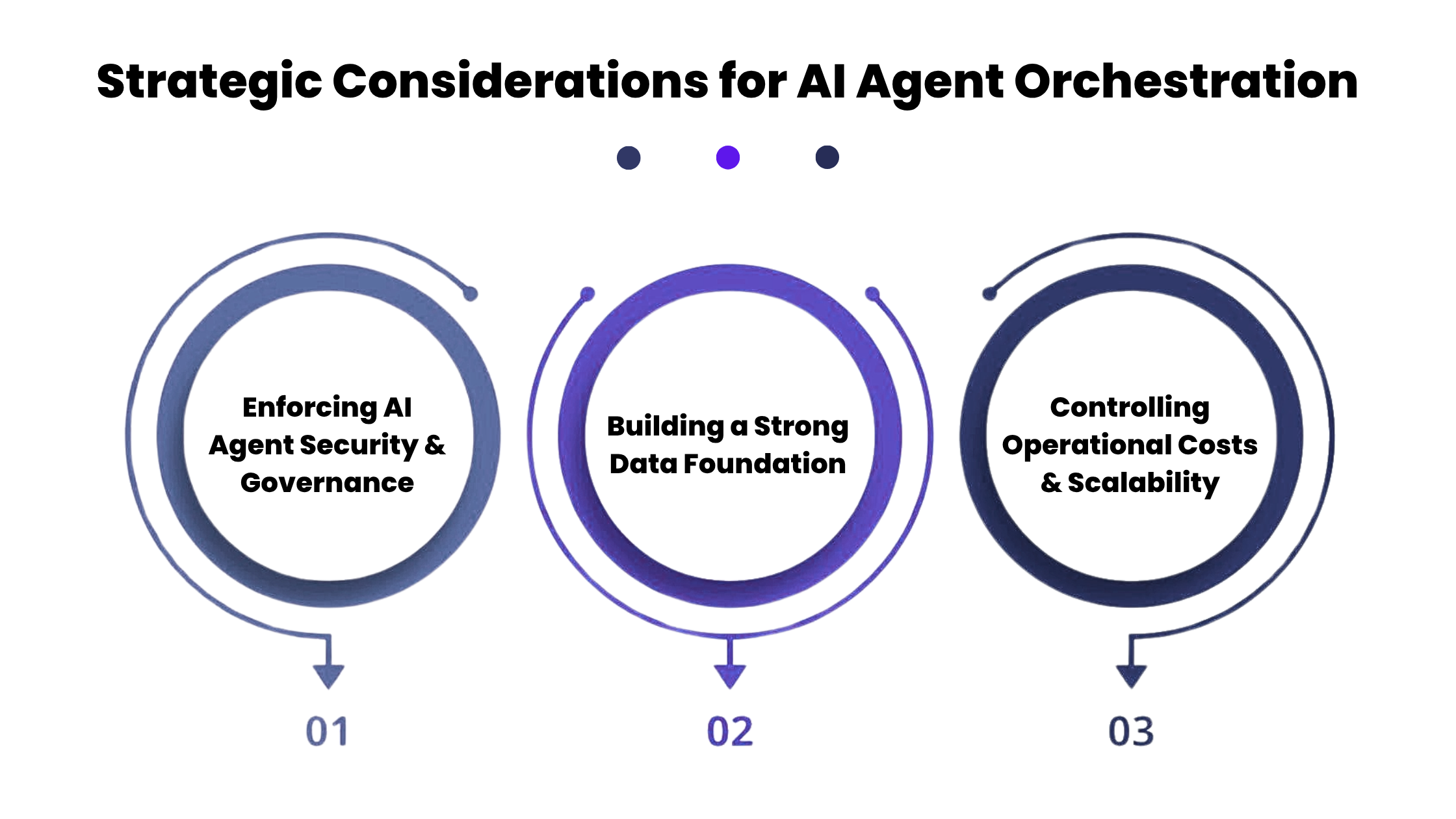
1. Enforcing AI Agent Security and Governance
Giving autonomous agents access to corporate databases introduces serious AI agent security risks. Enterprises must establish robust role-based access control (RBAC) and treat digital agents as secure service accounts rather than general users.
At the same time, platforms must log every transaction, database query, and model decision in immutable audit trails. This high level of observability is essential for meeting compliance standards like GDPR, SOC 2, and HIPAA.
2. Building a Strong Data Foundation
An agent is only as reliable as the data it retrieves. If the retrieval-augmented generation (RAG) pipeline is weak, the agents will execute actions based on incorrect or outdated information.
To address this, MoogleLabs designed Enterprise AI Search & Knowledge Assistant. Utilizing a secure, high-performance architecture powered by FastAPI and Vespa, this system enables contextual search and secure knowledge retrieval across fragmented corporate directories. By organizing and cleaning the underlying data layer first, businesses create a reliable source of truth that autonomous agents can safely reference.
3. Controlling Operational Costs and Scalability
A common issue in agentic deployments is "token burn," where infinite loops or repeated API calls quickly blow past budgets. Enterprises need orchestration platforms that offer granular cost monitoring, automatic run budgets, and token caching.
For smaller organizations, finding cost-effective entry points is crucial. Working with custom agentic AI solutions for SMBs allows small scale businesses to build highly targeted, lightweight workflows that scale naturally without requiring massive upfront infrastructure investments.
Conclusion
The shift toward agentic AI workflows is redefining how enterprise software operates. However, the key to success is not just deploying more advanced models but building a disciplined, secure, and stateful AI agent orchestration layer to manage them. By implementing robust orchestration frameworks, organizations can convert isolated AI pilots into highly secure, collaborative, and revenue-driving digital workers.
For companies looking to build a secure foundation for this transition, partnering with experienced technology leaders like MoogleLabs provides the deep expertise in custom artificial intelligence services and RAG architectures needed to achieve scale safely.
Loading FAQs
Please wait while we fetch the questions...